Holistic view of our universe — Expanding Solar System Resonance Theory
The orbits of the eight planets, the wobble of Earth’s axis, and the rhythm of ice ages are all governed by the same physics. This holistic view puts them in one place: standard Newtonian dynamics carrying every planet from a single cited J2000 state, and Earth’s long periods read as beats against its lunisolar precession clock — one integrated account of solar system dynamics and Earth’s climate record, in a form you can run. The preprint, “The Expanding Solar System Resonance Theory: A Geocentric Model of Earth’s Precession Cycles, Eclipses and Deep-Time Climate”, is on Research Square — read the preprint → . Its thesis in one sentence: one seed, one derived clock and one codebase produce Earth’s precession, timekeeping, eclipses and the orbital climate lines together, and the chain’s deep-time evolution is gated by the rock record.
How the model works, in 60 seconds. Two things carry the model:
- The N-body engine — standard Newtonian gravity with the first-order relativistic correction, integrated from one cited J2000 state with zero fitted constants. It supplies every planet’s orbit, the secular modes, the 405.6-kyr eccentricity metronome, and Earth’s own orbit: its eccentricity, inclination, node and perihelion of date.
- The clock — Earth’s mean lunisolar precession period, 25,771.6 years at J2000, its rate the IAU 2006 general precession, composed from the Sun’s and the Moon’s torques and lengthening through geological time as tides slow the spin.
Earth’s other long periods follow as beats of the clock against its orbit’s own motions, and the time-domain quantities — the cardinal points, the year and day lengths, the eclipses — ride the same clock and the same N-body series. There is no third layer of fitted corrections on the movements.
Nothing is tuned per phenomenon. The cardinal points, the day lengths and the eclipses are read off one seed and one clock, so they cannot be made to match the record one at a time. That is what makes the model falsifiable. (The clock was ~21,235 yr at 380 Ma; see Expanding Resonance for the deep-time evolution.)
See How It Works for the derivation methodology and Supporting Evidence for what aligns with and where the model differs from current science.
How far it holds — the same machinery, checked against independent records across six orders of magnitude in time:
| Surface | Reference | Agreement |
|---|---|---|
| Position of the Sun | JPL Horizons, N = 219,152 samples | 1.03″ RMS — the Meeus Ch. 25 reference itself reads 1.02″ |
| Positions of the seven planets and the Moon | JPL Horizons, joint RA+Dec RMS | 10.3″ (Jupiter) to 35.9″ (Mars) over 2000–2099 — every target inside 0.012° across 1800–2100, and inside 0.03° across the full 1600–2399 span |
| Cardinal points (equinoxes & solstices) | JPL Horizons, −3000 to +2000 | −1.02 min mean, 1.01 min SD; worst millennium 1.8 min |
| Solar eclipses | 26-event documented audit, −762 to 2026 CE | 21/26 with the umbra reaching the observation site |
| Lunar eclipse timings | Stephenson 2016, 267-event set | 20.2 min mean |residual| |
| Earth’s obliquity | La2004 (theory) | 1.3″ rms over the last 100 kyr; 14.8″ rms over the last 1 Myr |
| Climate record | CenCO2PIP, 0–66 Ma | R² = 0.692 |
| Deep-time precession | Dated Precambrian sections | Gated at 1.4 and 2.46 Ga |
The numbers were derived from measurement, not theorized — and the same engine produces all of them.
One Seed, One Clock
The model has two engines and one clock. The planets’ orbits — and Earth’s own eccentricity, inclination and perihelion of date — come from a Newtonian N-body integration of one cited J2000 state. Earth’s spin-side periods are read against its mean lunisolar precession period, whose J2000 rate is the IAU 2006 general precession. Two of Earth’s precession motions rotate in opposite directions:
| Motion | Direction | Cycle |
|---|---|---|
| Axial Precession (the clock) | Clockwise | ~25,772 years |
| Apsidal Precession (the orbit’s own motion, a J2000 reading) | Counter-clockwise | ~111,581 years |
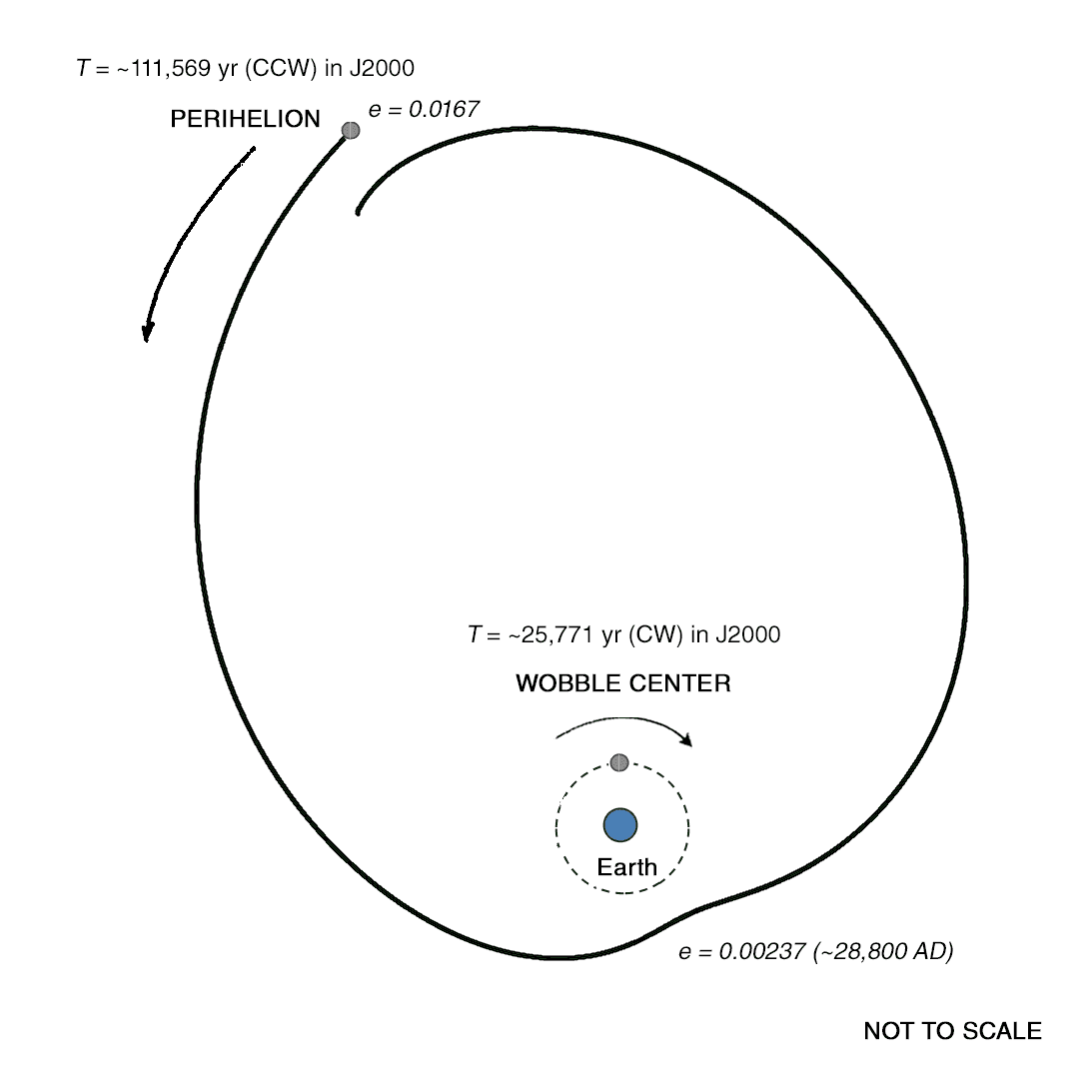
Earth’s two counter-rotating precessions. The perihelion direction advances counter-clockwise around the Sun at T ≈ ~111,581 years (apsidal precession); Earth’s Wobble Center circles Earth clockwise at T ≈ ~25,772 years (axial precession, the clock). Their ratio reads 4.330 today — a reading that wanders, not a constant.
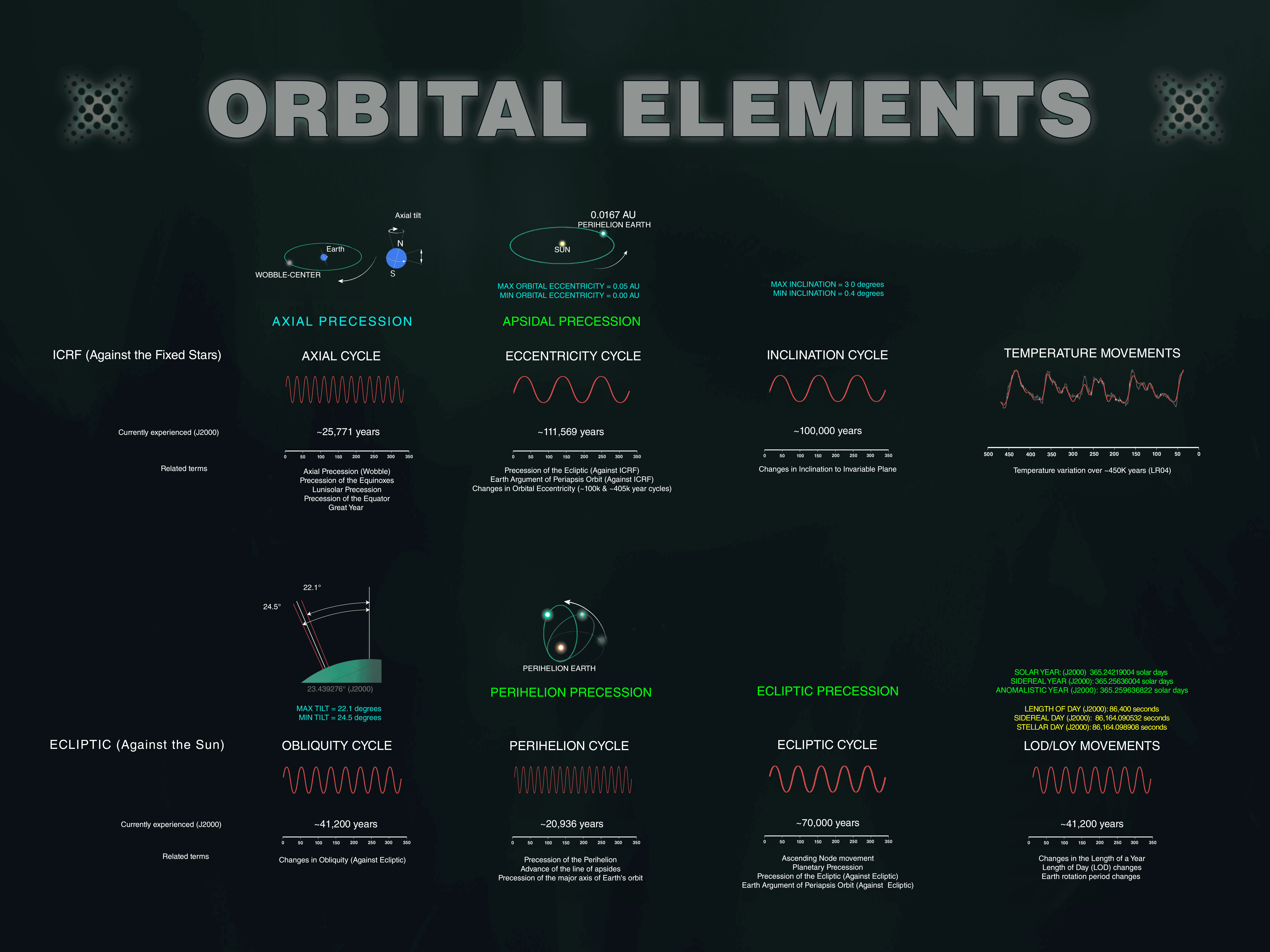
Because the two motions run in opposite directions their rates add, and their beat is the ~20,936-year perihelion-of-date cycle; the obliquity cycle is the spin axis’s beat against the orbit plane’s nodal turn. Every other quantity the model publishes — the precession of the equinoxes, the obliquity history, the eccentricity cycles, the lengths of days and years, the eclipse geometry, the climate formula’s line positions — is read from the same two engines against the same clock, and the planets’ periods are the engine’s own eigenfrequencies. The simulator draws the two motions as two reference points, Earth’s wobble centre and its perihelion marker; they are the picture, not the physics. A 3D simulation visualises it all in one interactive view.
Why This Matters
Modern celestial mechanics — JPL Horizons, Laskar’s secular theory, high-precision ephemerides — achieves sub-arcsecond accuracy on Myr timescales and remains the right instrument for high-precision position prediction. This framework claims no better accuracy and no new physics. What it adds is integration:
- Each phenomenon normally has its own model. Precession, obliquity, eccentricity, day and year lengths, eclipse timings and the climate spectrum are all driven by the same gravity, but are conventionally modelled independently, with separate parameterizations that never have to agree with one another.
- Here they share one causal chain. One cited J2000 state and one derived clock feed every published quantity. Nothing is tuned per phenomenon, so a change anywhere has to stay consistent everywhere — which is what makes the whole thing falsifiable at once rather than one claim at a time.
- The chain can be perturbed end to end. Multiply Jupiter’s GM by 1.01 and re-integrate: every planet’s apsidal rate moves, Mercury’s by +1.5″/cy — exactly one percent of Jupiter’s first-order Laplace–Lagrange share of Mercury’s precession — and Saturn’s window rate deepens its retrograde phase. The answer is not looked up; it falls out of the same run.
- No comparable unified 3D view exists. Existing tools handle orbital mechanics or Milankovitch cycles in isolation. None bring axial precession, obliquity oscillation, perihelion precession, eccentricity cycles, day and year length variation, eclipses and all eight planets’ orbits into a single interactive scene.
Observation First — A Bottom-Up Approach
Standard paleoclimate theory takes the climate record as its starting point. The 100-kyr, 41-kyr, and 23-kyr cycles observed in ice cores and ocean sediments are interpreted by selecting which combinations of planetary motions best fit each peak — eigenmode beats from classical Laplace–Lagrange theory. The math is rigorous, but the climate-to-planet attribution is fitted to the data. Several major puzzles remain unexplained: the 100,000-year problem (eccentricity forcing is too weak to drive ice ages directly), the absence of the theoretically dominant 400-kyr cycle in post-MPT climate records, and the Mid-Pleistocene Transition ~1 million years ago.
This holistic view reverses the direction. It starts from directly observed orbital motion — Earth’s measured precession periods, every planet’s measured orbital cycles — anchored against JPL Horizons / WebGeoCalc ephemeris data (1800–2100 AD, every target inside 0.012°) and historical astronomical records. From these observations the model’s own N-body engine yields the planets’ secular modes, and Earth’s spin clock is composed from the solar and lunar torques on the observed general precession. Only then are the beats of those quantities — the climate formula’s 28 orbital lines — overlaid onto the climate record. The line periods are fixed by the model’s dynamics, not fitted to climate — only the per-line amplitudes are fitted to LR04 / CENOGRID / EPICA / CenCO2PIP.
The framework makes a structural commitment the standard approach does not: the orbital layer carries only the engine’s own beat lines, a sharply falsifiable claim. A climate peak with no counterpart among those beats would refute the orbital layer.
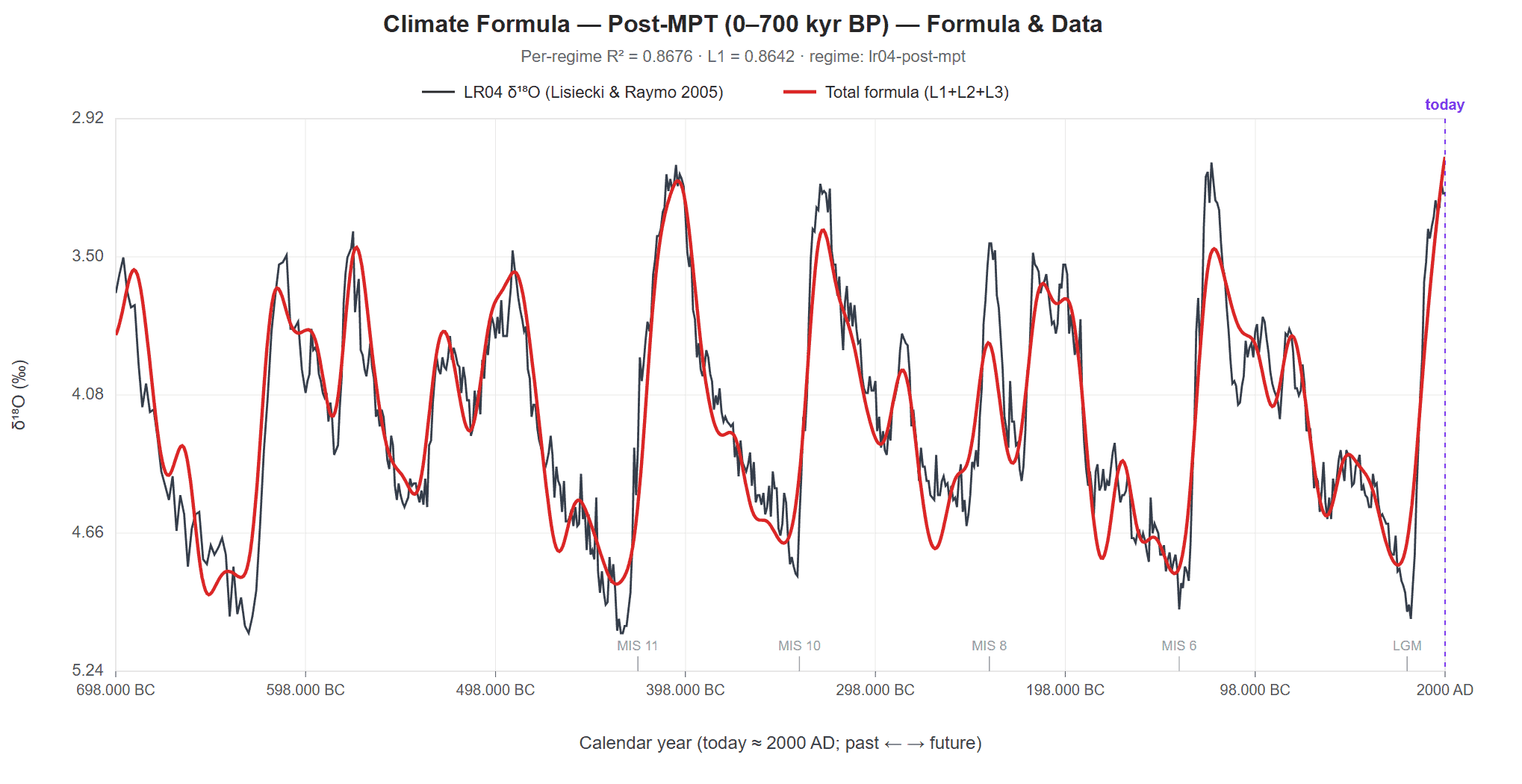
The canonical Climate Formula on LR04 δ¹⁸O over the past 700,000 years. R² = 0.780 post-MPT is an in-window description — the 28 engine-derived orbital lines with their amplitudes fitted inside the window; the model’s own orbital histories predict 0.362 of the record out of sample (T7, pre-registered).
From Software to Theory
This framework began as a software project — a 3D simulation that reproduces the positions of the Sun, Moon, and all seven planets, verified against JPL Horizons ephemeris data and historical astronomical observations. The same run simultaneously produces obliquity, perihelion precession, and the planets’ inclinations and eccentricities — quantities normally computed by separate models. Its inputs are kept in three ledgers rather than a single parameter count (Mathematical Foundations): the planetary side has no free parameters at all, and the fitted constants live only on the Earth-rotation side (the ΔT stack, the recession history’s regime knots) and in the climate formula’s amplitudes.
From this, a theoretical framework emerged:
- Observable patterns in obliquity, eccentricity, orbital longitudes, and planetary motions could be captured in closed-form formulas
- Precise measurements of day lengths and year lengths in the 3D model also reduced to formulas
- A clock emerged: Earth’s axial precession period, composed from the solar and lunar torques, against which every other Earth period is a beat — and which lengthens through geological time on the measured tidal history
- The planets ride dynamics: an N-body engine seeded by one cited J2000 state supplies their orbits, their secular modes and their long-period descriptors, with no fitted constant on that path
The simulation also serves as a test bed: existing results such as Souami & Souchay’s (2012) invariable plane definitions can be verified, and three falsifiable deep-time predictions — each naming the observation that would falsify it — can be checked against future observations.
What is at risk
The model stands on three pre-registered legs, each naming what would end it:
- The clock against the rock record. Earth’s precession rate is composed from the spin history and the receding Moon’s torque. It meets the cyclostratigraphic inference of Wu et al. 2024 at 650 Ma to 0.2 %, and the Precambrian precession constants at 1.4 and 2.46 Ga are carried as gates, where pure spin scaling already fails. The formula’s precession-band and obliquity lines ride that lengthening clock; its eccentricity-band lines are planetary beats and do not — every newly dated Precambrian section tests the split (Expanding Resonance).
- Historical-era exactness. One ΔT formula — pure-tidal Moon recession plus a GIA channel anchored on satellite gravimetry, with zero parameters fitted to eclipse data — does three things at once. It places the umbra within the ±4-hour scan window for 21/26 documented solar eclipses (−762 to 2026 CE), gives a 20.2-min mean |residual| on the 267-event Stephenson 2016 lunar set, and rejects the full Munk–MacDonald non-tidal speedup (Timekeeping).
- The two expansions’ consistency. Under the measured solar-mass history the 405-kyr cycle in dated Precambrian strata weighs the ancient Sun: μ(2.48 Ga) = 1.00 ± 0.07 (Expanding Resonance).
The Moon’s distance history is a cited input (Farhat et al. 2022), not a fit, so the geological record tests the chain instead of calibrating it: the Wells 1963 Devonian day count is met within 1 % with nothing fitted to it, and the deviations — the Mesoproterozoic precession constants above all — are reported as such. The Sun and the Moon behind the eclipse tests are themselves assembled from the framework’s structure — The Derived Sun with zero fitted solar constants, The Derived Moon with every Meeus constant derived, attributed or anchored by design.
On the climate record the model commits to a finite line list — 28 beats whose periods are its own modes and clock, only the amplitudes fitted per regime. Every significant LR04 peak has a counterpart among them; the in-window fits (R² = 0.780 on post-MPT LR04, 0.724 on EPICA CO₂, 0.692 on CenCO2PIP 0–66 Ma) are descriptions, and the model’s own orbital histories predict 0.362 of post-MPT LR04 out of sample (T7, pre-registered). Classical insolation features alone explain R² = 0.2362 of the same record, 3× less than the lines, and add no cross-window-stable gain on top of them; the 100-kyr band reads as the planets’ eccentricity beats, not direct Earth-eccentricity forcing (Climate Formula).
An open framework, not a closed theory
The model is offered as a framework for testing scientific theories, not a final word. Every observable in the published literature is reproduced; the two departures from current consensus (the origin of the 100,000-yr glacial cycle, and the Munk-MacDonald non-tidal speedup in pre-1900 length of day) and the one pre-registered deep-time prediction (the two-tier scaling of the climate lines) are catalogued with their discriminating tests.
All data, formulas, and the 3D simulation are publicly available. We invite independent replication and contradicting evidence — the framework is most useful when others apply it to their own data and report what they find.
Read more on Supporting Evidence → An open framework — invitation to test
Explore the Model
The Model
One seed and one derived clock: the N-body engine behind the orbits, the precession clock behind Earth’s spin-side periods, and how the two meet
3D Simulation
See the model in action with the interactive 3D solar system simulation
Mathematical Foundations
The model’s inputs and the clock built from them, the two-engine three-ledger parameter accounting, and the falsifiability criteria
Why Earth Is Special
Earth’s unique reference frame duality, the interface where the two engines meet, and why one planet anchors the entire framework
The Derived Sun
The apparent solar longitude assembled from the framework’s own year-length physics — zero fitted solar constants, 1.03″ against JPL, and the Sun inside every eclipse result on this site
The Derived Moon
The classical lunar theory rebuilt with every constant carrying its origin: the perturbation amplitudes from gravity at 100.0 ± 0.1%, the axial tilt from the Cassini state, and exactly one number left to nature
Climate Formula
A finite list of 28 orbital beats on the climate record: every significant peak has a counterpart, the in-window fit (R² = 0.780 post-MPT) is a description, and T7 states what is predicted
Moon & Planets
The planetary layer on the model’s own N-body engine — derived from one cited J2000 state, zero fitted constants
Supporting Evidence
Where the model meets standard astronomy — open problems, peer-reviewed alignments (Berger, Muller-MacDonald, Laskar), and observational tests
Predictions
Falsifiable deep-time predictions — the obliquity band on the precession–s₃ beat and the deglacial spin-up leading the interglacial optimum — each naming the observation that would end it
Scientific Background
Comparison with standard theory and detailed methodology
Orbital Calculator
Compute Earth orbital parameters, day/year lengths, and planetary precession rates for any year
Quick Facts
- The engine: Newtonian N-body from one cited J2000 state, zero fitted constants — it carries every planet’s orbit and Earth’s own eccentricity, inclination, node and perihelion of date (Moon & Planets)
- The clock — axial precession: 25,771.6 years at J2000 (rate: the IAU 2006 general precession, 50.288″/yr; lengthens through geological time)
- Apsidal precession: ~111,581 years (4.330 clock periods — a reading that wanders, between 1.08 and 9.81)
- Perihelion precession (of date): ~20,936 years (0.8124 clock periods)
- Obliquity cycle: ~41,099 years at J2000 (the beat of the spin axis’s precession against the orbit plane’s nodal turn; a dated record sees the window mean, ~40,927 years over the LR04 record)
- Obliquity range: ~22.08° – ~24.45°
Written, edited and composed by D. van Sonsbeek.
All original content Copyright © 2022-2026 D. van Sonsbeek. All rights reserved unless explicitly stated otherwise. The model source code is licensed under AGPL-3.0 ; commercial enquiries are welcome — see Licensing for what separate terms can cover.