The Six Fibonacci Relations
Earth is the one body in the solar system where the two halves of gravity’s work meet at full strength — the conservative half (the planets’ orbital dynamics) and the dissipative half (spin and tides, with a massive moon). The six Fibonacci relations are the J2000 signature of that interface: patterns built on Fibonacci numbers (1, 1, 2, 3, 5, 8, 13, 21, 34, …) connecting inclinations, eccentricities, and precession periods through a single timescale — the Earth Fundamental Cycle, H = 335,317 years — and describing orbital properties for all eight planets with zero free parameters (see Expanding Resonance for the one-system picture).
The relations operate within a broader Solar System Resonance Cycle of 8H = 2,682,536 years, on which each planet’s precession quantities carry an integer-divisor label as an era-typed descriptor — exact for the quantity and era it names, silent beyond (see Fundamental Cycles). The value of H is fitted to eight independent observational constraints simultaneously (precession cycles, climate patterns, integer day counts); see Mathematical Foundation for the derivation.
J2000 anchor. H and 8H above are the modern J2000-anchor values. The Fibonacci integer labels (3, 5, 8, 13, 21, …) and the H/N, 8H/N integer-divisor structure are invariant at any epoch, but the literal year counts rescale at geological time — at 380 Ma H was ~306,189 yr — see Expanding Resonance for the deep-time evolution layer. This page is the conceptual overview. For full mathematical derivations, worked examples, and the significance analysis, see Fibonacci Laws Derivation.
The Scientific Foundation
The Fibonacci Laws rest on three independently established pillars.
1. Two real counter-rotating precessions. Earth undergoes two well-documented precession motions in opposite directions: axial precession at ~25,794 years = H/13 (gyroscopic torque on Earth’s equatorial bulge) and apsidal precession at ~111,772 years = H/3 (planetary perturbations). The ratio of their periods is 13:3 — two Fibonacci numbers.
2. Fibonacci patterns are documented across orbital systems. Roughly 60% of solar-system orbital period ratios cluster near Fibonacci fractions (Aschwanden 2018, Pletser 2019), rising to 73% across 932 exoplanet pairs (Aschwanden & Scholkmann 2017). The Kirkwood gaps in the asteroid belt are dramatic visual confirmation — asteroids at simple resonances with Jupiter are swept away while Fibonacci-related orbits survive.
3. KAM theory explains why. The Kolmogorov–Arnold–Moser theorem (1954–1963) proves that in perturbed dynamical systems, orbits whose frequencies have the most irrational ratios are maximally stable. The golden ratio φ ≈ 1.618 — to which Fibonacci ratios converge — is the most irrational number, hardest to approximate by simple fractions. Greene (1979) confirmed computationally that the “golden” invariant torus is the last to break under perturbation; Morbidelli & Giorgilli (1995) showed super-exponential stability near golden-ratio ratios in the asteroid belt.
Over 4.5 Gyr, the solar system has been selecting for these maximally stable configurations. The Fibonacci relations below extend the observation into a quantitative framework describing orbital properties for all eight planets.
What is permanent, and what is a J2000 reading. The relations’ architecture is permanent: the addition identities (16 = 13 + 3, 8 = 5 + 3) are frame arithmetic, true at every epoch by construction. What is epoch-local is that the addends land on Fibonacci values — the “3” (Earth’s inclination/perihelion motion) is a wandering secular quantity that sits on the H/3 line today. Whether anything makes the 13:3 anchor more than the J2000 reading was pursued to exhaustion with the model’s own N-body engine — no lock, no capture, no preferred base period, not even the statistical mode of the rate — and closed negative; the full doorway list is doc 109 §13 in the 3d repository . The relations’ Fibonacci values are the measured J2000 configuration of Earth’s interface — claimed as observation, not as mechanism.
The Six Laws
The six laws form a symmetric architecture anchored on Earth and extending to all eight planets:
- Law 1 — Earth’s major precession periods are H divided by Fibonacci numbers (an Earth-unique hierarchy).
- Laws 2 and 4 — A universal constant predicts every planet’s inclination amplitude (ψ) and eccentricity amplitude (K) from Fibonacci divisors and mass.
- Laws 3 and 5 — Angular-momentum-weighted oscillations of seven planets balance against Saturn’s alone.
- Law 6 — Jupiter’s ICRF perihelion and Saturn’s ecliptic perihelion lock at 8H/65 — the climate-recorded obliquity beat.
Law 1: The Fibonacci Cycle Hierarchy
Earth’s major precession periods divide H by Fibonacci numbers — H/3, H/5, H/8, H/13. The Fibonacci addition rule connects them: 3 + 5 = 8, 5 + 8 = 13.
| Fibonacci | H/F | Period (years) | Earth’s astronomical cycle |
|---|---|---|---|
| 3 | H/3 | ~111,772 | Apsidal precession (ICRF) |
| 5 | H/5 | ~67,063 | Ecliptic precession |
| 8 | H/8 | ~41,915 | Obliquity cycle |
| 13 | H/13 | ~25,794 | Axial precession |
| 21 | H/21 | 15,967 | Beat frequency (8 + 13) |
| 34 | H/34 | 9,862 | Beat frequency (13 + 21) |
The periods are not independent. Their frequencies add — 1/(H/3) + 1/(H/5) = 1/(H/8) — a direct consequence of the Fibonacci recurrence applied to a timescale hierarchy. Consecutive ratios approach the golden ratio.
Earth’s hierarchy is unique. Only Earth has all major precession periods at H/Fibonacci. Other planets’ periods divide the Solar System Resonance Cycle (8H) by various integers, mostly non-Fibonacci. Jupiter’s and Saturn’s perihelion values fall near Earth’s Fibonacci anchors (H/5, H/8, H/21); their 8H-lattice values sit one lattice integer off (8H/39, 8H/65, 8H/169) — and the quantities these match are Earth-frame beats (|s₃|, k + s₃), not the giants’ own secular frequencies. This is the subject of Law 6 below.
Law 2: The Inclination Constant ψ
Each planet’s mass-weighted inclination amplitude, multiplied by a Fibonacci divisor, equals the same universal constant ψ:
d × amp × √m = ψ = 3.3070 × 10⁻³
The constant ψ is empirical — derived from Earth’s fitted inclination amplitude — and predicts every other planet from its Fibonacci divisor d and mass m alone. The eight divisors are pure Fibonacci numbers in a mirror-symmetric pattern (see §Mirror Symmetry):
| Planet | d | Predicted amplitude |
|---|---|---|
| Mercury | 21 | 0.386501° |
| Venus | 34 | 0.062168° |
| Earth | 3 | 0.63607° |
| Mars | 5 | 1.164287° |
| Jupiter | 5 | 0.021405° |
| Saturn | 3 | 0.065196° |
| Uranus | 21 | 0.023832° |
| Neptune | 34 | 0.013552° |
All eight predictions fall within Laplace–Lagrange secular-theory bounds — the standard celestial-mechanics framework for long-term orbital evolution.
Why √m? The √m weighting is not a free choice. It is the unique mass exponent that makes Law 2 equivalent to a mass-independent partition of the Angular Momentum Deficit (AMD), the standard conserved quantity in celestial mechanics. Substituting Law 2 into AMD = m·√a·amp²/2 cancels the mass exactly: each planet’s share is proportional to √a/d² alone. Saturn carries 56.1% of the partition (lowest d combined with a large orbit), Earth 18.2% (d = 3 beats Jupiter’s d = 5 despite Earth being 1000× lighter). The Earth–Saturn pair carries 74% of the eight-planet total; the E–J–S resonance triad (Law 6) carries 89%. See the derivation for the full AMD treatment.
Law 3: The Inclination Balance
The angular-momentum-weighted inclination oscillations of seven planets balance against Saturn’s alone.
Each planet’s tilt oscillates around its cycle anchor (the ICRF perihelion longitude at the balanced year). For the invariable plane — perpendicular to the solar system’s total angular momentum — to stay fixed, the oscillations must cancel between two groups:
- In-phase: Mercury, Venus, Earth, Mars, Jupiter, Uranus, Neptune
- Anti-phase: Saturn (alone)
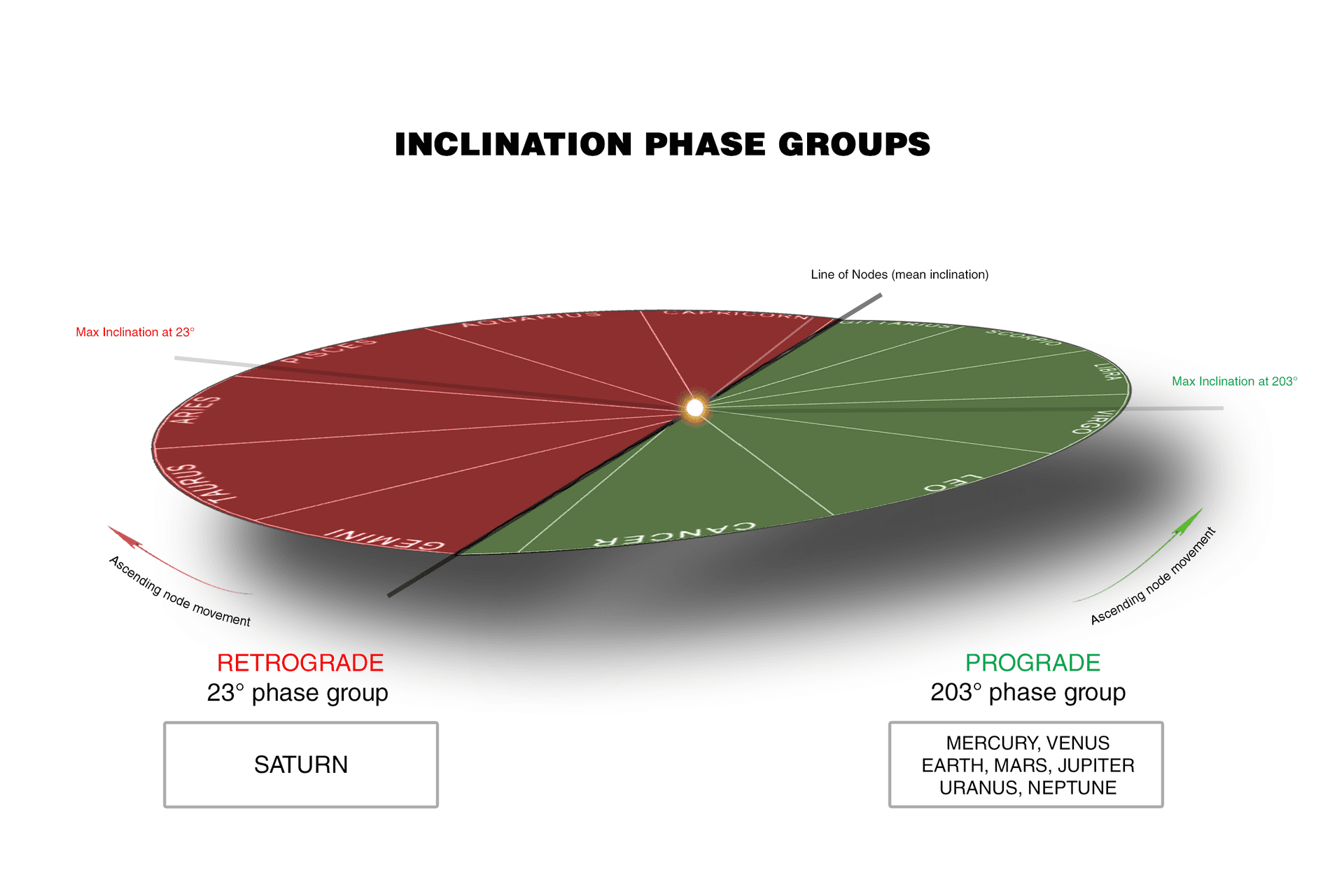
With structural weight w = √(m·a)/d (where ψ cancels because every planet shares the same Law-2 constant), the two sides match to 99.9974%. Jupiter alone provides 81% of the in-phase weight; Uranus and Neptune contribute most of the rest; the inner planets are negligible. The balance is genuine: it requires the actual masses, distances, and Fibonacci divisors. See the derivation for the full weight table and the J2000-eccentricity sensitivity analysis.
Law 4: The Eccentricity Amplitude Constant K
A single constant K predicts every planet’s eccentricity oscillation amplitude:
e_amp = K × sin(tilt) × √d / (√m × a^(3/2))
where K = 3.4143 × 10⁻⁶, derived from Earth’s eccentricity amplitude and axial tilt, tilt is the planet’s obliquity, and a is the semi-major axis. This is the eccentricity analog of ψ — empirical, derived from Earth, predicts all eight planets with zero free parameters.
Earth’s amplitude A is itself derived. Earth’s input A = 0.001356 is not a fitted number: it is the closing side of the 1246 triangle — e(J2000)² = base² + A² + 2·base·A·cos φ, with φ = 360°·(2000 − 1246.03)/(H/16) = 12.95° the arm-to-arm phase advanced since the perihelion–solstice alignment. The closure is sharp (5% off in A would move the alignment year to 690 or 2,000 AD). A is an of-date-class quantity — Earth’s |e|(t) rides the H/3 one law, and A is the Law-4 calibration and the wobble-marker distance.
| Law 2 (inclination) | Law 4 (eccentricity) | |
|---|---|---|
| Formula | amp = ψ / (d × √m) | e_amp = K × sin(tilt) × √d / (√m × a^(3/2)) |
| Constant | ψ = 3.3070 × 10⁻³ | K = 3.4143 × 10⁻⁶ |
| Predicts | 8 inclination amplitudes | 8 eccentricity amplitudes |
Law 4 predicts amplitudes only. The base (mean) eccentricities are derived from the System Reset phase (n = 7), the epoch when every planet passes through its mean eccentricity (in-phase planets rising at phase 90°, Saturn falling at 270°) — mirroring the inclination alignment at the same epoch. The base eccentricities are inputs to Law 5 below, which uses them to predict Saturn’s eccentricity from the other seven.
Law 5: The Eccentricity Balance
Mass- and distance-weighted eccentricities of seven planets balance against Saturn’s alone — same Fibonacci divisors and phase groups as Law 3.
Each planet’s eccentricity weight is v = √m × a^(3/2) × e / √d. The weight scales differently from Law 3 (a^(3/2) vs √a, linear e, 1/√d instead of 1/d), so this is a genuinely independent constraint. With phase-derived base eccentricities the balance reaches 99.8636%.
Three tests confirm the balance depends on actual eccentricities, not the formula’s structure:
- Without eccentricities, the weights give 74% balance — actual values contribute ~26 percentage points.
- Random eccentricities give 50–85%.
- The balance peaks sharply at linear e (drops to 91% for e² and below for other powers) — linear dependence is special.
Saturn’s eccentricity from Law 5. Since Saturn is alone on the anti-phase side, the balance equation directly determines its eccentricity from the other seven:
| Source | e_Saturn |
|---|---|
| Predicted from Law 5 | 0.05372 |
| Observed J2000 | 0.05386 |
| Error | 0.27% |
The Fibonacci divisors were chosen to satisfy Laws 1–3 (inclination constraints) and were never optimized for eccentricity — this is a non-trivial cross-validation.
The ~0.14% residual. The balance closes to 99.8636%, not exactly 100%. Sensitivity analysis rules out single-planet mis-measurement (required shifts are orders of magnitude larger than DE440 precision). The gap is what’s missing from the eight-planet sum: ~96% from minor-body contributions (cold classical-belt KBOs whose intrinsic amplitudes follow Law 4); ~4% from Uranus/Neptune mass uncertainty (Voyager-2 era). See Open Questions for the full decomposition.
Law 6: The Saturn-Jupiter-Earth Resonance
Jupiter’s ICRF perihelion period and Saturn’s ecliptic perihelion period lock at 8H/65 ≈ 41,270 yr — the climate-recorded obliquity beat. Earth’s own obliquity sits one 8H-lattice step away at the Fibonacci value H/8 = 8H/64.
Stated precisely, Law 6 is an Earth-frame beat identity at J2000: the quantities that coincide — and that match Laskar to 0.04 %/0.12 % in the table below — are Earth-frame beats (|s₃| and k + s₃) evaluated in the model’s frames at the present epoch. The giants’ own secular apsidal frequencies (g₅, g₆) are different quantities with different values; the identity is exact where stated and makes no claim about them.
Earth’s only intrinsic precessional motion is axial precession (H/13), driven by the lunisolar torque on Earth’s equatorial bulge. Every other “Earth cycle” — obliquity, eccentricity, climatic precession — is a planetary coupling beat dominated by Jupiter and Saturn. The identity at 8H/65 is the core: in the model’s frames at J2000, both gas giants’ perihelion motions read the same period in different reference frames, and that period is Earth’s obliquity beat (the climate-recorded k + s₃ eigenmode).
Why Earth’s obliquity sits one lattice step off (8H/64 vs 8H/65). Earth’s obliquity is its axial precession beating against the ecliptic. In 8H-integer terms it is 104 (axial = H/13 = 8H/104) minus the ecliptic integer. Against Law 1’s Fibonacci ecliptic anchor H/5 = 40, the beat is 104 − 40 = 64 → H/8. Against the gas giants’ actual ecliptic period 8H/39 = 39, it is 104 − 39 = 65 → 8H/65. The single-integer shift in the ecliptic period propagates one-for-one into the obliquity beat.
On the 8H lattice the four key periods order as 39 < 40 < 64 < 65: Jupiter ecliptic perihelion (8H/39), Earth ecliptic precession (8H/40 = H/5), Earth obliquity (8H/64 = H/8), Saturn ecliptic perihelion (8H/65). Earth’s two Fibonacci values each sit exactly one 8H-step off a gas-giant period. The two gas giants move in opposite senses and drive Earth’s orbital plane from both sides.
| Quantity | Fibonacci anchor | 8H-lattice secular | Laskar identification |
|---|---|---|---|
| Jupiter ecliptic perihelion | +H/5 | +8H/39 = 68,783 yr | |s₃| (Earth nodal eigenmode) |
| Jupiter ICRF perihelion | −H/8 | −8H/65 = 41,270 yr | k + s₃ (obliquity beat) |
| Saturn ecliptic perihelion | −H/8 | −8H/65 = 41,270 yr | k + s₃ (obliquity beat) |
| Saturn ICRF perihelion | −H/21 | −8H/169 = 15,873 yr | (no clean Laskar single-mode match) |
The Fibonacci anchors are Earth’s own precession periods (Law 1) — H/5 (ecliptic precession) and H/8 (obliquity). Jupiter’s and Saturn’s perihelion motions fall near these but not on them; their 8H-lattice values sit one integer away, and the Laskar-identification column shows what each value actually matches: Earth-frame beats. The duality is structural on the Earth side (the Fibonacci anchors fix Earth’s cycle hierarchy); on the giant side the 8H-lattice values are era-typed descriptors of the coupled motion as seen in Earth’s frames.
Cross-validation. The analytical 8H/39 and 8H/65 match Laskar’s numerical secular eigenmodes (|s₃| = 68,750 yr, k + s₃ = 41,220 yr) to 0.04% and 0.12% respectively. The empirical LR04 obliquity peak (40,950 yr) lands within one Rayleigh element of both. The convergence is not a calibration — neither method consults the other. See Supporting Evidence — Independent cross-validation.
Saturn’s ecliptic-retrograde perihelion precession. Saturn’s perihelion precesses retrograde in the ecliptic frame (opposite to its orbital motion), at the 8H/65 period. JPL’s WebGeoCalc shows the ecliptic trend at ~-3,400 arcsec/century (window-dependent) against the model’s lattice rate of -3,140.3 — the only gas giant with a negative rate. Standard celestial mechanics attributes this to a transient phase of the ~900-year Great Inequality; the model’s own N-body engine agrees with that mechanism — the retrograde is the window phase of the epicycle, with the long-term mean prograde (g₆) — so the model’s −8H/65 is a window-epoch descriptor of the present era’s motion, and the original permanence claim is retired. See Supporting Evidence §12.
Earth is the sole prograde planet in the ICRF. Earth’s ecliptic perihelion rate (H/16) is the only one that exceeds the general precession (H/13), so its ICRF perihelion stays prograde at +H/3 (the Fibonacci identity 16 − 13 = 3). Every other planet — including Jupiter and Saturn — precesses retrograde in the ICRF. See Why Earth Is Special for the full picture.
Mirror Symmetry
The eight Fibonacci divisors form an exact mirror-symmetric pattern across the asteroid belt:
| Inner planet | Divisor | Outer planet |
|---|---|---|
| Mars | 5 | Jupiter |
| Earth | 3 | Saturn |
| Venus | 34 | Neptune |
| Mercury | 21 | Uranus |
The divisors form two consecutive Fibonacci pairs — (3, 5) for the belt-adjacent planets and (21, 34) for the outermost pairs. Earth and Saturn share d = 3 but sit in opposite balance groups — Saturn’s unique anti-phase role is what makes it the pivot for both balance laws.
The symmetry was not assumed — it emerged from exhaustive search. All 7,558,272 possible configurations (Fibonacci-divisor + phase-group assignments for the five free planets) were filtered through successively stricter physical constraints:
| Filter | Surviving |
|---|---|
| Inclination balance ≥ 99.994% | 767 |
| + Eccentricity balance ≥ 99% | 96 |
| + Laplace–Lagrange bounds 8/8 (per-config optimised anchor) | 51 |
| + Direction match + ascending-node rate error ≤ 6″/cy | 15 |
| + Mirror symmetry | 1 |
Of the 15 configurations surviving all four physical filters, only one is mirror-symmetric: the actual solar-system assignment. Mirror symmetry is the model’s most surprising output, not an input — the asteroid belt is the natural mirror axis.
The Invariable Plane
The invariable plane — perpendicular to the solar system’s total angular momentum vector, passing through the Sun’s center, dominated by Jupiter (~60% of the angular momentum) and Saturn (~25%) — is the fixed stage on which the balance laws play out. It does not move; everything else moves around it. Planetary inclinations measured against the (moving) ecliptic look irregular, but against the invariable plane the same data shows smooth, predictable oscillations and the clean Fibonacci structure of Laws 2–3. Earth’s ~111,772-year apsidal precession (H/3) is Earth’s orbital plane tilting relative to this plane.
Planetary Inclinations
Every planet’s tilt to the invariable plane oscillates in a predictable pattern around its mean:
| Planet | J2000 inclination | Mean | Amplitude | Range | Ecliptic perihelion period† |
|---|---|---|---|---|---|
| Mercury | 6.347° | 6.703228° | ±0.386501° | 6.32° – 7.09° | ~243,867 yr |
| Venus | 2.155° | 2.151359° | ±0.062168° | 2.09° – 2.21° | ~447,089 yr* |
| Earth | 1.579° | 1.48113° | ±0.63607° | 0.845° – 2.117° | ~111,772 yr |
| Mars | 1.631° | 1.833263° | ±1.164287° | 0.67° – 3.00° | ~74,515 yr |
| Jupiter | 0.322° | 0.321086° | ±0.021405° | 0.30° – 0.34° | ~68,783 yr |
| Saturn | 0.925° | 0.984969° | ±0.065196° | 0.92° – 1.05° | ~41,270 yr* |
| Uranus | 0.995° | 1.015183° | ±0.023832° | 0.99° – 1.04° | ~111,772 yr |
| Neptune | 0.735° | 0.743803° | ±0.013552° | 0.73° – 0.76° | ~670,634 yr |
*Venus and Saturn have retrograde apsidal precession. †Ecliptic-frame perihelion periods, which is what direct observation reports; Earth’s row uses the ICRF perihelion period (H/3) because Earth is the only planet whose ICRF perihelion is prograde — see Why Earth Is Special. Jupiter’s small amplitude (±0.021405°) is because it contributes the most angular momentum — it essentially defines where the plane is; Mars has the largest (±1.164287°). Earth and Uranus sharing an H/3 period is a numerical coincidence (ICRF vs ecliptic quantities); Jupiter’s 8H/39 sitting close to Earth’s ecliptic-precession period, and the Saturn–Jupiter 8H/65 lock, are Law 6 above.
Inclination Oscillation
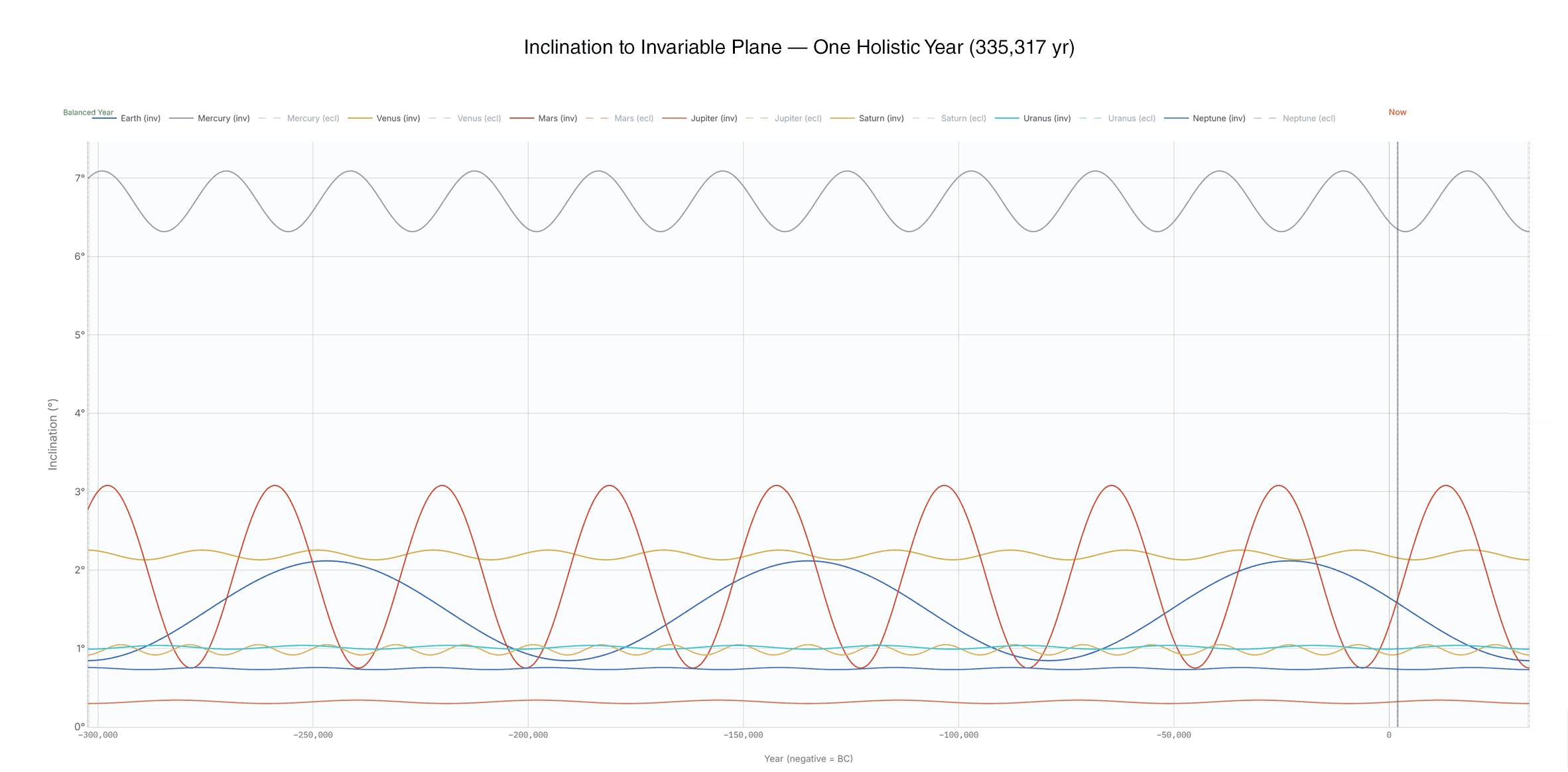
Gravitational pull from the other planets makes each orbit precess around the invariable plane, producing coupled nodal precession and inclination oscillation:
inclination(t) = mean + amplitude × cos(ϖ_ICRF(t) − phase_angle)ϖ_ICRF(t) is the planet’s ICRF perihelion longitude; the phase_angle is the planet’s own inclination cycle anchor φ, derived from the System Reset epoch (302,635 BC, n = 7) where all eight planets land at MIN inclination simultaneously — in-phase planets’ φ = ω̃(t_SR) + 180°, Saturn’s φ = ω̃(t_SR) with its sign flipped by antiPhaseSign = −1 (Earth’s anchor ~21.77°, Saturn’s ~116.26°). That 7+1 split — Saturn’s sign-flipped contribution — is what enables the Law-3 balance. Inclination values and ascending nodes are based on Souami & Souchay (2012) (A&A 543, A133), refined to reproduce JPL J2000 ecliptic inclinations to <0.0001° — methodology and verification at Plane Calibration; closed-form inclination expressions for any year at Formulas.
Why Not the Ecliptic?
The ecliptic — Earth’s own orbital plane — precesses (H/5 = ~67,063 yr), so a planet’s ecliptic inclination mixes two oscillations: the planet’s tilt to the invariable plane and Earth’s. Measured against the ecliptic the same motions look chaotic:
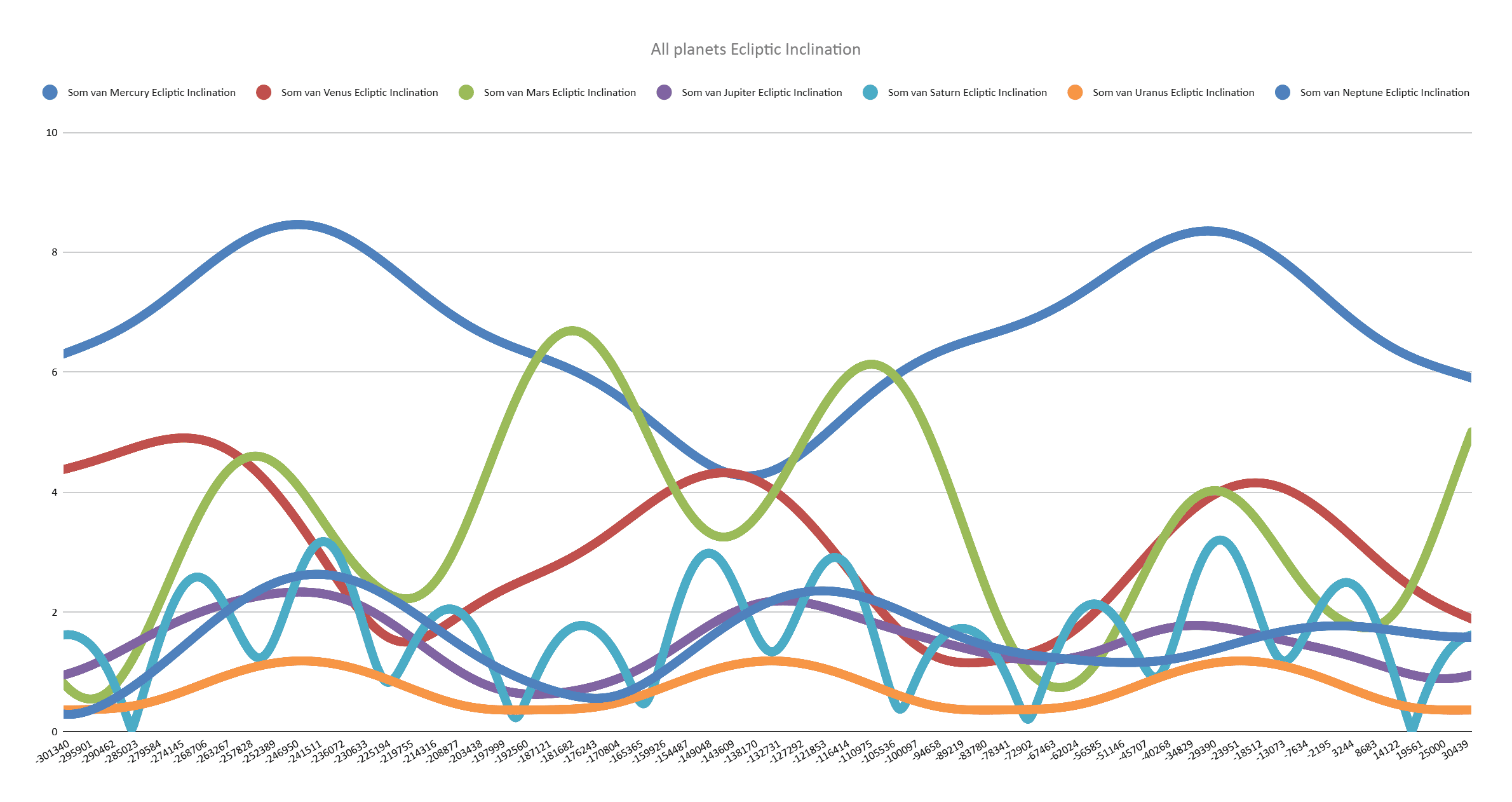
When inclinations and node alignments cooperate, several planets’ orbital planes can come near the ecliptic — Saturn can even reach exactly 0°, temporarily coinciding with it. Earth itself crosses the invariable plane twice a year (~July 4 ascending, ~January 4 descending around J2000, at most ~4 million km above or below). The plane is tilted ~1.579° to the ecliptic and ~60° to the galactic plane. In the Interactive 3D Simulation the invariable plane is shown as a reference grid under celestial tools.
The Vector Balance
The invariable plane is stable because the planetary angular-momentum perturbations cancel. The raw force share is concentrated in the outer planets — Saturn ~42% (the sole anti-phase pusher), Jupiter ~36%, Neptune ~11%, Uranus ~10%, the four inner planets <1% combined. That 42/58 magnitude split is not itself the balance: the Law-3 scalar balance uses the structural weight w = √(m·a(1−e²))/d × amp and closes at 99.9974%. The vector balance (whether the 2D forces cancel at all times) depends on how the nodes precess: in a single-mode approximation it degrades to ~72% as nodes go out of sync; in a multi-mode representation (7 eigenfrequencies per planet, matching secular theory) it is maintained at 100% — but that multi-mode property holds for any frequencies. The scalar balance is the genuine constraint that selects the Fibonacci d-values; the vector balance is guaranteed by the eigenmode structure regardless.
Ascending-Node Periods
Each planet’s ascending-node regression period takes the form 8H/N for integer N, with Jupiter and Saturn locked at a shared N = 36. Across the seven fitted planets the integers reproduce JPL’s J2000-fixed-frame node trends with cumulative residual ~5.8″/century (~0.8″/century per planet):
| Planet | Period | Note |
|---|---|---|
| Mercury | −8H/9 | |
| Venus | −8H/1 | full Solar System Resonance Cycle |
| Earth | −H/5 = −8H/40 | coincides with ecliptic precession |
| Mars | −8H/64 | |
| Jupiter | −8H/36 | locked with Saturn |
| Saturn | −8H/36 | locked with Jupiter |
| Uranus | −8H/11 | |
| Neptune | −8H/3 |
The model derives all eight from the single constant H; Laskar’s secular theory measures them as independent eigenfrequencies with no known structural relationship. These periods span 50,000–2,000,000 years, so with ~4,000 years of recorded astronomy no complete cycle can be verified by direct observation — the model’s advantage is that all eight derive from one constant.
Why Fibonacci? Physical Origin
The laws above document what the structure is; this section addresses why it exists. The answer has two parallel parts at different scales: at the planetary-spacing scale (Laws 1–5), KAM theory acting on configurations frozen during formation; at the 8H climate-lattice scale (the integer divisors 8H/N organizing Earth’s obliquity record), action-angle closure of the obliquity sector. The two mechanisms do not compete — they act on different scales.
KAM: The Mathematical Foundation
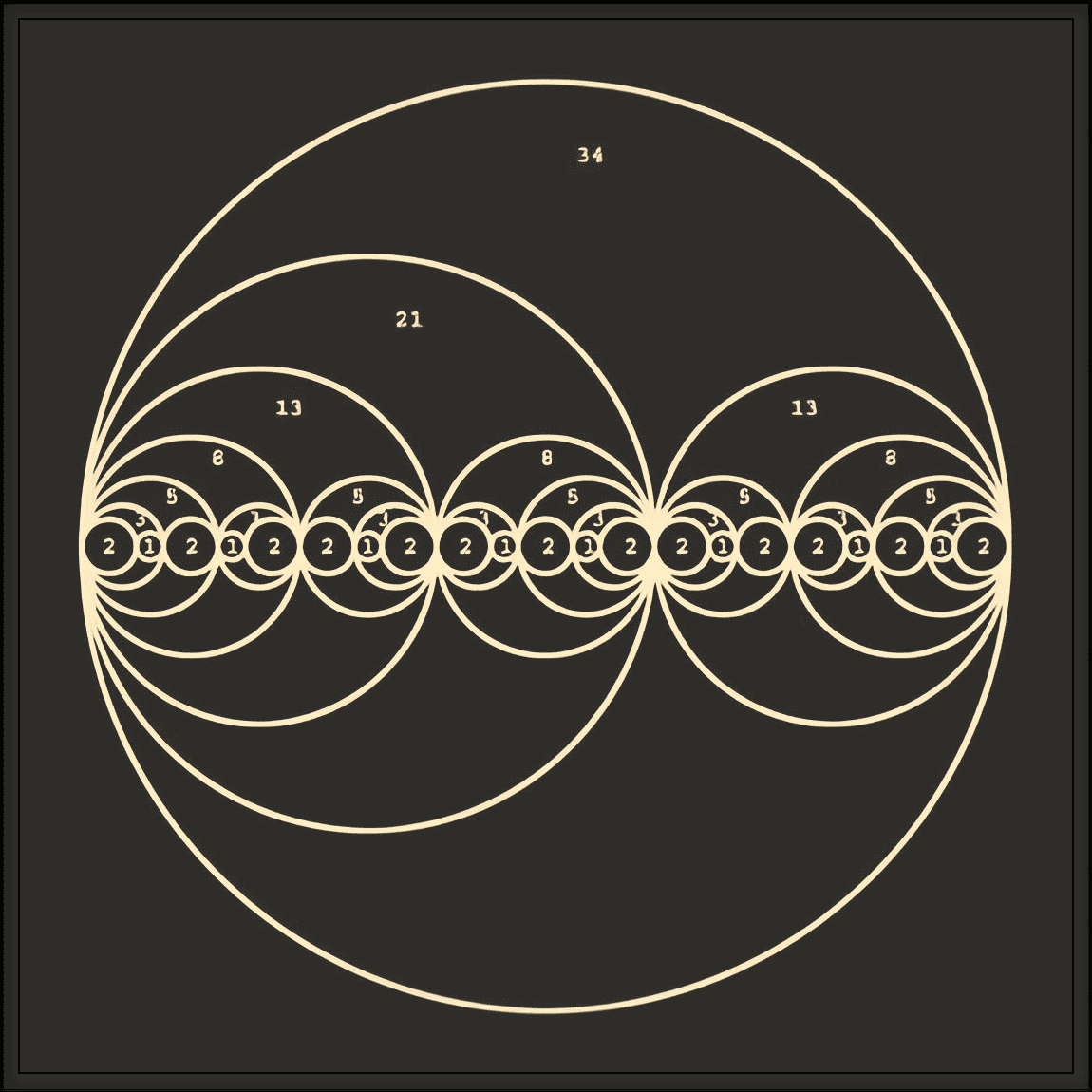
The KAM theorem (Kolmogorov 1954, Arnold 1963, Moser 1962) proves that orbits whose frequencies have the most irrational ratios are maximally stable against perturbation. Fibonacci ratios (3/2, 5/3, 8/5, 13/8, …) converge to the golden ratio φ ≈ 1.618 — the most irrational number, hardest to approximate by simple fractions. Orbits with golden-ratio-related frequencies are therefore the last to become unstable under perturbation. Over 4.5 billion years, simple-fraction resonances (2:1, 3:1) destabilized — most dramatically visible in the Kirkwood gaps — while golden-ratio-related orbits survived. The theorem predicts orbits with frequencies near — not exactly at — golden-ratio relationships, which is precisely what the laws show.
The Fibonacci patterns emerge when orbits are described in AMD-natural variables — eccentricity × √m and inclination × √m. The √m weighting is dictated by the Angular Momentum Deficit, the conserved quantity governing long-term orbital stability: substituting Law 2 into the AMD formula cancels the mass exactly, making each planet’s share a mass-independent partition (see the derivation). And of Earth’s precession cycles, only axial precession (H/13) is physically intrinsic — the lunisolar torque would sustain it with no other planets present; apsidal precession (H/3), ecliptic precession (H/5), and the obliquity and eccentricity oscillations are all sustained by gravitational coupling with Jupiter and Saturn (Law 6). That an intrinsic lunisolar motion and a planet-driven motion read a 13:3 Fibonacci ratio at J2000 — the seed of the H hierarchy — is exactly the kind of KAM-stable configuration the dissipative disk phase would select (with the permanence caveat of the warning box above: the 13:3 reading is the measured J2000 configuration, not a demonstrated lock).
Formation-Epoch Freezing
KAM theory explains why Fibonacci ratios are preferred — but not why the balance conditions are satisfied so precisely. The precision comes from the formation epoch:
| Phase | Mechanism | What it sets | Timescale |
|---|---|---|---|
| Protoplanetary disk | Dissipative forces (gas drag, disk torques, tides) continuously push orbits toward minimum AMD | The selection pressure | 0–10 Myr |
| KAM selection | Among AMD-minimizing configurations, Fibonacci-organized ones have the widest stability margins — dissipation converges toward the deepest wells | Specific Fibonacci divisors | 3–10 Myr |
| Disk dissipation | The dissipative mechanism shuts off; the configuration is frozen and conservative dynamics preserves it | Why the structure persists at J2000 | 4.5 Gyr |
Earth’s base eccentricity as a formation anchor. Earth’s base eccentricity (e_E = 0.015386) is the model’s single irreducible eccentricity parameter — an oscillation midpoint, not the J2000 value (0.01671, about 8.6% higher). The other seven bases derive from K, J2000 observations, and the System Reset anchor with balance-group phase offsets. One free eccentricity parameter is consistent with the formation-epoch picture: the dissipative era selected a specific Fibonacci-compatible configuration with Earth’s base at this value, and conservative dynamics has preserved it since.
The Mechanism for the Climate Lattice
The climate lattice — the Solar System Resonance Cycle 8H = 2,682,536 yr and the integer divisors 8H/N that organize Earth’s obliquity and eccentricity record — is a different scale and required a different mechanism. The empirical search identified it: action-angle closure of the obliquity sector, not KAM resonance protection.
The natural first hypothesis — that the 8H integers sit in gaps between overlapping resonance widths (Chirikov’s criterion) — tested null: across 33 spectral peaks in LA2004 eccentricity + obliquity, every peak is KAM-stable, lattice-aligned and non-lattice peaks have statistically indistinguishable Chirikov K (Mann-Whitney p = 0.667), and the direction runs opposite the hypothesis. KAM stability is necessary but not sufficient — the stable manifold contains more than the 8H lattice.
What does select the lattice: if 8H is a true closed-orbit period of the secular system, the obliquity trajectory must return to its starting point every 8H in action-angle coordinates, and the obliquity eigenfrequencies must be integer multiples of 1/(8H). Direct tests on LA2004’s 51-Myr data confirm this — in the obliquity sector only:
| Sub-test | Eccentricity vector (h, k) | Obliquity ε(t) |
|---|---|---|
Closure distance D(8H) vs 200 random lags | 57.5 % of random lags beat it → null | only 2.5 % of random lags beat it → ✓ |
Top 10 spectral peaks at integer divisors of 1 / (8H) | 6 / 10 within 5 % | 8/10 within 5 %, most within 0.2 % |
The eccentricity vector’s failure to close is predicted: obliquity is 100 % on the lattice while eccentricity is only 74 %, the off-lattice 26 % being Mercury-chaos-driven perturbation (consistent with Laskar 1989/1994 inner-planet chaos restricted to eccentricity). If 8H is the closed-orbit period and the eigenfrequencies are commensurate at it, each must take the form n/(8H) — the spectrum is forced onto integer divisors, conservation rather than coincidence; the climate-active L1 subset is then a selection within an already-quantized set. Both mechanisms persist as the lattice evolves: the integer labels stay invariant across geological time while the absolute periods rescale (Expanding Resonance). Scripts: chirikov_resonance_test.py, action_closure_test.py.
Hierarchy of Certainty
Not all claims carry equal evidence:
| Claim | Evidence | Status |
|---|---|---|
| Fibonacci numbers appear in solar system orbital architecture | p = 1.5 × 10⁻⁴–1.0 × 10⁻⁶ → 3.62–4.75σ | Established |
| The structure acts on AMD-natural variables (√m weighting) | Law 2 in AMD cancels mass exactly — mass-independent partition | Established |
| KAM theory provides the mathematical foundation | Proven theorem + computational confirmation (Greene 1979, Morbidelli & Giorgilli 1995) | Established framework |
| The structure was set during formation and frozen at disk dissipation | N-body confirms no secular mode preserves it | Well-supported |
| 8H is a closed-orbit period of the obliquity sector, forcing integer divisibility | Test A closure + 8/10 top peaks within 5 % of integer divisors; Chirikov null (p = 0.67) | Established (climate-lattice mechanism) |
The bottom line: the existence of non-trivial Fibonacci structure beyond chance is supported at 3.62–4.75σ. The planetary-spacing mechanism (KAM selection frozen at formation) is well-supported by theory and simulation; the climate-lattice mechanism (action-angle closure) is directly tested with sub-percent precision. The specific values — H, ψ, K, 8H itself — are empirically determined, not yet derived from first principles. Comparable to where Kepler’s laws stood before Newton: the patterns are real and the mechanisms identified, but the deepest “why these numbers” awaits a theoretical breakthrough.
Relation to Existing Physics
The Fibonacci Laws combine established physics with genuinely new structural claims.
What builds on existing theory. Law 1 builds on the known precession periods; the new claim is recognizing them as a Fibonacci-divided hierarchy of one timescale. Law 3 is rooted in angular momentum conservation around the invariable plane; the new claim is that Fibonacci divisors preserve that balance to 99.9974%. Law 5 connects to Angular Momentum Deficit (AMD) conservation but differs in the linear (rather than quadratic) eccentricity dependence and the 1/√d scaling. Law 6 identifies a structural lock between known measurable perihelion periods.
What appears genuinely new.
- Fibonacci division of a single timescale — no known theory predicts that all major precession periods should be H/F(n) for one H and successive Fibonacci numbers.
- Fibonacci structure in eccentricities and inclinations — prior work (Molchanov, Pletser) found Fibonacci patterns in orbital periods only. Laws 2 and 4 extend to inclination and eccentricity amplitudes through mass-weighted variables.
- Two universal amplitude constants ψ and K — both derived from Earth, both predict all eight planets with zero free parameters. No theory explains why they exist.
- Mirror symmetry across the asteroid belt — no known law pairs inner and outer planets at identical Fibonacci divisors.
- Saturn eccentricity from Law 5 — one equation in eight unknowns, predicting Saturn’s base eccentricity from the other seven to ~0.27%. The Fibonacci divisors were chosen to satisfy Laws 1–3 and were never optimized for eccentricity.
- Gas-giant lock at Earth’s obliquity beat (Law 6) — Jupiter’s ICRF perihelion and Saturn’s ecliptic perihelion fall on the same 8H/65 period, which coincides with Earth’s k + s₃ obliquity beat. No standard theory predicts that two independent gas-giant perihelion motions should share Earth’s spin-axis beat period.
- Ascending-node periods are integer divisors of 8H — each planet’s ascending-node regression sits at 8H/N, with Jupiter and Saturn locked to a shared N = 36. All seven derive from a single constant; Laskar’s secular theory has them as seven independent eigenfrequencies.
- Law-4 closure as a quantitative criterion for planethood — the eight bodies that satisfy Law 4 intrinsically are the eight IAU planets; every named TNO, asteroid, and comet is externally dominated and fails Law 4 closure. See Open Questions.
Statistical Significance
Are these patterns real or numerology? 4 empirically testable claims — Law 3 (inclination balance), Law 5 (eccentricity balance), Saturn eccentricity prediction, solo planet identification — were evaluated against three null distributions: a direct joint permutation test (8! = 40,320 reshufflings of the real values) and two types of Monte Carlo simulation (100,000 fully random systems each).
Combined p = 1.5 × 10⁻⁴ ≈ 3.6σ (direct joint permutation test)
Joint significance is robust across the three nulls (3.62–4.75σ), all exceeding the conventional 3σ “evidence” threshold and approaching the 5σ “discovery” threshold. A leave-one-out jackknife confirms no single planet drives the result: Jupiter and Uranus are the most load-bearing (dropping either collapses the signal), but all eight planets are required for the full significance.
See Fibonacci Laws Derivation — Statistical Significance for the full 11-test methodology, including why Laws 2 and 4 are tautological (the model defines amplitudes from ψ and K) and Laws 1 and 6 are multiset-invariant under permutation.
Exoplanet Context
Compact multi-planet exoplanet systems raise the question of whether Fibonacci patterns appear beyond the solar system. TRAPPIST-1 (5 of 6 period ratios near Fibonacci fractions) and Kepler-90 (5 of 7) are consistent with prior period-ratio findings (Pletser 2019, Aschwanden 2018), but neither system can test the Fibonacci Laws above: TRAPPIST-1 is a mean-motion resonance chain (Fibonacci-like period ratios are partly a resonance by-product) and its eccentricities span only ~0.002–0.01 (a factor of 4, vs the solar system’s 141×). Kepler-90 has only two mass measurements. The period-ratio observations are suggestive, not confirmatory; they motivate future work with better-characterized TTV systems but are not used as evidence for the significance results above.
Open Questions
What determines the base eccentricities? Laws 2 and 4 predict amplitudes. Saturn’s base eccentricity is predicted by Law 5. The remaining seven base eccentricities come from the System Reset phase (n = 7), where every planet passes through its mean eccentricity simultaneously — mirroring the inclination alignment. Whether the System Reset itself is derivable from first principles is open.
What conservation law produces the eccentricity balance? Law 3 follows from angular momentum conservation around the invariable plane. Law 5 has the same Fibonacci structure but operates on linear e rather than the quadratic AMD form — distinct from any known conserved quantity. A theoretical derivation is open work.
Are the Fibonacci Laws universal? The laws rest entirely on solar-system data. Whether Fibonacci structure appears in other stable planetary systems remains an open question that future TTV-characterized exoplanet observations may address.
The 0.14% Law-5 residual. The eight-planet balance closes to 99.8636%, not exactly 100%. Sensitivity analysis rules out single-planet mis-measurement. The gap decomposes into two channels:
- Minor bodies (~96% of the residual). Substituting Law 4 into the Law-5 weight gives v = K·sin(tilt) ≈ 1.7 × 10⁻⁶ per body — independent of mass and distance (the a^(3/2) and √m factors cancel exactly). Random ± aggregation across N ≈ 625 sub-200 km low-e classical-belt KBOs gives σ ≈ 4.3 × 10⁻⁵, matching the residual. Named TNOs (Pluto, Eris, Haumea, Sedna) are not in the aggregation — their amplitudes are dominated by external forcing (Neptune resonance, scattering, galactic tides), not intrinsic Law-4 dynamics. For Pluto, long-term integrations give actual e_amp ≈ 0.025 vs intrinsic Law-4 prediction ~0.001 — a 1:24 intrinsic-to-external split, with Neptune’s 3:2 resonance pumping the amplitude ~25× above the intrinsic baseline.
- Mass uncertainty (~4%). Uranus and Neptune masses are currently constrained only by Voyager-2 flybys (~5 × 10⁻⁴ relative uncertainty). A Uranus/Neptune orbiter would shrink this channel by ~100×.
Law 4 closure as a quantitative criterion for planethood. The eight bodies that close under Law 4 intrinsically (actual e_amp matches K·sin(tilt)·√d/(√m·a^(3/2)) to <1%) are exactly the eight IAU planets. Every named TNO, comet, and asteroid fails Law-4 closure. The IAU’s 2006 third criterion — “has cleared the neighborhood around its orbit” — and Law-4 closure are the same physical statement in two languages: both say I evolve under my own dynamics, not someone else’s pull. The IAU criterion is qualitative; Law-4 closure returns a clean numerical pass/fail. The agreement is not tautological — all proposed Planet Nine candidates fail Law 4 by 4–7 orders of magnitude (independent of how observed eccentricity is interpreted), and the framework predicts a specific obliquity-clustering signature in small classical-belt KBOs that LSST will test by 2030–2035.
Summary
| Finding | What it means | Precision |
|---|---|---|
| Precession hierarchy (Law 1) | All major Earth cycles from H/Fibonacci | 6 cycles from one timescale |
| Eight planet tilts (Laws 2–3) | Zero free parameters; ψ + balance condition | All within secular theory bounds |
| Eight eccentricity amplitudes (Law 4) | Zero free parameters; K from Earth | All eight predicted |
| Saturn eccentricity (Law 5) | From balance equation using other 7 planets | 0.27% error |
| E–J–S resonance (Law 6) | Jupiter ICRF = Saturn ecliptic = 8H/65 = obliquity beat | Exact structural identity |
| Laskar cross-validation | 8H/39 matches |s₃| at 0.04%; 8H/65 matches k + s₃ at 0.12% | Independent confirmation |
| Mirror symmetry | Only 1 of 15 surviving configurations is mirror-symmetric | Exhaustive search |
| Statistical significance | 3.62–4.75σ across three null distributions | Approaches 5σ discovery |
For the complete mathematical framework, derivations, divisor assignments, and computational verification, see Fibonacci Laws Derivation.