Precession
Two slow motions turn in opposite directions and between them set every long cycle of Earth’s orbit and spin. The spin axis traces a circle on the sky, clockwise, once per clock period — the axial precession that moves the pole star and drifts the equinoxes through the zodiac. The perihelion point drifts round the orbit the other way, far more slowly. Where the two meet, the seasons and the orbit’s shape realign; the last time was in the thirteenth century.
This page establishes:
- The two motions, their directions and their periods — The two motions.
- What axial precession is, and what it does to the sky — Axial precession.
- What apsidal precession is, and the orbit-plane motion that is not it — Apsidal precession.
- The perihelion-of-date cycle, their beat, and the 1246 AD alignment — Perihelion precession.
- How the model’s perihelion compares with Meeus, and the three periods together against three reference solutions — Comparison with Meeus, The three periods together.
The two motions
| Motion | Direction | Period at J2000 | What moves |
|---|---|---|---|
| Axial precession | Clockwise | ~25,772 years | Earth’s wobble center around Earth |
| Apsidal precession | Counter-clockwise | ~111,635 years | Earth’s perihelion point around the Sun |
The axial motion is the model’s clock, the mean lunisolar precession period composed from the Sun’s and the Moon’s torques on Earth’s spin; the apsidal motion is an orbital quantity, read from the model’s N-body chain. Every other precession period is a beat of these two, or of the clock with the orbit plane’s own turn — the five periods and their ratios are tabulated on Earth’s Clock, and the full geometric setup is canonical at How It Works. The periods on this page are J2000 readings: the clock lengthens through geological time, and the ratios wander (Earth’s Clock).
Axial precession
Earth’s spin axis traces a circle on the sky over ~25,772 years, changing which star sits near the celestial pole:
- Today: Polaris
- ~2900 BC: Thuban
- ~13,700 AD: Vega
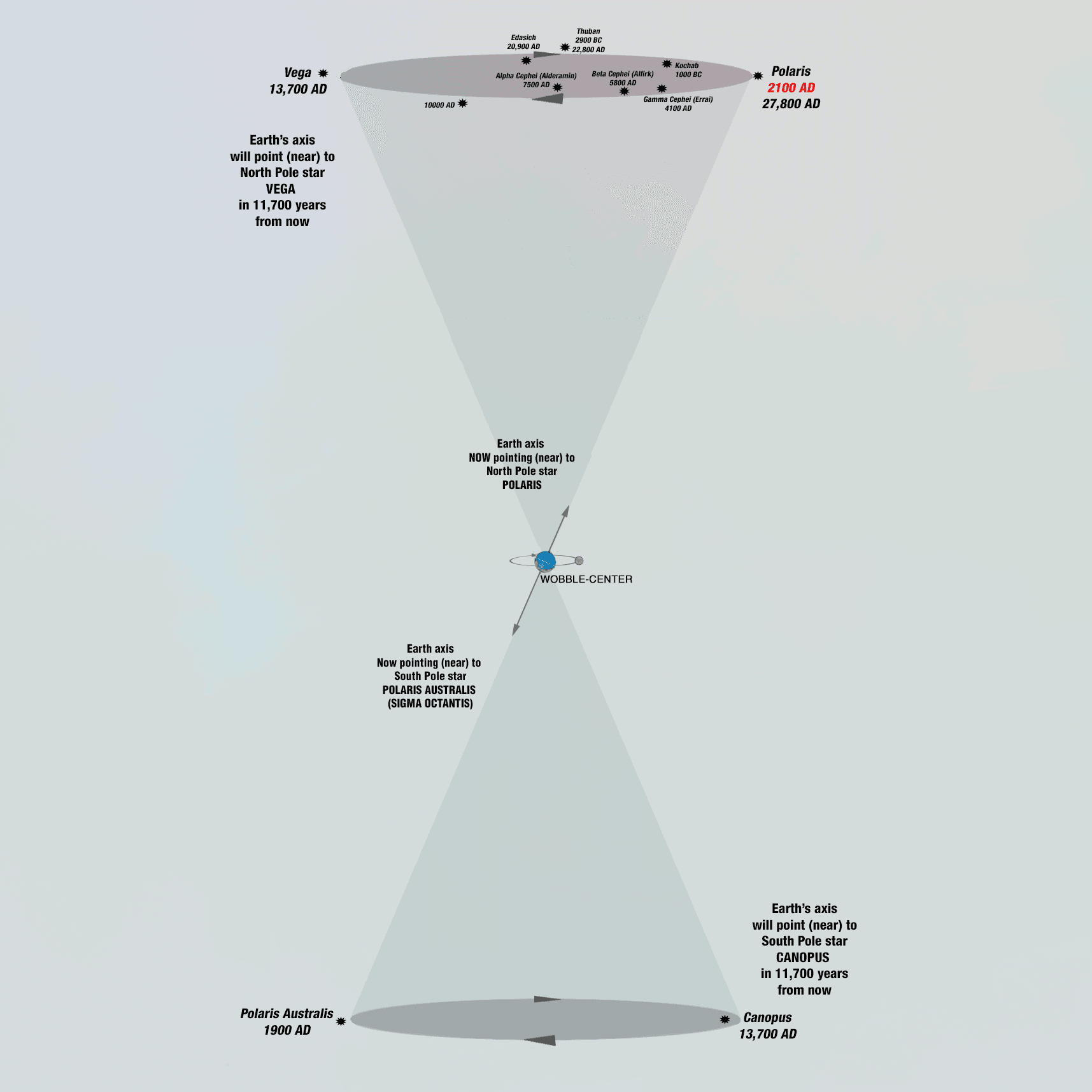
In mainstream astronomy this is the precession of the equinoxes — the equinox points drift along the ecliptic — and is also called the Great Year or Platonic Year. In the model it is the clockwise circuit of Earth’s wobble center around Earth, and its period is not a constant: it was shorter in the past and will be longer in the future, because the torques that drive it change as tides slow the spin and the Moon recedes (Earth’s Clock).
Apsidal precession
Earth’s perihelion point moves around the orbit counter-clockwise in ~111,635 years (the N-body chain’s secular apsidal rate at J2000), shifting the calendar date of perihelion. Earth’s orbital inclination is a separate motion: the orbit plane turns on the invariable plane at the nodal period ~68,751 years (the dominant nodal mode s₃), the motion the obliquity beats against.
Earth’s own apsidal precession does not drive climate directly in the 100-kyr world, and it is not a line of the shipped climate formula. The ~100-kyr band visible in ice cores is a broad single peak carried by the planetary eccentricity beats — g₄−g₅ (94.9 kyr), g₃−g₅ (98.8 kyr), g₃−g₁ (110.0 kyr) among the formula’s ten eccentricity lines — whose periods do not follow Earth’s spin. Canonical record and full attribution: Climate Formula.
Perihelion precession
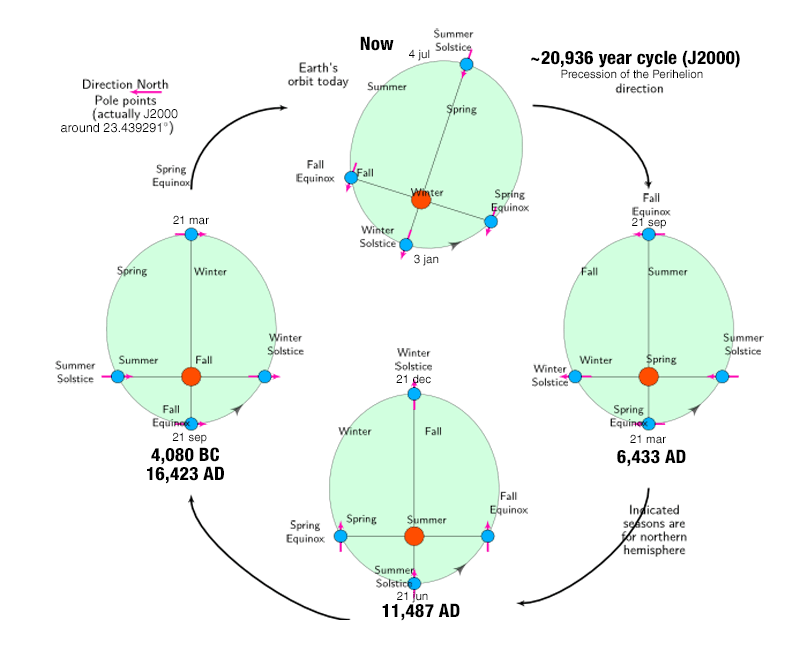
Every ~20,938 years axial and apsidal precession meet — the cycle in which the two reference points realign. The period is the J2000 reading of the beat 1/T_peri = 1/T_p + 1/T_aps; it wanders between 11,303 and 26,698 years across ±26,000 years and lengthens with the clock on geological timescales (Expanding Resonance). The last such alignment was 1246 AD by the IAU mean elements, when the December solstice coincided with perihelion; the model’s own series crosses slightly later, at 1247.2 AD. The perihelion reaches the June solstice half a perihelion-of-date cycle after that alignment.
Comparison with Meeus
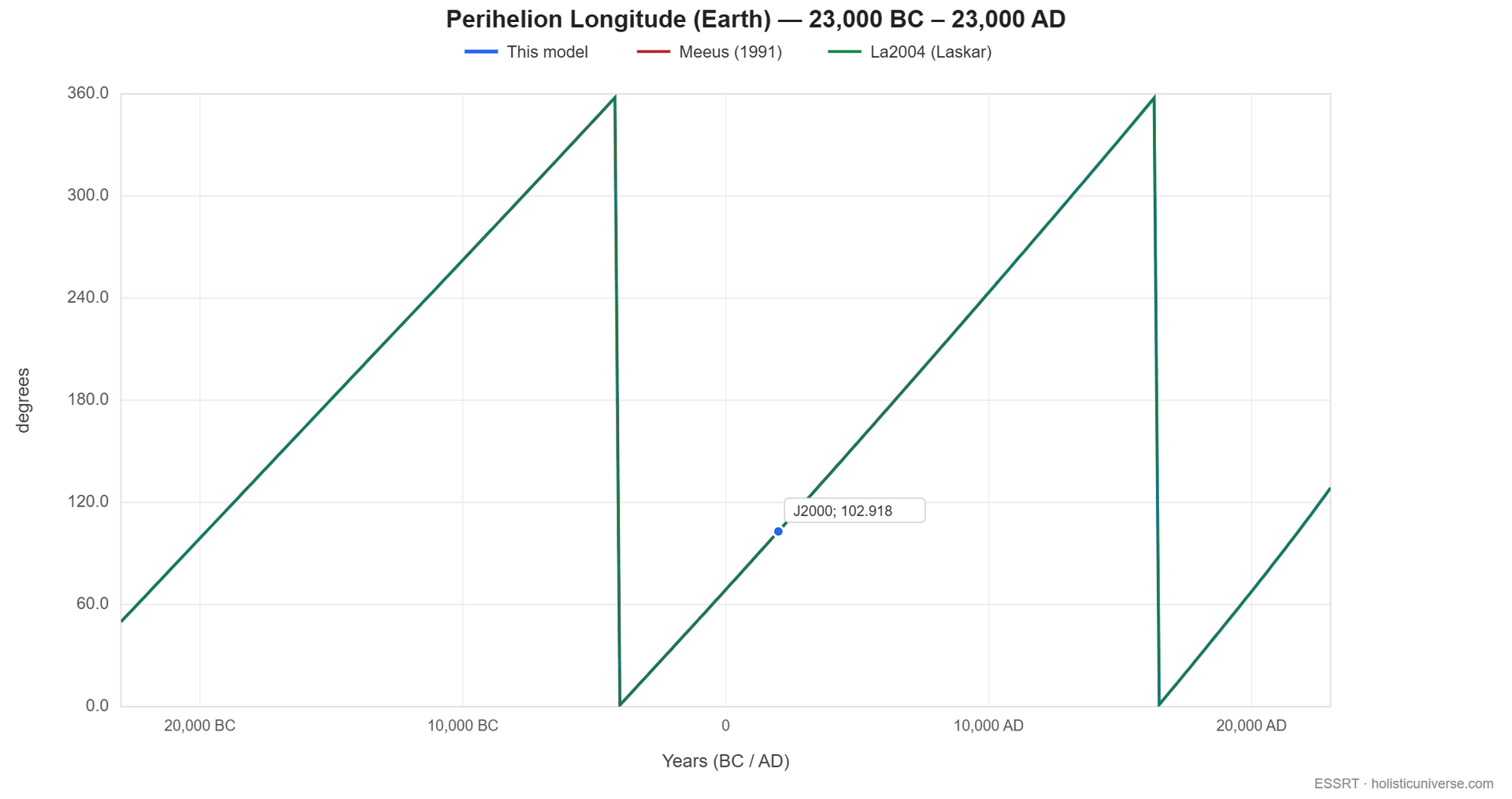
The longitude of perihelion specifies the angular direction of Earth’s closest approach to the Sun, measured from the vernal equinox. The model’s prediction matches Meeus (1998) closely for several millennia around the present:
- 1000 AD: model 85.789° vs Meeus 85.788° (Δ = +0.001°)
- 2500 AD: model 111.546° vs Meeus 111.546° (Δ = -0.000°)
Beyond ~3,000 AD the two predictions diverge. The model completes 360° in a mean period of ~20,938 years (with a varying rate within each cycle); Meeus’s polynomial extrapolation deviates increasingly outside its fit window.
The three periods together
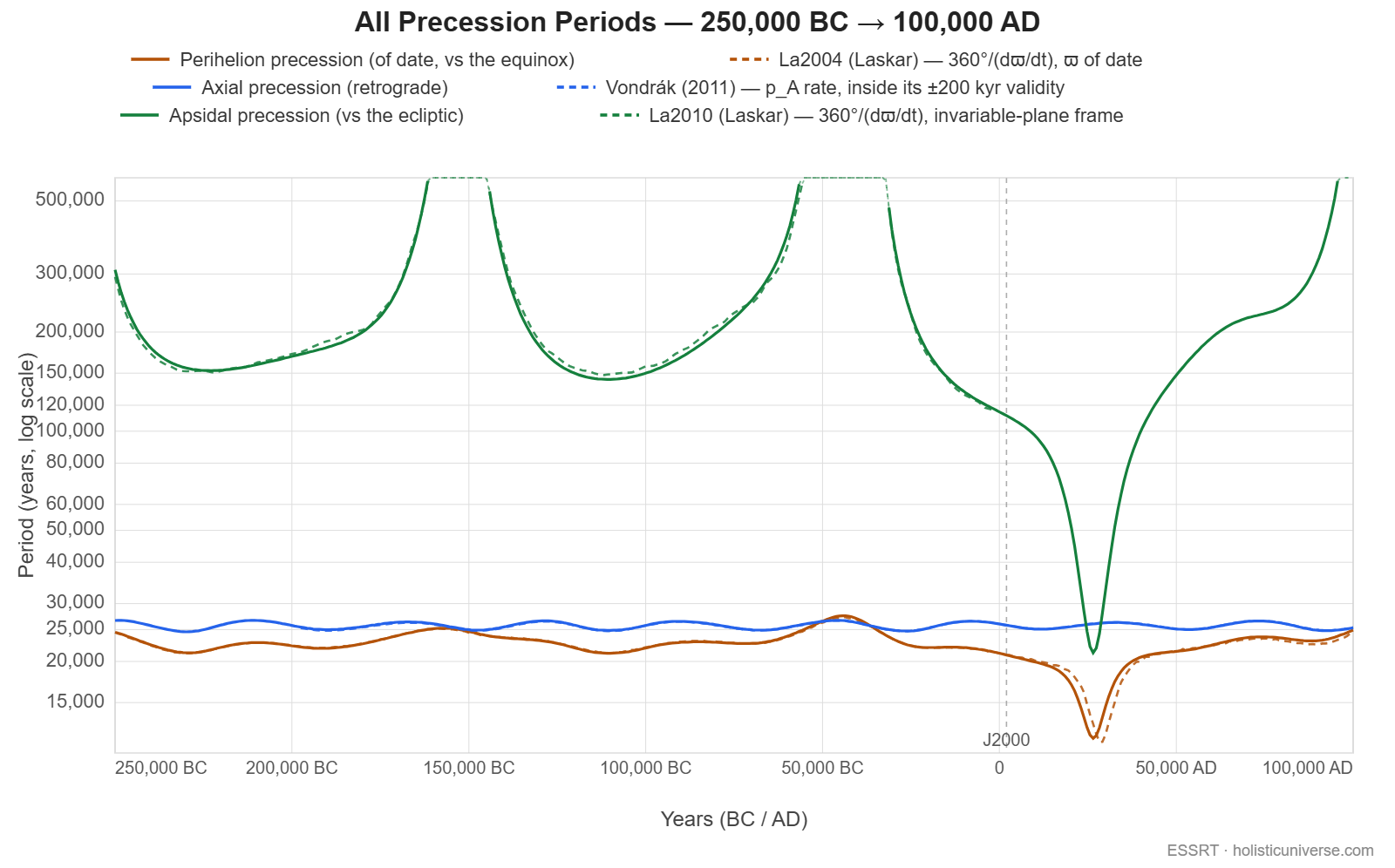
The three on one axis, against three independent reference solutions — La2004 for the perihelion of date, La2010 for the apsidal motion in the invariable-plane frame, and Vondrák 2011 for the axial rate, the last drawn only inside its stated ±200 kyr validity. The clock is the flat one. The apsidal period is the one that runs away: it diverges wherever the apsidal rate passes through zero, which is why it is quoted as a J2000 reading and not as a cycle length.
Beyond Earth
The other planets’ apsidal and nodal periods are the model’s own N-body eigenfrequencies, read from its chain — there is no common cycle they divide (retired machinery). The planets’ values: Moon & Planets; what makes Earth’s spin clock special: Earth.
Compute precession at any year
The full closed-form expressions for axial, inclination, ecliptic, obliquity, and perihelion precession at arbitrary year are in Formulas.
Continue to Obliquity & Inclination to see how axial tilt and orbital inclination combine to produce the obliquity cycle.