Obliquity & Inclination
Earth’s obliquity is the tilt of its equator against its orbit — the angle that makes summers hot and winters cold, and whose slow oscillation paces the ice ages. It is the angle between two directions that both move: the spin axis, which precesses once per clock period, and the orbit’s own normal, which turns on the invariable plane as the other planets perturb Earth’s orbit. The tilt therefore oscillates at the rate the one gains on the other, and in the model that history is derived from one precession equation on the model’s own dynamics, with no fitted constant.
This page establishes:
- Obliquity is the angle between two moving directions, and its cycle is their beat, not the precession period — Two motions, one angle.
- The orbit plane’s own turn must enter the tilt, by geometry — Why the orbit plane must enter.
- The derived band, ~22.08° to 24.45°, and how it compares with the standard solutions — The obliquity band, Comparison with standard solutions.
- The whole history follows from one equation with zero fitted constants — Derived from one equation.
- What drives climate and what does not, and the planets’ obliquities as bands, not cycles — Climate connection, The planets’ obliquity.
| Property | Value |
|---|---|
| Current obliquity (J2000) | ~23.4393° |
| Direction | Decreasing |
| Range in model | ~22.08° – ~24.45° |
| Range in standard theory | ~22.1° to ~24.5° (Laskar) |
| Oscillation period | ~41,099 years — the beat 2π/(ψ̇ − |s₃|) of the precession clock against the orbit plane’s nodal turn (the beat of the spin axis's inertial precession against the nodal mode s₃, 1,296,000/(ψ̇ᵢₙ − |s₃|)) |
Two motions, one angle
| Direction | Motion | Cause | Period at J2000 |
|---|---|---|---|
| Earth’s spin axis | Axial precession — the axis traces a cone in space | Lunisolar torque on Earth’s equatorial bulge | ~25,772 years |
| Earth’s orbit normal | The orbit plane turns on the invariable plane (its inclination and node change) | Gravitational perturbations from the other planets — the nodal modes, s₃ dominant | ~68,751 years |
| Obliquity | The angle between the two | Their beat | ~41,099 years |
The two motions run in opposite senses, so the angle between the axis and the orbit normal oscillates at the rate the one gains on the other: 1/T_obl = 1/T_ψ̇ − 1/T_s₃. Here T_ψ̇ = 25,722 yr is the spin axis’s own inertial period, 0.097 ″/yr faster than the equinox clock T_p — the planetary precession. That gives ~41,099 years at J2000, the observed ~41k-year Milankovitch obliquity cycle. The amplitude of that oscillation is not a free number; it follows from integrating the precession equation on the model’s own orbit-plane history (Derived from one equation).
Two easily confused things act on Earth’s spin axis, and only one of them changes the tilt. The precession of the equinoxes (~25,772 yr) — the classical precession observed by Hipparchus, the model’s clock — rotates where the axis points but does not change the tilt angle. The obliquity cycle (~41,099 yr) is the angle oscillating, because the orbit plane turns on the invariable plane once per nodal period (~68,751 yr, the dominant nodal mode s₃ of Earth’s orbit) in the opposite sense to the spin axis.
The period is a J2000 reading: it lengthens at geological time with Earth’s precession clock — 31.6 kyr in the Devonian, 41.1 kyr today, 47.7 kyr in 200 Myr (Expanding Resonance). A dated record sees the beat of the pole rate’s mean over the record’s window, not the J2000 instant. The spin turned faster in the past, so the mean obliquity was lower and the mean eccentricity higher. Over the LR04 record (0–5.32 Ma) the realized period is therefore ~40,928 yr: the model’s own obliquity history fitted over that window reads ~40,920 yr, and La2004’s on the same fit ~40,900 yr (Supporting Evidence §7). The climate formula’s obliquity lines carry that window mean.
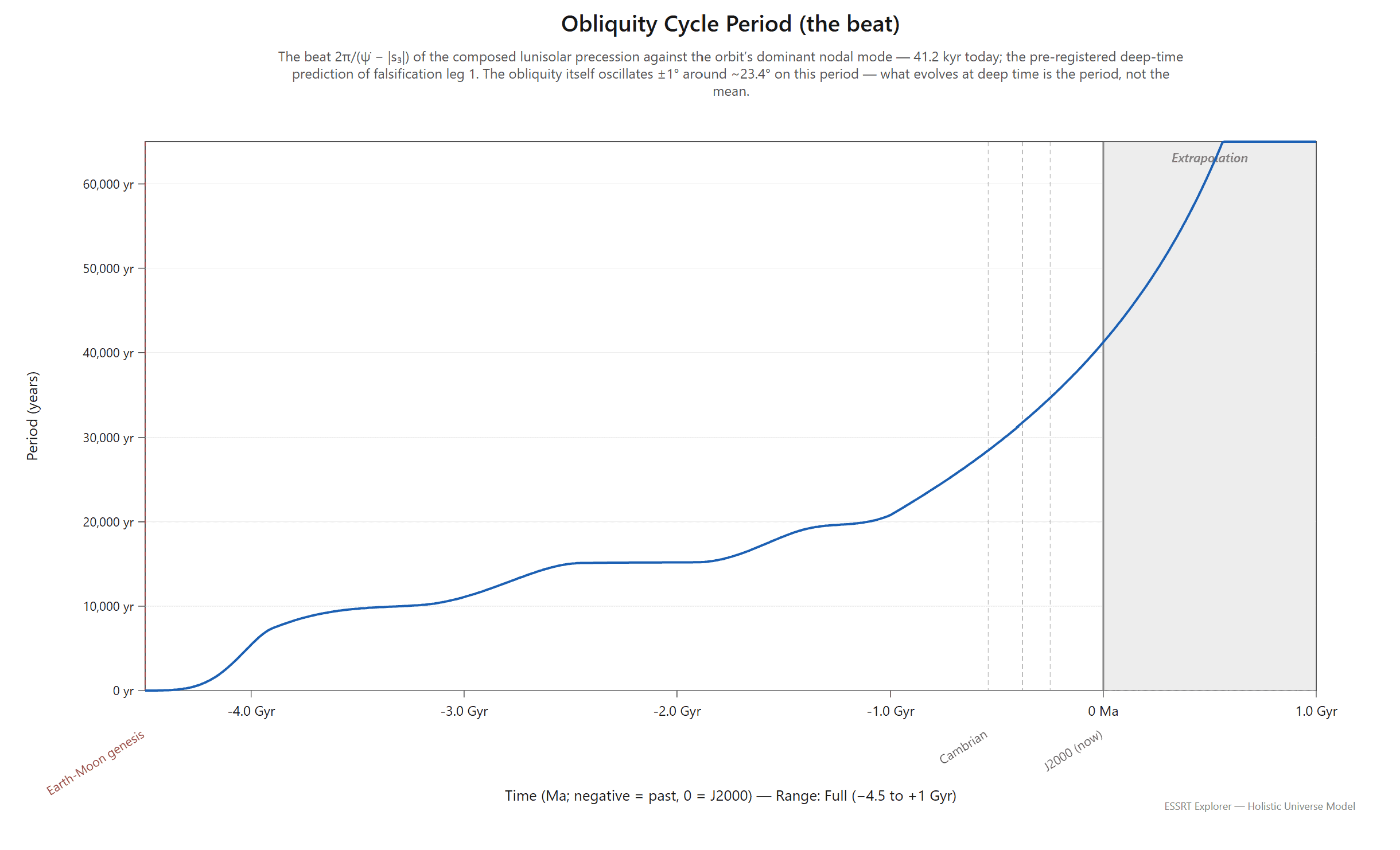
The curve is the beat 2π/(ψ̇(t) − |s₃|), with ψ̇(t) the composed lunisolar rate of the two-engine table and s₃ the orbit’s dominant nodal mode — the pre-registered deep-time prediction of falsification leg 1. It is degenerate today with the pure precession-scaling reading “obliquity period ∝ T_p” (41.1 vs 41.1 kyr) but roughly a factor two apart by 2.46 Ga (15.1 vs 19.8 kyr). See Prediction 5.
Why the orbit plane must enter
Standard astronomy attributes obliquity variation to a combination of axial precession and orbital-plane changes from planetary perturbations. The geometric reason why the orbit plane must independently contribute follows from a simple chain:
| Step | Reasoning |
|---|---|
| 1 | Obliquity = angle between Earth’s spin axis and the ecliptic normal |
| 2 | The ecliptic = Earth’s orbital plane (by definition) |
| 3 | Earth’s orbital plane oscillates relative to the invariable plane |
| 4 | When the orbital plane moves, the ecliptic reference moves with it |
| 5 | A moving reference plane changes the measured obliquity |
Even if Earth’s spin axis were perfectly fixed in space, the obliquity would still change — because the ecliptic itself is moving. The spherical cosine law makes it exact:
cos(i_ecl) = cos(i_inv) · cos(i_earth) + sin(i_inv) · sin(i_earth) · cos(ΔΩ)
so every angle measured relative to the ecliptic — including obliquity — depends on Earth’s invariable-plane inclination (i_earth). When i_earth changes, the ecliptic tilts and all ecliptic-referenced angles shift with it. This is geometry, not a model assumption (Plane Calibration for the full derivation).
Earth’s orbital inclination is that second motion. Earth’s orbital plane is tilted 1.57869° to the solar system’s invariable plane at J2000 (Souami & Souchay 2012). That inclination and the node where the orbit crosses the invariable plane change as the other planets perturb Earth’s orbit — a motion on the nodal modes, s₃ (~68,751 years) the largest. It is a separate quantity from the obliquity, and it is one of the two motions the obliquity depends on. The simulator’s Earth panel and its inclination path draw the engine’s own inclination history, read from the same N-body modes. Its Inclination of all planets panel draws that history against the La2010a numerical solution (Laskar et al. 2011) and the JPL Horizons elements over the shared window. For the invariable plane and the other planets’ relation to it, see Plane Calibration.
The obliquity band
The derived obliquity oscillates between about 22.08° and 24.45° around the present ~23.4393°, with the ~41,099-year beat as its dominant period — the standard Milankovitch band (~22.1° to ~24.5° in Laskar’s solution). Berger (1978) decomposed the obliquity into 47 Fourier terms; the dominant one sits at the frequency s₃ + k — the same beat of the precession rate against the nodal mode — with amplitude 0.684°, and the next term is only a third as strong (0.238°). The model produces that dominant beat natively: k is its composed precession rate, s₃ the leading nodal mode of Earth’s orbit read from its own N-body secular modes, and the period lands within 1 % of Berger’s 41,000 years with nothing fitted to it (Supporting Evidence §7).
The obliquity does not split into separate “axial” and “inclination” contributions of equal size: both motions enter the one precession equation, and the amplitude is whatever the integration gives. The simulator places Earth’s frame of date — its orbit plane, equinox and spin axis — from that derived state.
Comparison with standard solutions
The model’s obliquity values closely match the La2004 numerical solution (Laskar et al. 2004) and the Chapront et al. (2002) polynomial for thousands of years around the present. Both converge at J2000 (model: 23.4393°, La2004: 23.4393°). Over the last million years the model’s obliquity follows La2004 to arcseconds, oscillating within ~22.08° – ~24.45°; Chapront’s polynomial extrapolation diverges to unphysical values beyond ±10,000 years.
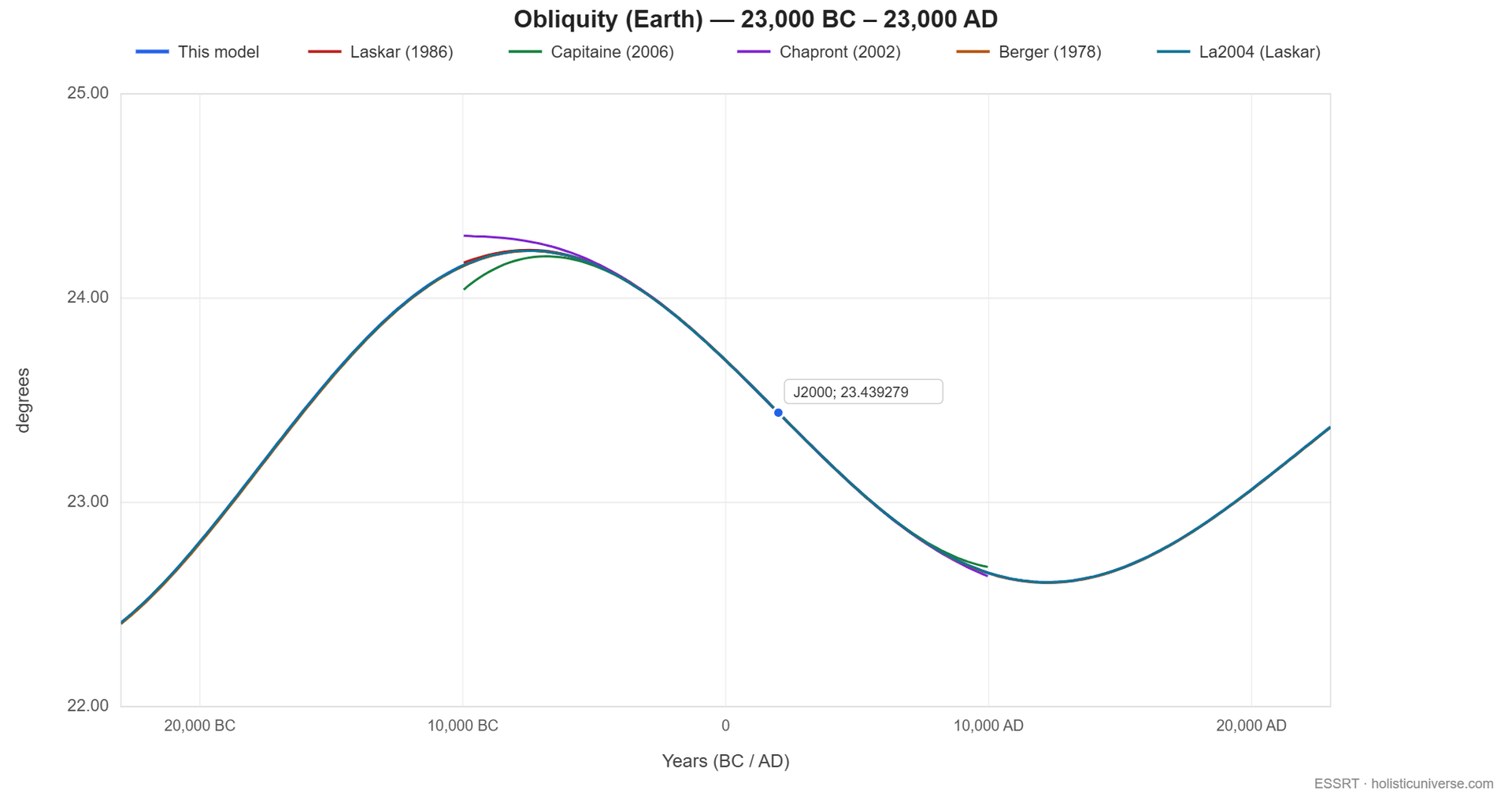
| Timeframe | Agreement |
|---|---|
| ±2,000 years | Exact match with Laskar / Chapront |
| Last 100,000 years | 1.3″ rms against La2004 |
| Last 1,000,000 years | 15.0″ rms against La2004 |
| Beyond ±10,000 years | Chapront’s polynomial diverges; La2004 and the model continue together |
Actual measurements only exist for a short timeframe around the present epoch. All values before ~1000 AD and after today are theoretical predictions — including those from Laskar and Chapront.
Derived from one equation
The obliquity story on this page can be derived rather than asserted. Integrating the single averaged precession equation — the spin axis precessing about the moving orbit normal, with the orbit normal taken from the model’s own N-body node modes (the same ±10-million-year run behind the deep-time metronome) and exactly one anchor, the model’s J2000 precession rate (derived from its own year laws) — reproduces the obliquity history with zero fitted constants:
| Quantity | Derived | Reference |
|---|---|---|
| Obliquity rate at J2000 | -48.00″/cy | IAU: -46.84″/cy |
| Precession constant α | 54.811″/yr | literature ~54.9″/yr |
| Dominant obliquity beat | 41.1 kyr | the observed ~41-kyr cycle |
| ε vs La2004, last 13 kyr | 50″ rms | the same integration on the 18-mode table: 530″ |
Two readings. First, the obliquity rate — a number the simulator’s scene machinery previously had to solve for — falls out of the node modes plus the precession anchor to a quarter-percent. Second, the ~41-kyr cycle emerges as the beat between the axial precession and the strongest nodal mode (s₃) — the model’s obliquity beat, produced natively by the dynamics. The full verdict is banked as a gate-guarded artifact in the simulation repo (Supporting Evidence §15); every number above reads live from it. The last row is this derivation’s own fit; the published obliquity, which adds the solar torque at the eccentricity of date and the ice-age oblateness, is the one compared above.
Climate connection
Earth’s climate variations are driven by the planets’ secular modes acting on Earth’s spin axis and orbital plane. The model’s climate formula carries them as 28 engine-derived lines: the beats of Earth’s precession clock with the nodal modes (the obliquity band, 27–54 kyr) and with the apsidal modes (the climatic-precession band, 19–24 kyr), plus the planetary eccentricity beats (95–135 kyr) with the 405-kyr metronome (Climate Formula).
Obliquity (~~41,099-year cycle) directly affects seasonal contrast. Higher tilt produces more extreme seasons, lower tilt milder. This is the standard Milankovitch obliquity mechanism, visible as the ~41-kyr cycle in climate records. In the model this cycle is the beat of the clock against the nodal mode s₃ — the dominant of the formula’s ten obliquity lines — and it rides the clock at deep time.
Earth’s apsidal motion does NOT directly drive climate. Earth’s ~111,635-year apsidal precession is a real geophysical cycle, but it is not a line of the shipped climate formula. The dominant ~100-kyr climate signal is a broad single peak (~80–125 kyr) carried by the planetary eccentricity beats — g₄−g₅ at 94.9 kyr, g₃−g₅ at 98.8 kyr, g₃−g₁ at 110.0 kyr among the formula’s ten eccentricity lines — whose periods are set by the planets’ masses and distances and do not follow Earth’s spin. Full empirical case in Climate Formula and the insolation null test.
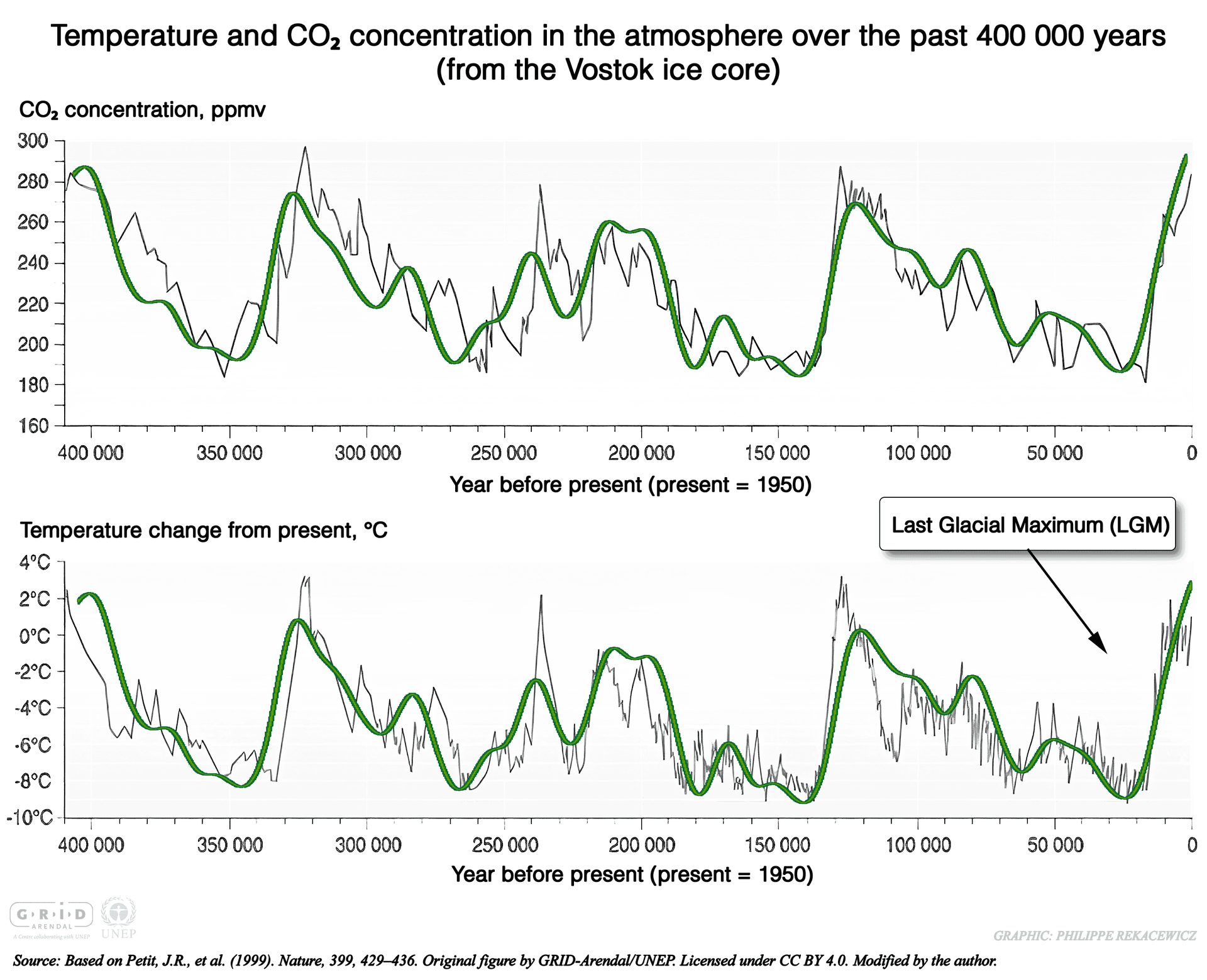
Vostok ice core (Petit et al. 1999) with Earth’s apsidal-period inclination cycle overlaid. The visual alignment at this 400-kyr window is striking but misleading: on the full LR04 record the 100-kyr signal is carried by the planetary eccentricity beats. The apsidal motion remains a real geophysical cycle, just not the climate driver.
The planets’ obliquity: the spin channel
A planet’s obliquity is set by its own spin precession beating against the invariant nodal s-modes — Saturn’s spin is locked to s₈, Jupiter sits near s₇ (Ward & Hamilton 2004; Saillenfest 2020–2022) — and the published long-term spin-axis integrations find no regular cycle for Jupiter and Saturn and a frozen axis for Uranus. The model reads the planets’ obliquity from the spin channel: each planet’s precession constant is derived from its own J₂, moment of inertia, spin rate and satellites on the model’s own orbit, and the spin is integrated on the planet’s own orbit-plane history from the IAU J2000 pole. No obliquity cycle is claimed for any planet — the channel publishes a band (the envelope over ±1 Myr around J2000) and the axial precession period at J2000. The planets’ inclination and node motions come from the same N-body chain (Moon & Planets).
| Planet | Axial precession period (J2000) | Pole precession rate | Obliquity at J2000 (derived) | Band ±1 Myr |
|---|---|---|---|---|
| Mercury | 287,214 yr (Cassini-locked to the node) | — | 0.034° | locked |
| Venus | 29,043 yr | 44.624 ″/yr | 177.362° | 177.23–178.52° |
| Mars | 170,532 yr | -7.600 ″/yr | 25.192° | 13.12–34.56° |
| Jupiter | 489,843 yr | -2.646 ″/yr | 3.120° | 2.59–3.93° |
| Saturn | 1,682,466 yr | -0.770 ″/yr | 26.731° | 26.39–28.53° |
| Uranus | 205,646,752 yr | 0.0063 ″/yr | 97.770° | 95.82–98.04° |
| Neptune | 105,623,757 yr | -0.0123 ″/yr | 27.848° | 26.47–28.02° |
Venus and Uranus are read on the angular-momentum axis (retrograde rotation), Neptune from its mean pole. Mars’s derived pole rate closes on the measured −7.606 ″/yr (Konopliv 2016) to -0.08%; Saturn’s lands 11.4% above the model’s own s₈ line at the gravity-constrained moment of inertia.
The spin channel derives a J2000 obliquity for every planet — the IAU pole measured against the chain’s J2000 orbit plane, in acute form — so each row below is a check: the derived angle against the independently published tilt. (The retired eccentricity-amplitude relation consumed these same values as its sin|ε| input; the values are live, that relation is not.)
| Planet | J2000 tilt (IAU) | Derived obliquity (acute) |
|---|---|---|
| Mercury | 0.03° | 0.03° |
| Venus | 2.64° | 2.64° |
| Earth | 23.44° | 23.41353° (the scene device’s mean) |
| Mars | 25.19° | 25.19° |
| Jupiter | 3.13° | 3.12° |
| Saturn | 26.73° | 26.73° |
| Uranus | 82.23° | 82.23° |
| Neptune | 28.32° | 27.85° (mean pole) |
Calculate obliquity at any year
To calculate obliquity values for any year, see the Formulas page.
Continue to Eccentricity to see how Earth’s orbital shape changes over time.