Eccentricity
Eccentricity is how far Earth’s orbit departs from a circle: the Sun sits off the orbit’s centre by that fraction of the orbit’s size, so Earth is nearer the Sun in early January than in early July. Today the orbit is nearly circular, e = 0.01671022, and it is slowly becoming more so. Two separate things change about the orbit over long times — how elliptical it is, and where the perihelion points — and they move on different clocks: the shape follows the planets’ secular modes, the direction follows the perihelion-of-date beat.
This page establishes:
- What the number means in kilometres and in sunlight — What eccentricity means in practice.
- Earth’s eccentricity in the model is its own N-body series on every path, with the 405-kyr metronome and its companions — The N-body series.
- The shape and the direction are two quantities on two periods, and the 1246 AD alignment is about the direction — Eccentricity values.
- The ~100-kyr glacial cycle is a planetary eigenmode-beat band, not direct eccentricity forcing — The 100-kyr question.
- The series against the secular solutions is theory against theory, and how it reaches the climate — Comparison with the secular solutions, Climate implications.
What eccentricity means in practice
The eccentricity value represents the offset distance between the centre of Earth’s orbit and the Sun, as a fraction of the semi-major axis (1 AU).
| Measurement | Value |
|---|---|
| 1 AU (mean Earth-Sun distance) | 149,597,870.698828 km |
| Eccentricity (J2000) | 0.01671022 (IAU/Standish mean element; the model’s N-body series reads the secular element 0.01670244) |
| Offset distance | 2,499,813 km |
| Perihelion distance | 147,098,057 km |
| Aphelion distance | 152,097,684 km |
| Difference | 4,999,627 km |
- At perihelion (closest, ~January 3): Earth is 147,098,057 km from the Sun.
- At aphelion (farthest, ~July 4): Earth is 152,097,684 km from the Sun.
- Earth receives about 6.9% more solar energy at perihelion than at aphelion.
The N-body series
Earth’s eccentricity in the model is its own N-body series — Earth’s eccentricity vector integrated, together with the seven other planets, from one cited J2000 state (the model’s orbital dynamics engine; N-body Exploration). One source feeds every path: the published value, the Sun’s equation of centre behind the eclipse and cardinal-point (seasons) instants, and the Moon’s eccentricity channel, which reads the same engine’s ±10-Myr mode table anchored at J2000 to the observed eccentricity and its rate. No lattice ingredient enters Earth’s orbit.
The series carries the ~95 and ~125-kyr beats of the planetary modes and the g₂ − g₅ metronome at 405.6 kyr (La2004: 405.7; the rock record: 405.6), with the 123.8- and 94.9-kyr companions present and correctly ranked (Supporting Evidence §14). The magnitude |e| and the perihelion direction ϖ are separate quantities:
| Quantity | Motion | Period |
|---|---|---|
| |e| — how elliptical | the planets’ secular modes (the N-body series) | the g₂ − g₅ beat, 405.6 kyr, with the ~95 and ~125-kyr companions |
| ϖ — where perihelion points | the perihelion-of-date beat | ~20,938 years |
The ~20,938-year cycle is the meeting frequency of two counter-rotating motions — the precession clock clockwise, the apsidal motion counter-clockwise, 1/T_peri = 1/T_p + 1/T_aps — and it governs where the perihelion points relative to the seasons. The beat moves the perihelion direction, not the orbit’s shape. Earth’s apsidal period today, about ~111,635 years, is a J2000 reading of the wandering apsidal motion, not a permanent rate (N-body Exploration). The eccentricity cycle is not the same as the perihelion period: the apsidal period says how fast the perihelion turns; the eccentricity cycle is the beat of the orbit’s two largest modes.
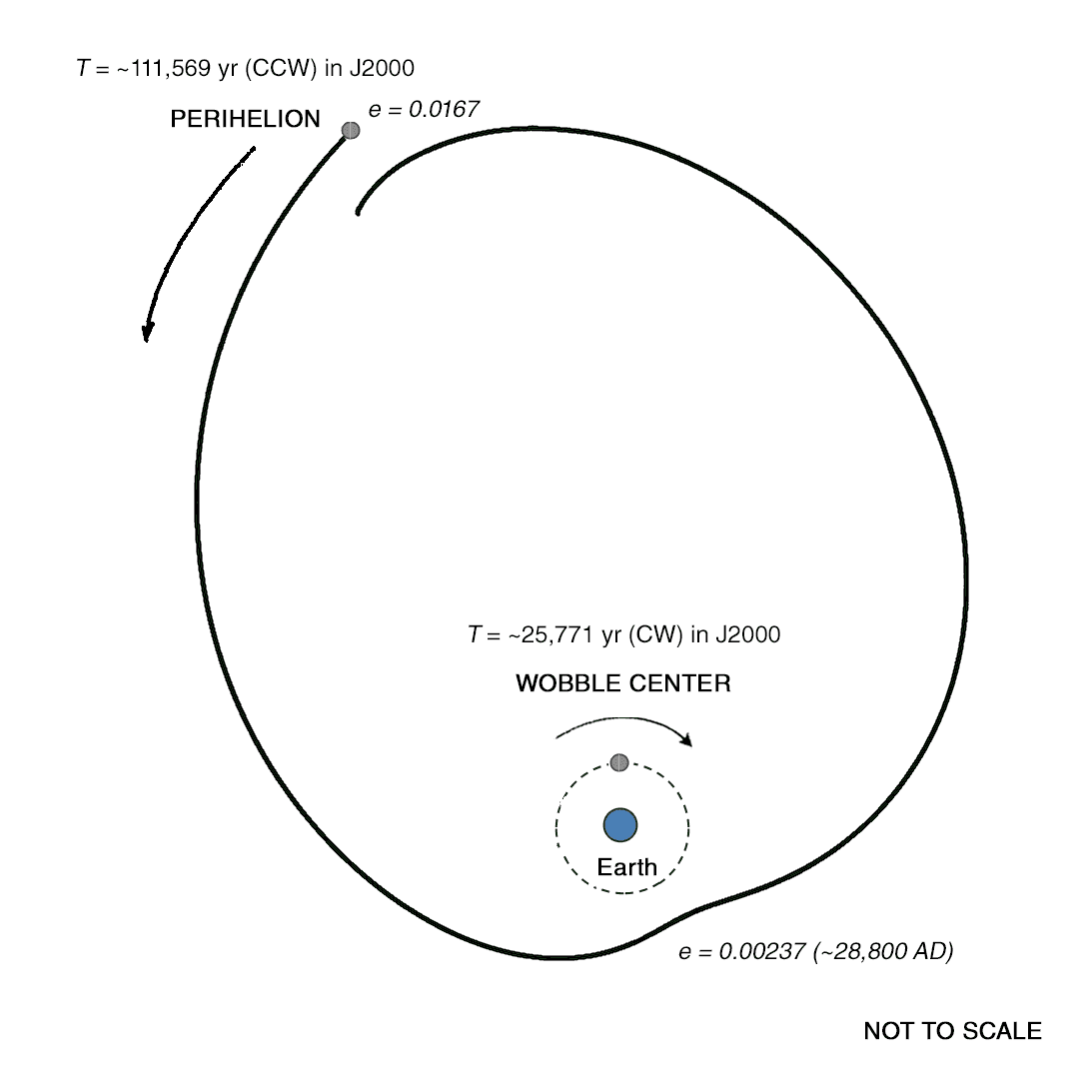
The wobble centre is a marker. Earth’s visible wobble-centre in the simulation circles Earth once per axial precession. It marks the precession direction and does not enter e(t).
Eccentricity values
| Parameter | Value | Notes |
|---|---|---|
| Current eccentricity (J2000) | 0.01671022 | IAU/Standish mean element (JPL Keplerian-elements table); the N-body series’ secular element is 0.01670244, 7.8e-6 lower — two conventions, labelled not reconciled |
| Rate at J2000 | −4.2037e-5 per century | observed (JPL/Meeus); the J2000 anchor of the deep-time channel’s slope |
| Long-eccentricity metronome | 405.6 kyr | the g₂ − g₅ beat of the model’s own modes; rock record 405.6 kyr |
| Companions | 123.8 and 94.9 kyr | present and correctly ranked |
| Leading modes | g₅ = 4.2574, g₂ = 7.4524 ″/yr | from the ±10-Myr run |
| Deep minimum | near 27,000 AD | 0.00265 vs La2004 0.00263 — La2004-class |
The 1246 AD alignment is about the perihelion direction. By the IAU mean elements (Meeus’s polynomial) the perihelion pointed at the December solstice in 1246; the model’s own series, whose secular element sits slightly below the mean element, puts the crossing at 1247.2 AD — two conventions, labelled. It will point at the June solstice half a perihelion-of-date cycle later. The 1246 alignment is a dated event of the perihelion direction; it is not an eccentricity extreme.
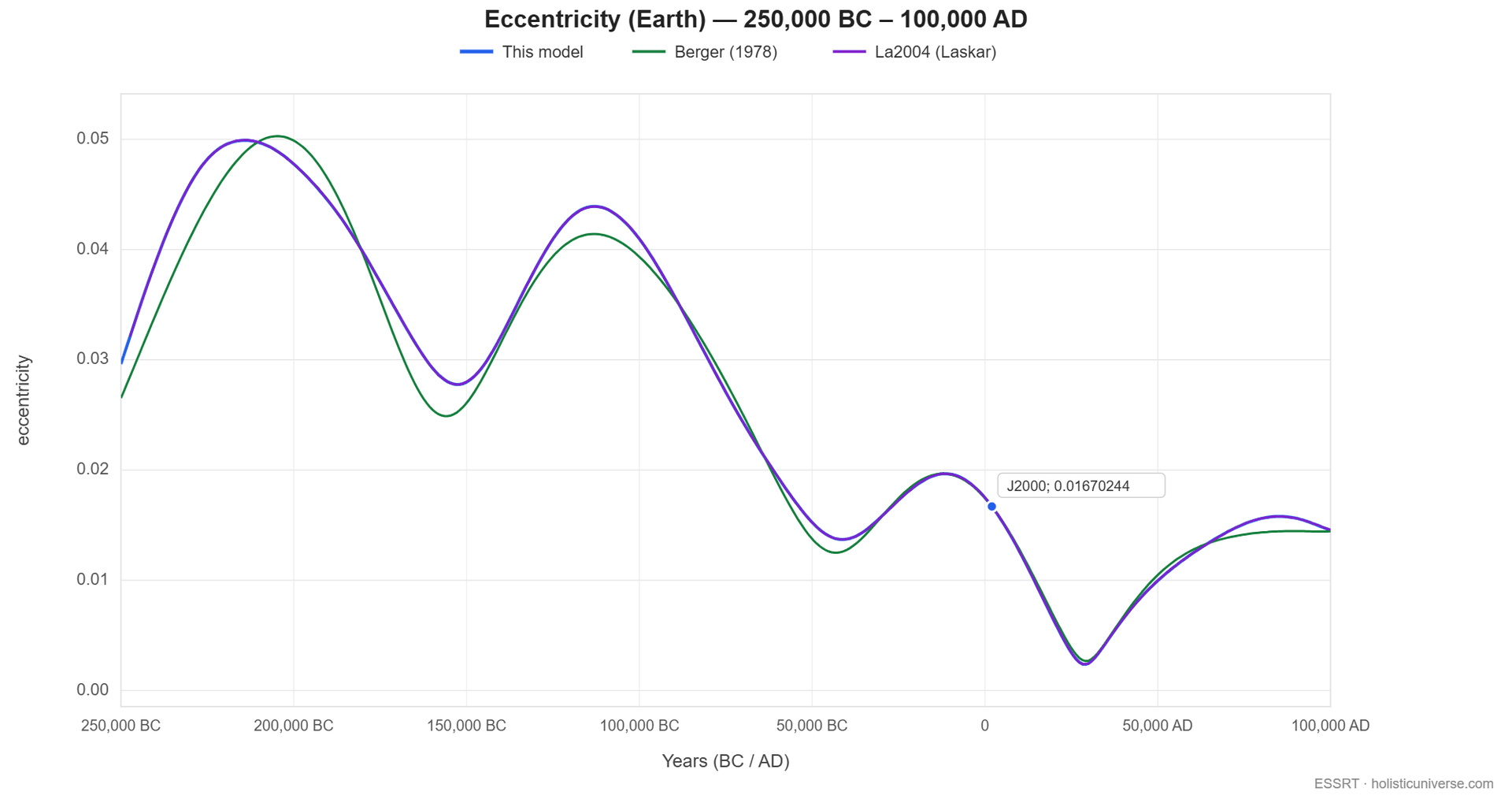
The model’s series (blue) against Berger (1978) and La2004 over −250,000 to +100,000 years — theory-vs-theory, three integrations of the same secular system.
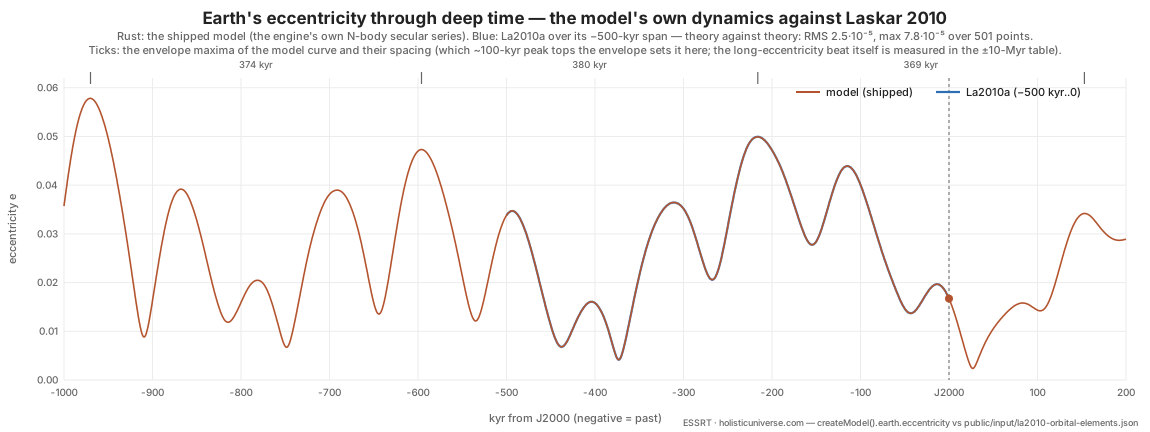
The last million years against the Laskar 2010a solution (theory against theory; La2010a covers the last 500,000 years). The ~100-kyr cycles ride inside the slow envelope whose beat is the metronome. Over the shared span the two curves coincide at the scale of the plot; the figure’s subtitle prints the measured difference.
The 100-kyr question
Conventional Milankovitch theory attributes the ~100-kyr glacial cycle to eccentricity’s ~95k and ~125k beats, with a ~400k-year cycle as the strongest term. The model’s own N-body series carries those same beats and the 405-kyr metronome; what the model disputes is the climate attribution, not the eccentricity spectrum. Five open questions in the conventional account:
| Question | Details |
|---|---|
| 1. The “~100k” simplification | Milankovitch’s calculations give ~95k and ~125k cycles. The commonly cited “~100k” is the combined quasi-periodic effect of these two components (and harmonics like ~99k from g₃−g₅), not a single physical cycle. |
| 2. The 100,000-year problem | Geological records show a dominant ~100k pattern but no clear ~400k periodicity — despite the ~400k eccentricity cycle being the strongest in theory. A recognised unsolved problem in paleoclimatology. |
| 3. The energy problem | Eccentricity changes affect total annual insolation by only ~0.2%. How this small signal drives major glacial cycles remains debated — most proposals invoke amplification mechanisms (ice-albedo feedback, CO₂ feedbacks). |
| 4. Modeled vs observed | The ~95k, ~125k, and ~405k cycles are derived from secular perturbation models — they are beat frequencies between planet-pair eigenmodes (95k = g₄−g₅; 125k = g₄−g₂; 405k = g₂−g₅), not directly measured in the geological record. The Mars/Venus/Jupiter labels on g_j are Berger’s convention; the model accepts the eigenmodes as math objects but does not endorse the single-planet attribution (see N-body Exploration). |
| 5. Earth’s own apsidal period | Earth’s perihelion advances against the stars once per ~111,635 years, its orbit plane turns on the invariable plane once per ~68,751 years. Neither is a line of the model’s climate formula: the 100-kyr band is carried by the planets’ beats, not by Earth’s own motions. |
The 100-kyr cycle in ice cores is a planetary eigenmode-beat signal, not direct eccentricity forcing. The shipped climate formula carries the band as the planets’ eccentricity beats — g₄−g₅ at 94.9 kyr, g₃−g₅ at 98.8 kyr, g₃−g₁ at 110.0 kyr among its ten eccentricity lines — read from the model’s own N-body secular modes. The 405-kyr g₂−g₅ term is essentially absent in post-MPT LR04 (amplitude ratio 0.12); bispectral analysis finds no significant 95k+125k phase coupling. Earth’s own apsidal precession (~111,635 yr) is a real cycle but is not a line of the formula and does not directly drive climate. Full empirical case: Climate Formula.
Comparison with the secular solutions
The model’s series and the La2004 solution are two integrations of the same secular system, so their agreement is a consistency check (theory-vs-theory), not a model-vs-standard discriminator:
| Year | La2004 | The model’s series |
|---|---|---|
| 3,000 AD | 0.01628 | 0.01627 |
| 5,000 AD | 0.01534 | 0.01533 |
| 10,000 AD | 0.01258 | 0.01261 |
| 15,000 AD | 0.00948 | 0.00951 |
| 27,000 AD | 0.00263 (Laskar’s minimum region) | 0.00265 |
Both decline together through the coming minimum near 27,000 AD. The engine’s Venus-driven mode g₂ reads 7.4524″/yr against La2004’s 7.452″/yr, and its long-eccentricity beat 405.6 kyr against the rock metronome’s 405.6 kyr. The Moon’s quadrupole term in the integration is what places g₂ there: a run with the Earth–Moon pair merged into a single point mass reads the mode low and the beat long. See Climate Formula: eccentricity attribution headwinds for the discriminating empirical tests on the climate attribution (405-kyr absence, bispectrum, band shape).
Both the model’s series and the standard secular solutions for ancient or future eccentricity are theoretical. Neither can be directly verified for times before ~1900 AD; the one measured referee at deep time is the rock record’s long-eccentricity metronome.
Climate implications
Eccentricity affects Earth’s climate through two mechanisms:
Total annual energy. Higher eccentricity gives Earth slightly more total annual solar energy. Orbit-averaged flux scales as 1/√(1−e²); perihelion’s intense, close-range flux more than compensates for the longer time spent near aphelion. Over the secular range of the solutions (about 0.0005 to 0.058) that factor moves by only ~0.17 % — too small alone to cause ice ages.
Seasonal contrast. The more important effect is when perihelion occurs relative to seasons:
| Perihelion timing | Northern Hemisphere effect |
|---|---|
| January (current) | Milder winters, cooler summers |
| June (half a perihelion-of-date cycle after the 1246 alignment) | Hotter summers, colder winters |
Eccentricity cycles for other planets
Each planet’s eccentricity cycle is the beat of its own secular modes: the dominant mode of its eccentricity vector against the largest companion, read from the model’s own N-body mode table (the simulator’s “Eccentricity Cycle (g-mode beat)” row). The planets’ elements come from the N-body chain — Moon & Planets.
| Planet | Eccentricity cycle (g-mode beat) |
|---|---|
| Mercury | 593,093 yr |
| Venus | 432,396 yr |
| Earth | the g₂ − g₅ beat, 405.6 kyr (the long-eccentricity metronome) |
| Mars | 94,981 yr |
| Jupiter | 54,025 yr |
| Saturn | 54,025 yr |
| Uranus | 900,623 yr |
| Neptune | 487,844 yr |
Calculate eccentricity at any year
The series has no closed form; the published API and the MCP server serve it per epoch, and the simulator’s Earth panel and Framework Verification charts read the same source. In the @essrt/physics package it is createModel(undefined, { secularSeriesArtifact }).earth.eccentricity(year), with the series artifact (data/nbody-secular-series.json in the public repository) passed in; without the artifact the package evaluates its compact mode table instead, which follows the series only approximately. See Formulas for the model’s closed-form laws.
Continue to Days & Years to learn how these cycles affect the length of our days and years.