Predictions
The model makes nine predictions, each naming the observation that would falsify it, grouped by timeline. Validated retrodictions (the Earth-Moon genesis at the Roche limit, the Devonian day count, the Cheng cross-proxy fit) are catalogued in Supporting Evidence; resolved questions (Mercury’s anomaly → General Relativity, the Jupiter/Saturn window trends) live on their subject pages — Mercury Precession and Supporting Evidence §12 — and earlier versions of this page remain available in the project’s git history.
All predictions are measured from the 3D model. Every value on this page is read directly from the 3D Simulation using objective measurement functions — not derived from theoretical assumptions. See Analysis & Export Tools for how measurements are taken.
Observatory-era predictions (decades to centuries)
1. RA at maximum declination will shift from 6h
Coordinate-system note: in standard precessing equatorial coordinates the June solstice is at RA 6h by definition. This prediction refers to the Sun’s position in a fixed reference frame (ICRF) at maximum declination.
The Sun’s ICRF position at June solstice oscillates about a mean of 5h47m22s with amplitude ±3.20° (±12.8 min), a compound signature from two co-equal H-lattice cycles. It has sat near the top of that range throughout recorded history, reaching its maximum of 6h00m04s in 1675 AD — and it is only now beginning to decline, at ~5.5″/century.
The turnover is extremely flat: 6h00m03.1s at 1246.03125 AD, 6h00m04.0s at the 1675 peak, 6h00m03.4s at J2000 — about one second of RA across 750 years. The 1246.03125 AD perihelion–solstice alignment is the anchor epoch for H, not a feature of this curve: it sits at 99.0 % of maximum swing, indistinguishable from the peak at this resolution.
| Property | Value |
|---|---|
| Maximum reached | 1675 AD at 6h00m04s |
| Value at 1246.03125 AD | 6h00m03.1s (99.0 % of max swing) |
| Current rate (2000→2100) | −5.5″/century |
| Oscillation amplitude | ±3.20° (±12.8 min RA) |
| Component 1 (inclination frame shift) | ~111,772 years (H/3) |
| Component 2 (obliquity) | ~41,915 years (H/8) |
| Period ratio | 8:3 (H/3 : H/8) |
| Component amplitudes | equal, A/sin(ε̄) ≈ 1.60° each (A = 0.63607°) |
| Mean RA at max declination (fixed frame) | 5h47m22s / 17h47m22s |
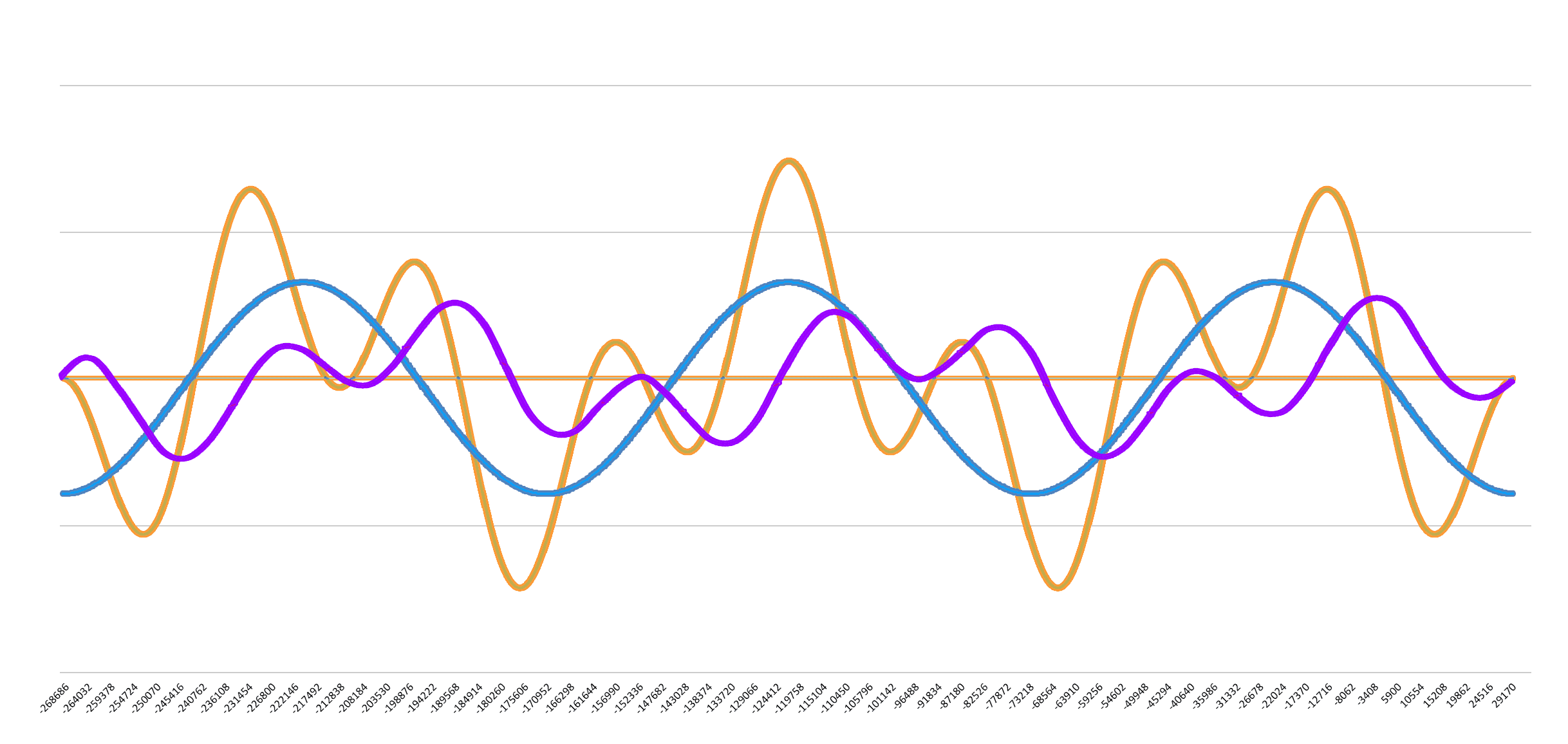
Falsifiable signature — two co-equal spectral peaks, not one. The prediction combines two co-equal H-lattice mechanisms with matched amplitudes:
- H/3 inclination-frame shift (co-equal, ~96 arcmin peak): Earth’s orbital-plane inclination in ICRF oscillates ±0.63607° at the H/3 = ~111,772-yr period. This tilts the ecliptic frame relative to ICRF, shifting the RA at which the max-declination event occurs. Contribution
A/sin(ε̄) ≈ 1.60°. - H/8 obliquity variation (co-equal, ~96 arcmin peak): Earth’s axial tilt oscillates over the H/8 = ~41,915-yr obliquity cycle with the same 0.63607° driver (the shared amplitude appears in the two-component obliquity formula
ε(t) = ε̄ − A·cos(2π·t/(H/3)) + A·cos(2π·t/(H/8))— see Obliquity & Inclination), contributing an equalA/sin(ε̄) ≈ 1.60°term with opposite sign. The two terms superpose as−sin(2π·t/(H/3)) + sin(2π·t/(H/8))to give an exactly H-periodic composite signal with inner beat envelope at H/5 = ~67,063 yr, reaching ±12.5-min RA peak swing. (The H/16 Equation-of-Center term and the secondary mechanisms contribute only sub-arcmin residuals — detail at Supporting Evidence §7.)
Typing note (the restatement): the H/8 component rides the spin family; the H/3 component is Earth’s inclination/perihelion motion — an epoch-local law (exact through the validated historical era, the H/3 line’s tangent beyond it). The claim tested here — the current decline and its two-component decomposition against historical and future solstice records — lives inside that era; the full-cycle periodicity is the lattice’s chart of the motion, not a multi-hundred-kyr forecast.
Traditional obliquity-only estimates (Laskar et al. 1993 ) predict a single spectral peak at the obliquity period. The Holistic model’s dual mechanism predicts two co-equal peaks in an 8:3 ratio at the H/3 (~111,772 yr) and H/8 (~41,915 yr) periods — with the H/16 EoC peak reduced to a sub-arcsec residual by the max-declination event definition. Testable via long-baseline VLBI or historical solstice records; current shift rate is ~5.5″/century, within modern astrometric precision but demanding a long baseline. Empirical validation: least-squares fit against model-computed SS events sampled at 1-year cadence across one full Earth Fundamental Cycle gives RMSE 2.1 arcmin for the two-term basis (verified via computeSolsticeRA in the reference implementation). Canonical derivation: Supporting Evidence §7.
2. No major Planet Nine (key differentiator)
The Batygin–Brown hypothesis posits an undiscovered 4–10 M_Earth planet at 290–700 AU shepherding extreme TNOs. A two-tier test against the model rejects all proposed candidates: (primary) Law-4 compliance — the observed eccentricity must match e_amp = K · sin(tilt) · √d / (√m · a^(3/2)); all proposed candidates fail by 4–7 orders of magnitude. (secondary) v-balance — adding a 9th body crashes the canonical closure for any mass above ~10⁻⁴ M_Earth. Combined threshold for compatibility at high-e ETNO orbits: ~2 × 10⁻¹⁰ M_Earth (~2-km rocky asteroid).
| Candidate | Mass (M_E) | Distance (AU) | Best 9-planet balance | Verdict |
|---|---|---|---|---|
| Batygin & Brown 2016 | 10.0 | 700 | 1.25% | REJECT |
| Brown & Batygin 2021 | 6.2 | 380 | 10.07% | REJECT |
| Siraj et al. 2025 | 4.4 | 290 | 13.19% | REJECT |
| Pluto-mass test | 0.0022 | 460 | 94.71% | MARGINAL |
| Ceres-mass test | 0.00016 | 460 | 99.99% | ACCEPT (v-balance only) |
Under the primary Law-4 test, even the Ceres-mass candidate fails (its eccentricity 0.25 is 4,270× larger than the maximum Law-4 amplitude). Verdict: no candidate at proposed parameters is framework-compatible.
Near-term test — Vera Rubin Observatory (LSST 2025–2035):
| LSST outcome | Model prediction | Conventional Batygin/Brown |
|---|---|---|
| M ≥ 1 M_Earth at 300–700 AU, e ≈ 0.2–0.6 | FALSIFIED | confirmed |
| Ceres-mass body at 300–500 AU, high e | FALSIFIED | weakened |
| Tiny body (≲ 2 × 10⁻¹⁰ M_Earth) at similar orbit | consistent | n/a |
| No detection above ~10⁻¹⁰ M_Earth by 2035 | consistent | FALSIFIED |
| ETNO clustering disappears with more discoveries | consistent | FALSIFIED |
A single detection of any ≳ Ceres-mass body in a high-e Batygin–Brown-style orbit falsifies the model. The conventional hypothesis can be re-parameterised to fit nearly any detection — making it harder to falsify cleanly. In Popper’s terms, the model’s prediction is more vulnerable and therefore stronger. Status note (the restatement): Law 4 and the balance are open empirical relations of the J2000 configuration — never validated against long-term dynamics — and this prediction, with Prediction 3, is their direct observational test: LSST tests the relations themselves, not a consequence of something already proven. Full search, ETNO data, and alternative explanations: Planet Nine.
3. Small classical-belt KBO obliquity clustering (Law 4 bidirectional)
Law 4 is bidirectional. Solving the closure for sin(tilt) gives an obliquity prediction from a body’s mass, semi-major axis, eccentricity amplitude, and Fibonacci d-slot:
sin(tilt) = e_amp · √m · a^(3/2) / (K · √d)
For the 8 IAU planets this closes to <1%. For a representative ~124-km classical-belt KBO (mass ~10⁻¹² M☉ at ρ ≈ 2 g/cm³) at a ≈ 45 AU, e ≈ 0.05, Law 4 predicts axial obliquity ≈ 36.6° at d = 55 (a 100-km body at the same density gives ≈ 26°). The population-statistical claim: small cold-classical-belt KBOs (the regime where external forcing on e_amp is weakest) should cluster near this prediction, rather than show the uniform-random ~57° mean expected from Lambert’s law on a sphere.
| LSST outcome (~10³ small-TNO rotation-pole measurements by 2030–2035) | Verdict |
|---|---|
| Small classical-belt KBO obliquities cluster near ~30°–50° | Bidirectional Law 4 confirmed beyond the 8 planets |
| Obliquity distribution is uniform-random (~57° mean) | Bidirectional reading restricted to the 8-planet domain |
The ~30% gap between the model prediction (~36.6°) and the random expectation (~57°) is resolvable with ~10² obliquity measurements at ±10° precision.
Scope caveat: no individually named TNO is per-body testable — every catalogued/named TNO (Pluto, Eris, Haumea, Makemake, Quaoar, Sedna, …) is too large at its observed eccentricity to be Law-4-admissible. Comets and main-belt asteroids fail too (Jupiter scattering, outgassing, Yarkovsky/YORP). The framework’s positive predictive zone is the sub-200 km low-e cold-classical-belt population (10⁴–10⁵ bodies enumerated by Col-OSSOS), tested statistically across many rotation-pole measurements.
Law-4 closure ≡ “cleared the neighborhood”: the framework’s planet/non-planet partition coincides with the IAU’s 2006 third criterion. Soter (2006) proposed a mass-discriminant Λ but it never became canonical; Law-4 closure provides a different quantitative formalisation that returns a clean pass/fail and matches the same 8-body partition. Agreement is not tautological: Planet Nine candidates fail Law-4 closure by 4–7 orders of magnitude (Prediction 2), and the small-KBO obliquity-clustering signature here is the second non-circular extension.
Medium- and long-term predictions (centuries to millennia)
4. The elements turn where standard polynomials keep going
Every orbital element the model bounds reverses — reaches a minimum (or maximum) and comes back — where the standard polynomial extrapolations continue monotonically past their fit windows. One claim, one table:
| Quantity | Standard extrapolation | The model’s turn |
|---|---|---|
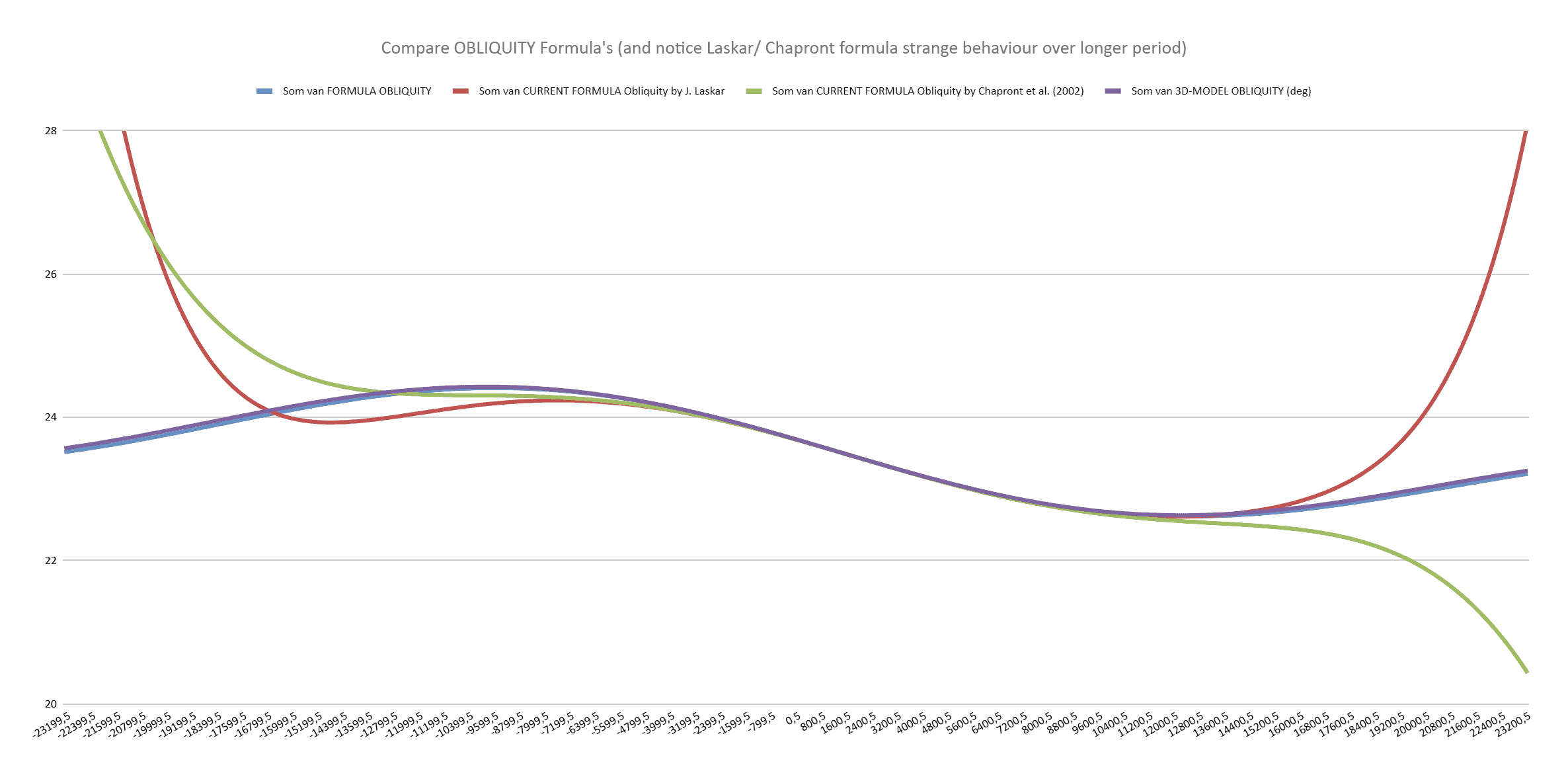
| Obliquity | decreases past ~13,900 AD (Chapront/Laskar polynomials) | minimum ~22.51° at ~13,664 AD, then rises on the ~41,915-yr cycle; long-term envelope ~22.21° – ~24.72° |
| Longitude of perihelion | Meeus polynomial diverges after ~3000 AD | completes 360° in a mean period of ~20,957 yr |
| Axial precession period | Capitaine polynomial: monotonic decrease | minimum ~25,312 yr at ~12,443 AD, rise to ~26,051 yr at ~32,357 AD |
| Solar year in days | Laskar: decreases until ~10,900 AD then reverses | decreases secularly under Driver 1 (LOD growth) — no near-term reversal |
(Two rows this table once carried — Earth’s eccentricity and inclination minima from the H/3 line at ~25,000 AD — are removed under the restatement: H/3 is an epoch-local law, and at that range the model’s own N-body engine is the referee, forecasting a deeper eccentricity pass in agreement with the standard integrations. The H/3 and H/16 laws’ genuine content — exactness through the entire observation window — is banked in Supporting Evidence.)
The model agrees with the standard curves throughout the fitted windows (obliquity through ~13,700 AD, perihelion through ~3000 AD); the discriminator is always what happens next. Two visible consequences ride along: the Gregorian calendar drifts against the real solar year (June solstice on June 17 by 6486 AD; by ~11,725 AD perihelion sits at the June solstice), and the analemma changes shape — width with eccentricity, length with obliquity (22.21°–24.72°).
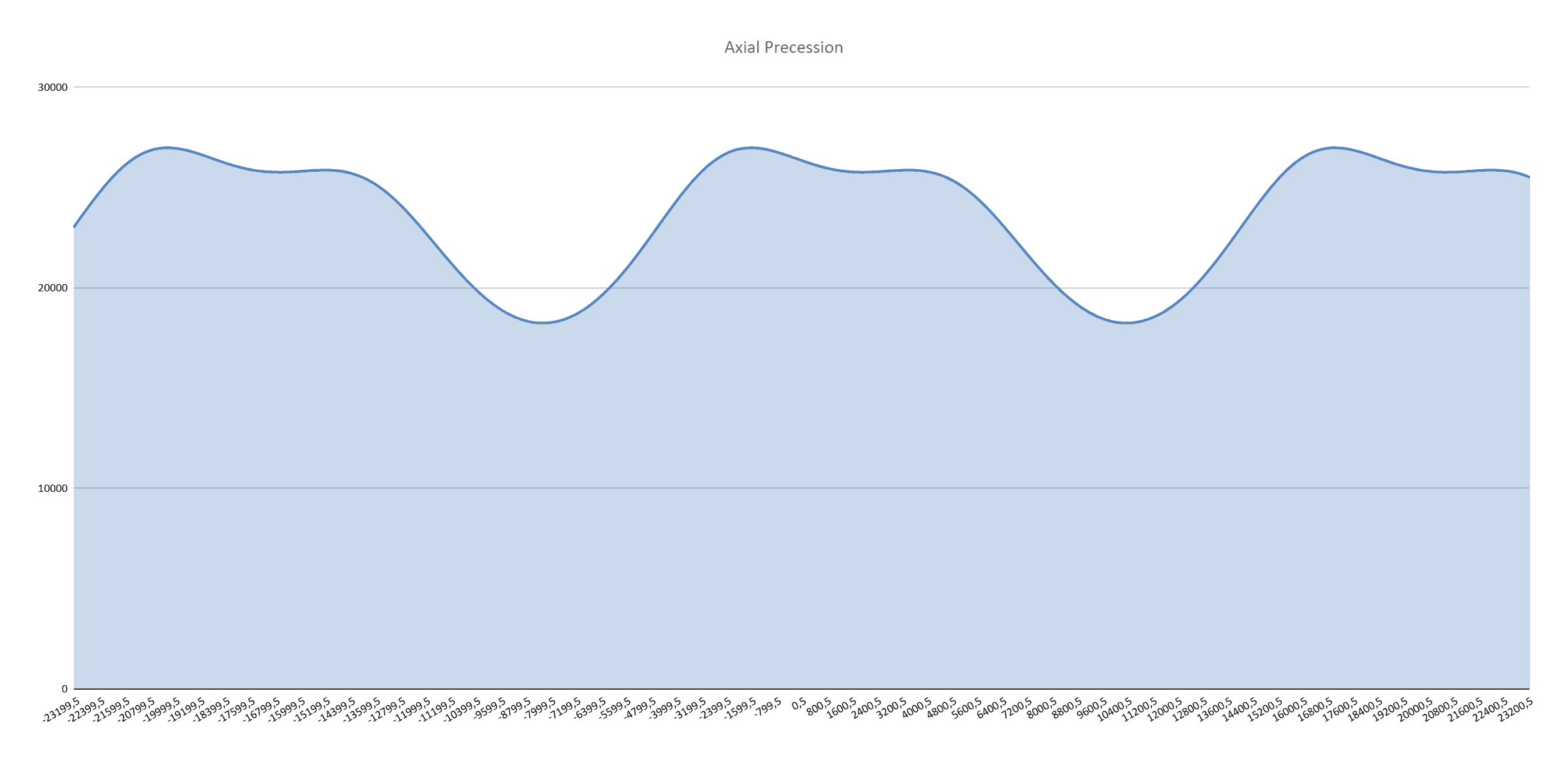
At geological timescales the means themselves drift with H(t) — the axial-precession period was ~23,553 yr at the Devonian and rises to ~27,123 yr at +200 Myr (~6 yr per Myr today, in principle observable in high-precision IAU precession-rate series over decades). Framework: Expanding Resonance.
5. Earth rotation / LOD / Delta-T
Standard theory: Earth’s rotation is monotonically slowing due to tidal friction. The empirical Stephenson polynomial encodes a Munk-MacDonald-scale (~5-6 ms/cy) non-tidal Earth-rotation speedup component on top, attributing the apparent gap to glacial isostatic adjustment + core-mantle coupling. The model predicts LOD monotonically increases under Driver 1 (Earth-Moon tidal recession) at a modern rate of ~1.7 ms/century, with a ~250 ms peak-to-peak Milankovitch oscillation superimposed from the refined α(t) coupling to the Climate Formula’s L1 orbital layer (see below). Short-term fluctuations (like the 2020–present speedup) sit on top of this trend. Both sidereal day and stellar day follow the same tidal-recession + Milankovitch pattern.
Two timescales coexist. At geological timescales (Myr+) the model agrees with standard tidal evolution — LOD monotonically increases per ESSRT Driver 1 (Earth-Moon tidal evolution), the same mechanism standard theory invokes. See Expanding Resonance for the deep-time layer. On top of that monotonic tidal drift, the refined α(t) coupling to the Climate Formula’s L1 orbital layer adds a ~250 ms peak-to-peak Milankovitch oscillation at ~100 kyr timescales — visible as wiggles on the tidal trend, matching known glacial-interglacial cycles. Standard theory’s polynomial extrapolation doesn’t model this Milankovitch oscillation; the model adds it as a specific physical prediction. The disagreement is therefore about the superimposed climate-cycle structure — not about the monotonic deep-time trend.
The model’s ΔT formula has been empirically confirmed against the historical record on two independent eclipse tracks, with a third, weaker comparison against a paleoclimate proxy: (a) a 26-event eclipse alignment audit on documented solar eclipses spanning -762 BCE to 2026 CE (20/26 events with framework umbra reaching the observation site within the ±4-hour scan window; 6/26 pure geographic misses); (b) the higher-resolution lunar timing test on 267 primary-source observations (20.2-min mean |residual|, matching NASA within 14 s and beating NASA on 118/267 events); and (c) an out-of-sample comparison against the Bond 2001 IRD drift-ice record at Pearson r = +0.37 in the 4,000 BC – 1,800 AD window — an open correspondence that fails its null tests, and which the two eclipse tracks do not depend on. The full Munk-MacDonald postulate (~5-6 ms/cy) is rejected by the historical record; a dominant GIA-scale channel (dLOD/dt = -0.35 ms/cy at J2000, Cox & Chao 2002 satellite anchor with Peltier ICE-6G factor-2.0) is included via the L1-orbital-coupled α(t) correction, and a smaller fractional non-tidal secular rate (~0.5 ms/cy) is detected in the residual but not currently modelled — see Lunar Eclipse Validation §1 for the quantitative statement and §6 for the three-component decomposition of the medieval residual. Canonical: Timekeeping; empirical validation: Solar Eclipse Validation and Lunar Eclipse Validation.
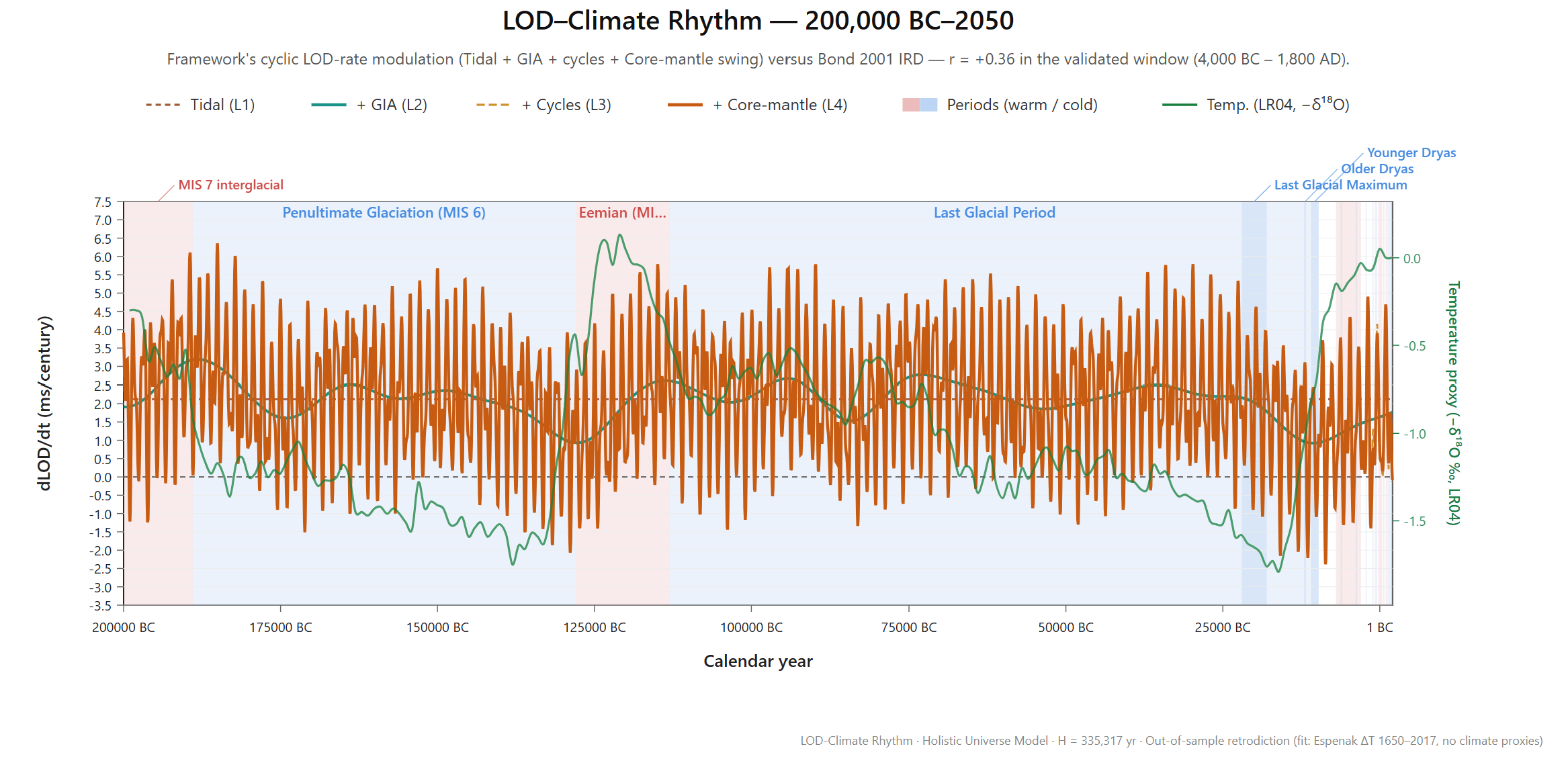
LOD is coupled to the same orbital forcing that drives climate. The L1-orbital-coupled α(t) correction above uses the same L1 orbital layer that fits the LR04 δ¹⁸O record in the Climate Formula — one mechanism, two observables. Ice sheets grow and retreat under Milankovitch orbital forcing on ~100 kyr timescales; that ice-mass redistribution modulates Earth’s polar moment α on the same timescale; and α modulates LOD. The model predicts that length-of-day carries a ~250 ms peak-to-peak Milankovitch oscillation in phase with the glacial cycle, superimposed on the smooth tidal-recession trend. LOD peaks (α max) fall at glacial extrema — MIS 6 (~140 ka BP), MIS 2 / LGM (~22 ka BP), and the projected next-glacial (~60,500 AD, matching Prediction 6) — and LOD troughs (α min) fall at interglacial extrema — MIS 7e (~215 ka BP), MIS 5e Eemian (~125 ka BP), and today’s Holocene. The underlying “ice → J₂ → α → LOD” mechanism is confirmed on decadal timescales by Cheng, Tapley & Ries 2011 (LAGEOS satellite J₂ shifting from linear GIA-driven decrease to acceleration around 1998, attributed to polar ice-mass loss). The 100-kyr extrapolation follows from the same physics but is not yet directly observable — modern satellite records span only ~50 years. The unifying claim: planetary gravity, climate, and Earth’s rotation are one system, connected by ice mass as the mediator. Predictions 5 and 6 are the same physical mechanism viewed through two observables (LOD vs δ¹⁸O). See Lunar Eclipse Validation §4 for the derivation.
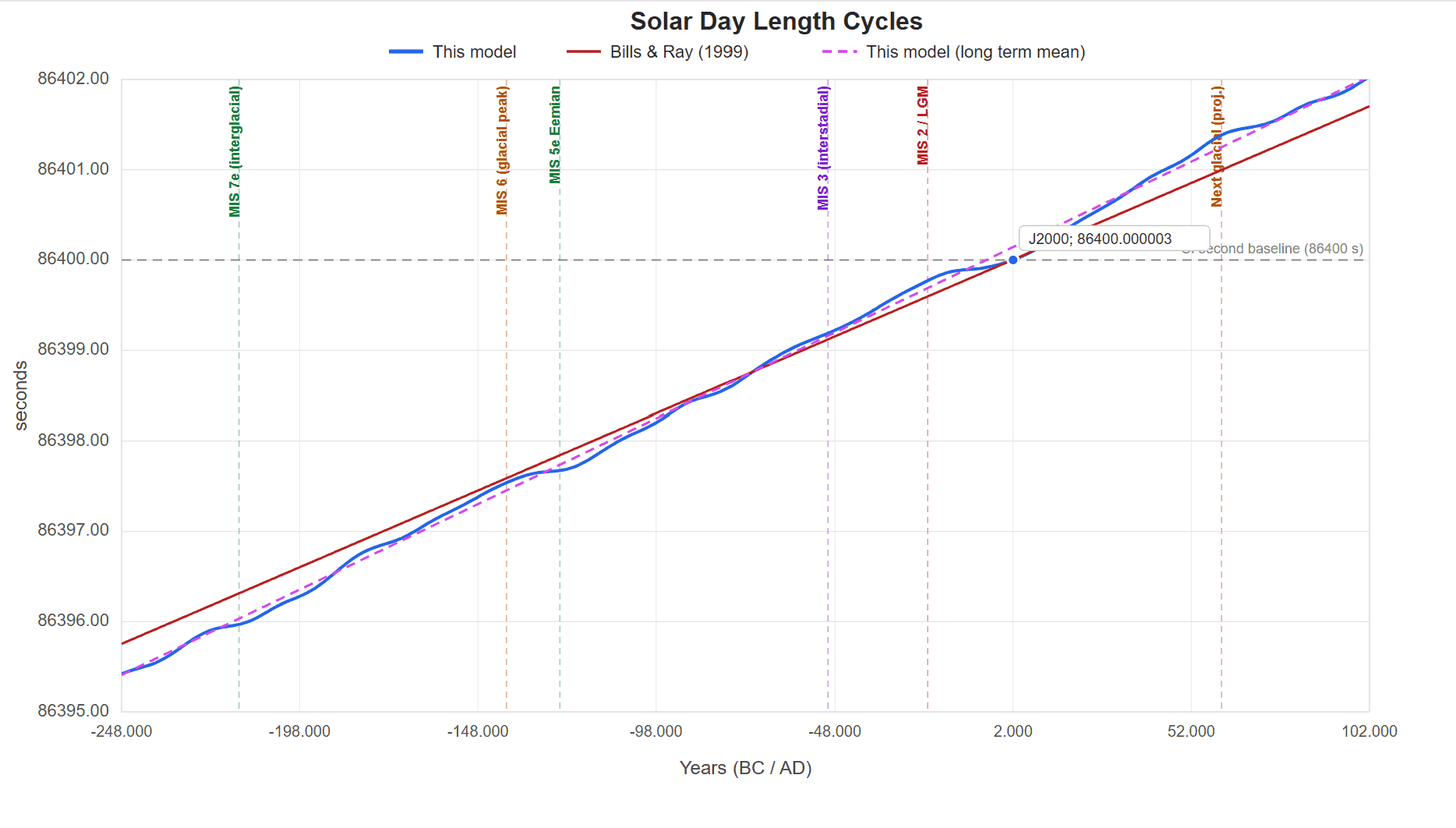
The same coupling in the rate domain: over the last two glacial cycles the Tidal + GIA baseline rides above the tidal line through ice-sheet growth and dips sharply at the two deglaciations — with the LR04 record itself (inverted δ¹⁸O, the very dataset the L1 layer is fitted against) overlaid for direct comparison. The deepest negative-rate excursions land at Termination II (→ Eemian) and Termination I (→ Holocene).
Climate prediction
6. Next natural glaciation peak at ~60,500 AD
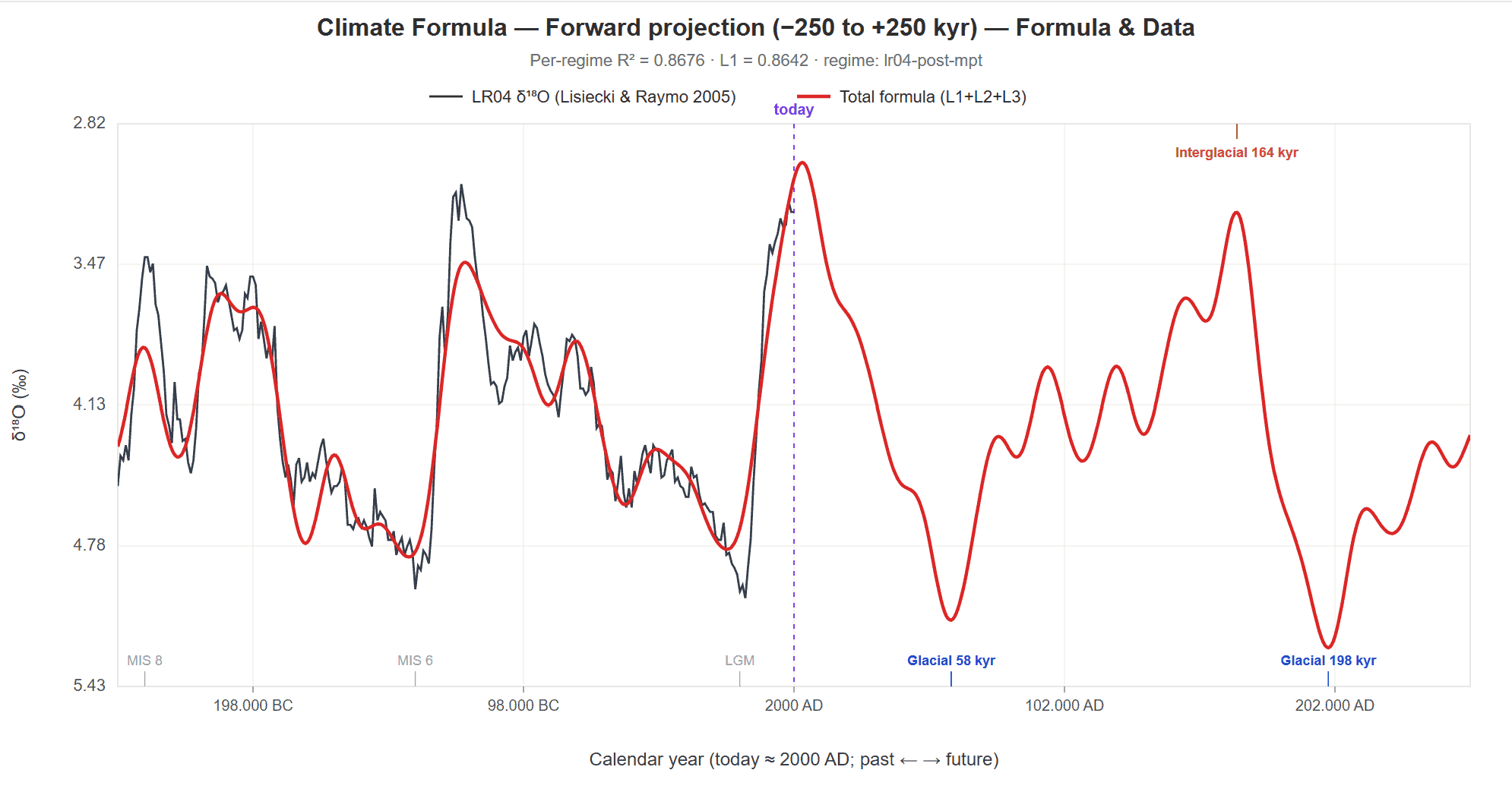
The canonical 3-layer Climate Formula extrapolated forward from t ≈ 2000 AD identifies the next predicted glacial maxima and interglacial peaks:
| Years from now | AD date | C(t) normalized | Note |
|---|---|---|---|
| ~58,500 | ~60,500 AD | +2.27 | Next natural glaciation onset |
| ~106,000 | ~108,000 AD | +0.24 | mild |
| ~153,000 | ~155,000 AD | −0.99 | (local max, interglacial-range) |
| ~164,000 | ~166,000 AD | −2.31 | Warmest interglacial in window |
| ~196,500 | ~198,500 AD | +2.48 | Strongest glaciation in next 250 kyr |
The signal C(t) is the normalised δ¹⁸O proxy from the post-MPT regime fit (negative = warmer/interglacial; positive = colder/glacial). The Holocene is correctly identified as interglacial; MIS 6 is placed within ~2 kyr; the LGM is predicted within ~9 kyr (the expected ice-sheet response lag).
Comparison with established forecasts:
| Framework | Next glacial onset (kyr from now) | Mechanism |
|---|---|---|
| Berger & Loutre (2002) | ~50 | Astronomical insolation + LLN-2D climate model |
| Loutre & Berger (2003) | ~50–100 | Same + low-CO₂ scenarios |
| Tzedakis et al. (2012) | ~50 (analog-bound) | MIS 19c past-interglacial analog |
| Ganopolski et al. (2016) | ~50 (no CO₂) / ~100 (moderate) / ≥500 (high) | CLIMBER-2 with explicit CO₂ feedback |
| Holistic Climate Formula | ~58 | 33-integer 8H lattice + L2 carbon thermostat + L3 step transitions |
The Holistic ~58.5 kyr (~60,500 AD) prediction sits in the consensus range and matches Berger & Loutre 2002 within ~16%. What distinguishes it is the mechanism: standard frameworks attribute the 100-kyr cycle to direct eccentricity forcing; the model attributes it to the s₁ − s₄ nodal eigenmode beat at n = 25 = 107.3 kyr — a planet-pair orbital-plane coupling. Full comparison and mechanistic distinction: Climate Formula.
Orbital forcing is not climate: the formula captures the orbital component (L1) + silicate-weathering thermostat (L2) + discrete Cenozoic step transitions (L3). It does not model ice-sheet hysteresis, CO₂ amplification feedbacks beyond L2, regional asymmetries, or anthropogenic CO₂. The ~58,500 yr glacial-onset prediction is when the orbital clock makes a phase transition possible, not when surface climate necessarily follows — ice sheets carry thermal memory. Ganopolski et al. (2016) found moderate-emission anthropogenic CO₂ may delay the next natural glaciation by 50+ kyr (high-emission ≥100+ kyr).
The pacing departs from the post-MPT 100-kyr regime: two strong glaciations at ~58.5 kyr and ~196.5 kyr from now (138 kyr apart, not the regular ~100-kyr drumbeat), with mostly weak intermediate wiggles. The L1 orbital component is exactly 8H-periodic by construction (a property of the L1 fit — see Climate Formula) and within that stated precision matches the late-Pliocene “41-kyr world” 8H ago. Physical interpretation and three climate-response scenarios: Climate Formula §Pacing shift.
Deep-time predictions
These predictions extend the model’s testable claims across geological time. They follow from the proper-physics two-layer LOD formula (Driver 1 — Earth-Moon tidal evolution) combined with the adiabatic invariant a × M_☉ = const (Driver 2 — solar mass loss). Framework: Expanding Resonance — which also carries the model’s validated deep-time retrodictions (the Earth-Moon genesis at the Roche limit at ~4.5 Ga, the Devonian day count matching Wells 1963, the Cheng cross-proxy fit): those are banked evidence, catalogued in Supporting Evidence, not open predictions.
7. Lunar precession scales as (H/H₀)² across geological time
The Lunar Precession Invariant T_apsidal × H = 2,966,728 yr² (year-units, equinox-of-date frame) is held exact at every epoch by the framework’s (H/H₀)² scaling, with the analogous T_nodal × H = 6,241,369 yr² for the nodal mode. The Moon’s apsidal period was ~9.69 yr at the Devonian and ~17.15 yr at −2.5 Gyr (J2000 anchor: 8.848 yr); the nodal period was ~20.38 yr at Devonian (J2000 anchor: 18.613 yr). The H² scaling form matches the leading m² order of Brown’s lunar perturbation theory (the historical Newton-Clairaut problem); the framework sharpens Brown’s theory by anchoring the J2000 magnitude from observation and adopting the structural (H/H₀)² scaling for deep-time evolution, with no polynomial corrections.
Independent deep-time reconstructions of the lunar apsidal period — via spectral analysis of tidal rhythmites, cyclostratigraphic records sensitive to perigean modulation, or future high-precision paleo-tidal sediment studies — should reproduce the H₀²/H(t) track within ~1%. A Phanerozoic apsidal period substantially off this track would falsify the invariant. Full derivation: Expanding Resonance §6: The Lunar Precession Invariant.
8. The deep-time obliquity band follows the beat, not pure H-scaling
The obliquity cycle is physically the beat of Earth’s spin precession against the strongest nodal mode: period = 2π/(ψ̇(t) − |s₃|), with ψ̇ scaling per the recession history H(t) (the confirmed spin tier) while s₃ stays at its dynamical value under the measured solar-mass history (μ(2.48 Ga) = 1.00 ± 0.07). Today this beat and the simpler “H/8 scales with H” reading are degenerate — 41.3 vs 41.9 kyr, which is why both have always fit — but they diverge into the Precambrian: at 1.4 Ga 27.9 vs 32.3 kyr, and at 2.46 Ga 24.9 vs 29.7 kyr (~19%) — a split cyclostratigraphy can resolve. The model pre-registers the beat form (it is what the derived obliquity dynamics produce — Supporting Evidence §18); the existing 1.4/2.46-Ga confirmations constrain the precession/LOD side only, so the deep obliquity period is an open, discriminating test. A precisely dated Precambrian obliquity band at the H-scaled period rather than the beat period would falsify this form — and vice versa.
9. Deglacial spin-up leads the interglacial optimum
Sustained negative dLOD/dt occurs nowhere in the framework’s 200-kyr record except during the two major deglaciations — GIA-channel rate minima of ~−1.2 ms/cy at ~10,600 BC (Termination I) and ~127,800 BC (Termination II). The mechanism makes this a leading indicator by construction: the GIA rate term tracks the melting rate — α follows ice volume (more ice ⇒ mantle displaced equatorward ⇒ larger α), so dα/dt ∝ d(ice)/dt and melting drives α down — so the rate minimum marks maximum melting speed, and peak interglacial warmth follows ~5–10 kyr later, when melting completes (LR04 warm peaks at ~121,000 BC and the Holocene plateau — the derivative leads the integral). See the 200-kyr chart in Prediction 5 and Timekeeping §When the day got shorter.
Falsifiable test: any eclipse-independent paleo-rotation record should show the spin-up episode preceding the Holocene Climatic Optimum and the Eemian peak by several kyr. A rotation record showing the spin-up concurrent with or after peak warmth would falsify the α(t) coupling’s phase structure.
Scope caveat: causality runs climate → rotation (ice → J₂ → α → LOD); the rotational signature indicates warming already in progress — a leading indicator of peak warmth, not a driver of warming. At millennial scale the stack channel follows the concurrent sign rule on the accumulated offset — warm ↔ Σstack > 0, i.e. a longer day — not on its rate; the lagged relationship is specific to the deglacial GIA channel, whose sign is the opposite (see Timekeeping §Two channels).
Verification pathways
| # | Prediction | Timeframe | Type |
|---|---|---|---|
| 1 | RA shift from 6h | Centuries | New observable |
| 2 | No major Planet Nine (Law-4 compliance, ≳ 2 × 10⁻¹⁰ M_Earth at high-e ETNO orbits) | Decades (LSST 2030–2035) | Key differentiator |
| 3 | Small classical-belt KBO obliquity clustering (~36.6° at ~124 km / 45 AU / e≈0.05) | Decades (LSST 2030–2035) | Bidirectional Law 4 |
| 4 | The elements turn (obliquity, perihelion, axial precession, year length) | Centuries–millennia | Differs from polynomial extrapolations |
| 5 | LOD growth-rate modulation (stack trough ~2,207 AD → peak ~2,741 AD) | Centuries | Differs from standard theory |
| 6 | Next natural glaciation ~60,500 AD (~58,500 yr ahead) | Millennia | Climate Formula forward projection |
| 7 | Lunar precession on the (H/H₀)² track | Deep time (paleo-tidal records) | New observable |
| 8 | Deglacial spin-up leads interglacial optimum by ~5–10 kyr | Deep time (paleo-rotation records) | New observable |
The quickest tests:
- Vera Rubin Observatory / LSST (2030–2035) — delivers two verdicts simultaneously: (a) Planet Nine — any ≳ Ceres-mass detection at 300–700 AU with e ≈ 0.2–0.6 falsifies the model; no detection above ~10⁻¹⁰ M_Earth falsifies the conventional hypothesis; (b) small-KBO obliquity clustering — ~10³ rotation-pole measurements test whether sub-200 km cold-classical-belt KBOs cluster near ~36° rather than uniform-random ~57°.
- The RA at maximum declination shifting from 6h (Prediction 1)
- BepiColombo (April 2027) — the Mercury consistency check the model shares with General Relativity (resolved to GR), plus the sharper solar-J₂ separation.
Most predictions on this page can be verified directly using the formulas at Formulas.