How the Model Works
The model has two engines and one clock, and it matters which does what. A Newtonian N-body engine carries the orbits — every planet’s, and Earth’s own eccentricity, inclination, node and perihelion of date — integrated from one cited J2000 state with zero fitted constants. A lunisolar precession channel carries Earth’s spin and time, read against one clock: the mean lunisolar precession period, composed from the Sun’s and the Moon’s torques on the observed general precession. Two of Earth’s precession motions — the axial precession that is the clock, and the apsidal motion of its perihelion that the orbit supplies — rotate in opposite directions, and the simulator draws them as two counter-rotating reference points; that picture organises this page, but it sets nothing. The two engines meet at Earth: the spin axis precesses about an orbit plane the engine supplies, and the obliquity that results is integrated, not constructed.
This page establishes:
- Two counter-rotating motions, and what each is in standard astronomy — The core idea.
- The two reference points are mathematical constructs, markers of direction, not objects — The two reference points.
- Opposite directions make the frequencies add, which is why the perihelion-of-date cycle is shorter than either motion — How the motions interact.
- What comes from the geometry and what from the engine — What comes from where.
- How the clock is fixed, and which inputs are assumptions and which measurements — Methodology.
The starting point
Standard astronomy treats four phenomena as separate, each with its own physical cause:
| Phenomenon | Standard explanation |
|---|---|
| Axial precession (~26k years) | Gravitational torque from Sun and Moon |
| Obliquity variation (~22.1° to ~24.5°) | Planetary gravitational perturbations |
| Eccentricity cycles (~100k/400k years) | Planetary perturbations |
| Day/year length changes | Tidal friction, core-mantle coupling |
In this framework the first two share one cause — the two counter-rotating motions below — and the day/year length variations follow from them. The eccentricity cycles are the engine’s: they come out of the N-body integration, not out of the geometry on this page.
The core idea
Earth’s spin-side periods are readings against one clock, and two counter-rotating motions set the clock and its first beat:
| Motion | Direction | Period | Creates |
|---|---|---|---|
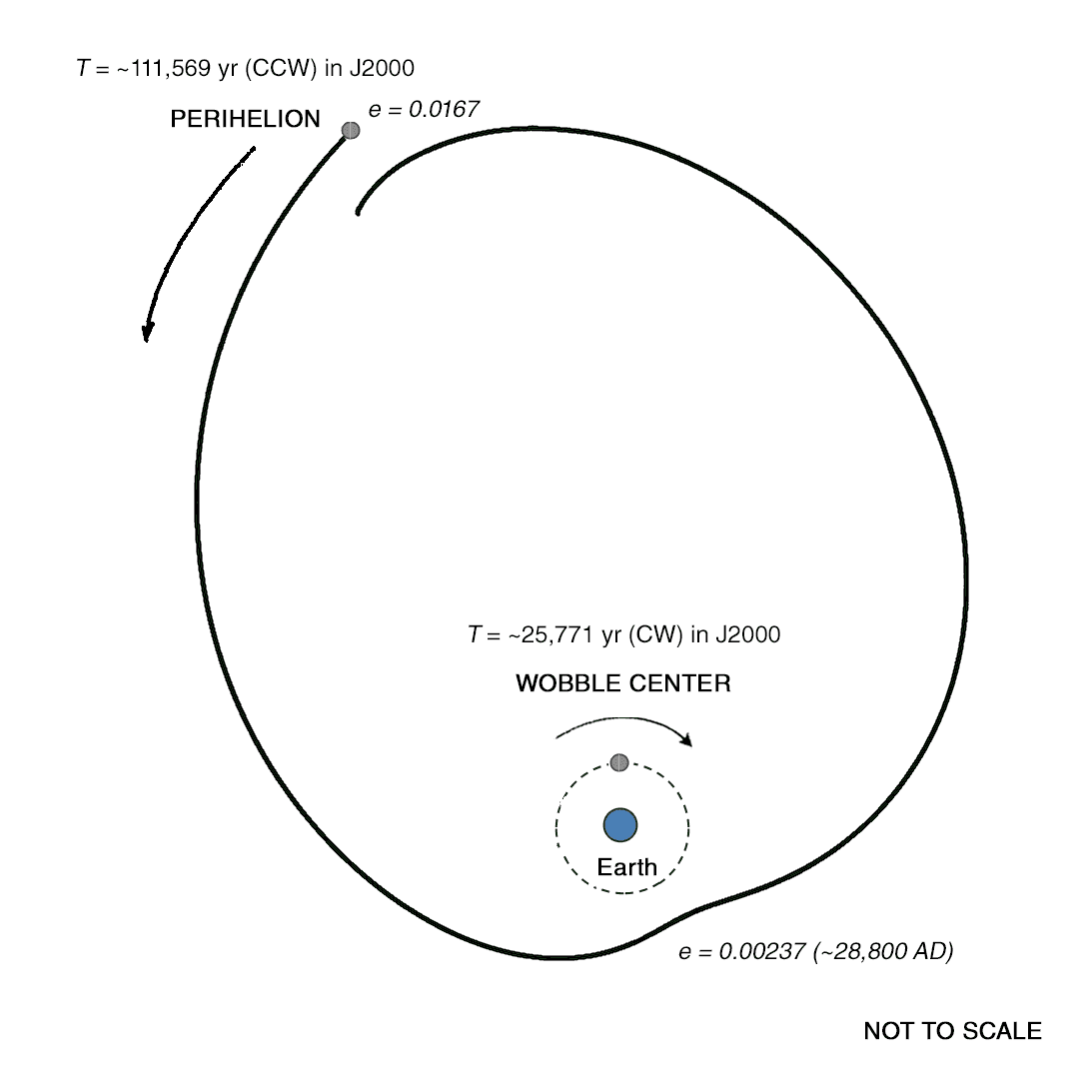
| Earth around EARTH-WOBBLE-CENTER | Clockwise | ~25,772 years* | Axial precession |
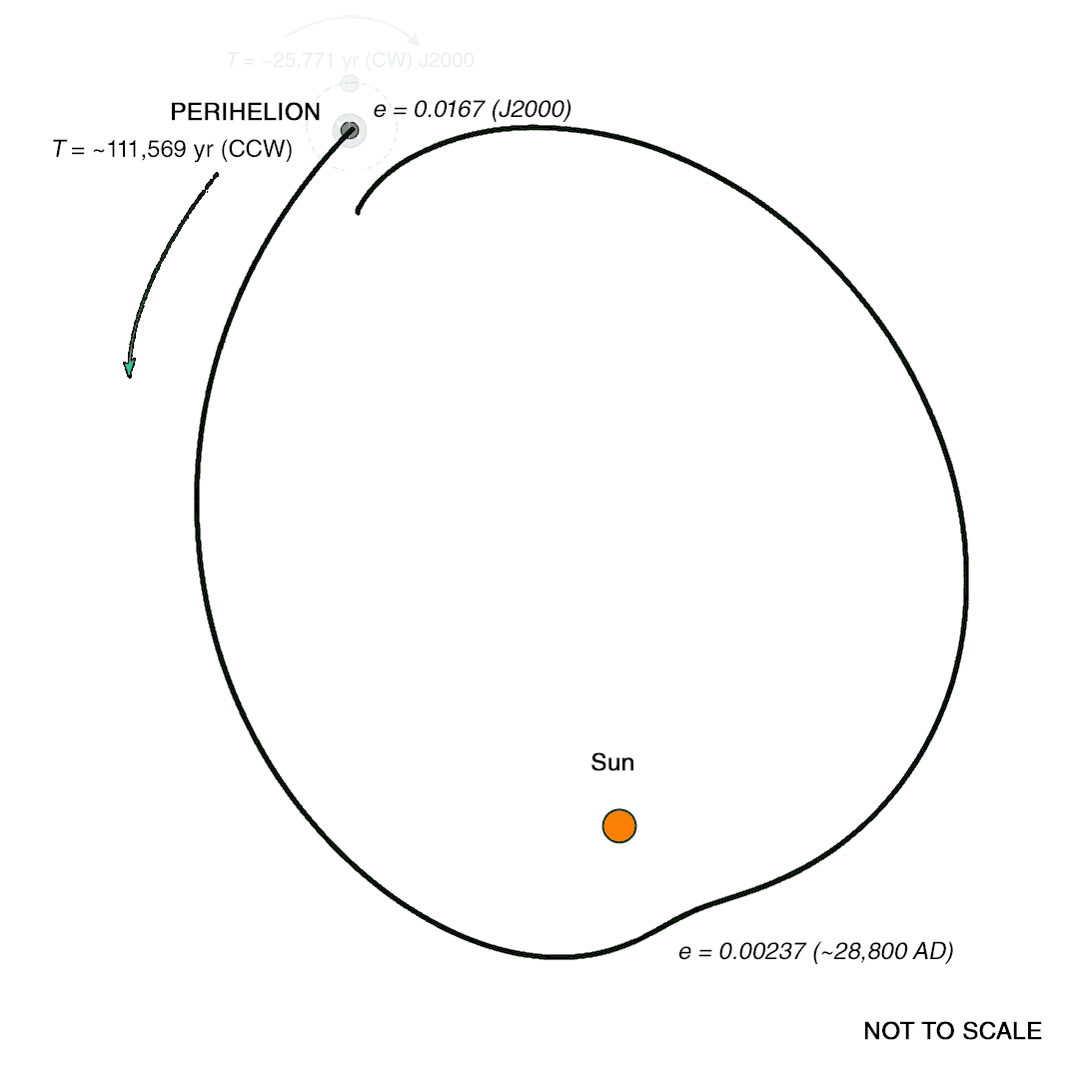
| PERIHELION-OF-EARTH around Sun | Counter-clockwise | ~111,635 years | Apsidal precession |
*The model’s clock is the J2000 axial precession period, 25,771.58 years — one circle at the IAU 2006 general precession rate, 50.288″/yr, a cited input, not fitted. The of-date period is not constant: it wanders between 24,802 and 26,560 years across the ±26,000-year window, currently shortening toward a minimum near 11,822 AD before lengthening again, and it lengthens through geological time as tides slow the spin and the Moon’s torque weakens — at 380 Ma it read ~21,699 yr (Earth’s Clock, Expanding Resonance).
Because the two motions rotate in opposite directions, they meet every ~20,938 years — the perihelion precession cycle.
These are standard astronomical phenomena. The two motions correspond to well-known precession cycles — axial precession (lunisolar torque on Earth’s equatorial bulge) and apsidal precession (planetary perturbations) — and they naturally move in opposite directions. The model represents them in a different mathematical framework (Scientific Background §1).
The two reference points
EARTH-WOBBLE-CENTER and PERIHELION-OF-EARTH are mathematical constructs — reference points that make the model work. They are not physical objects you could visit.
EARTH-WOBBLE-CENTER
A reference point near Earth. It circles Earth clockwise once per axial precession (as seen from the north ecliptic pole). In the standard model, Earth’s axis wobbles due to gravitational torque; here the same wobble is represented by that reference point circling Earth. The motion is identical — only the mathematical representation differs.
| Property | Value |
|---|---|
| Earth’s orbital direction | Clockwise (from north) |
| Orbital period | ~25,772 years (mean) |
The marker is display-only; no model quantity is measured from it. See Scientific Background §5.
PERIHELION-OF-EARTH
A reference point near the Sun. It orbits counter-clockwise around the Sun, marking the direction of Earth’s closest approach. Perihelion currently occurs around January 3; in ~10,000 years it will occur in July.
| Property | Value |
|---|---|
| Orbital direction | Counter-clockwise (from north) |
| Orbital period | ~111,635 years (mean) |
Like the wobble centre, this marker shows a direction, not a measured distance: Earth’s eccentricity — how far the orbit actually departs from circular — is the engine’s N-body series (Eccentricity).
How the motions interact
Meeting frequency. Because the two motions rotate in opposite directions, their frequencies add rather than subtract:
Wobble center around Earth (axial precession): ~25,772 years
Earth's perihelion point around Sun: ~111,635 years

Meeting frequency = 1/~25,772 + 1/~111,635 = 1/~20,938

They meet every ~20,938 years (perihelion precession)
When orbits go the same direction, frequencies subtract; opposite directions, frequencies add. This is why the ~21k-year perihelion precession cycle is shorter than the ~26k-year axial precession.
The ratio. The ratio of the two periods at J2000 is:
~111,635 / ~25,772 = 4.332A reading, not a constant. The apsidal ratio reads 4.332 today but wanders between 1.08 and 9.81 across the past and coming 26,000 years: the perihelion’s motion is a sum of planetary modes with no single period, while the clock is nearly flat over that window. See Mathematical Foundation.
What comes from where
From the two counter-rotating motions:
| Phenomenon | How it emerges |
|---|---|
| Axial precession | Earth’s wobble center circling Earth |
| Apsidal precession | Earth’s perihelion point orbiting the Sun |
| Perihelion precession (of date) | Meeting frequency of the two motions |
| Obliquity variation | The spin axis precessing about the orbit plane — the beat of the clock against the plane’s nodal turn |
| Day/year length changes | Follow from the precession rates and the orbit the engine supplies |
From the N-body engine, not from the geometry above:
| Quantity | Source |
|---|---|
| Earth’s eccentricity | The engine’s own series, integrated from the J2000 seed (Eccentricity) |
| Earth’s inclination and node | The engine’s nodal modes — these are what the obliquity beat runs against |
| The planets’ orbits | The governed element chain (Moon & Planets) |
Earth’s other long periods are read against the clock the wobble centre sets, the mean lunisolar precession period of 25,771.6 years at J2000. Each is the model’s own dynamical value, and each is a beat of the clock with an orbital motion: the perihelion of date at 0.8124 clock periods, the obliquity cycle (~41,099 years) at ≈ 1.6, the ecliptic precession (~68,751 years) at ≈ 2.7, and the apsidal at 4.332. The table and the derivations are on Earth’s Clock. The cardinal points, day lengths and eclipses are read from the same clock and the same N-body series, with no correction layer on the movements (Earth’s Clock).
Every planet shows the same kinds of cycles
The two-reference-point construction is Earth’s geometric framework — built from observed phenomena. The same kinds of motions exist for every planet:
| Phenomenon | Earth | Other planets |
|---|---|---|
| Axial precession | ~25,772 yr | Each planet’s spin axis precesses (own period) |
| Apsidal precession | ~111,635 yr | Each planet’s perihelion advances against the stars |
| Perihelion precession (of date) | ~20,938 yr | Each planet’s perihelion against its own moving equinox |
| Nodal precession | ~68,751 yr | Each planet’s orbital plane turns on the invariable plane |
| Obliquity oscillation | ~22.08° – ~24.45° | Each planet’s tilt oscillates (where measured) |
| Eccentricity variation | the engine’s series | Each planet’s eccentricity from the same integration |
These are observations, not assumptions — visible in JPL ephemeris data and Laskar’s La2010 long-term integrations. In the current model the planets’ orbits ride the model’s own N-body engine, derived from one cited J2000 state with zero fitted constants — the bridge from Earth’s framework to the architecture of the whole solar system is dynamics, not a law set (see Moon & Planets).
The geo-heliocentric perspective
The model is built from Earth’s point of view but describes the same physics as the heliocentric model.
| Perspective | What orbits what |
|---|---|
| Heliocentric | Earth orbits the Sun |
| Geo-heliocentric | Earth’s perihelion point orbits the Sun; Earth’s wobble center circles Earth |
| Result | Both produce the same observable motion |
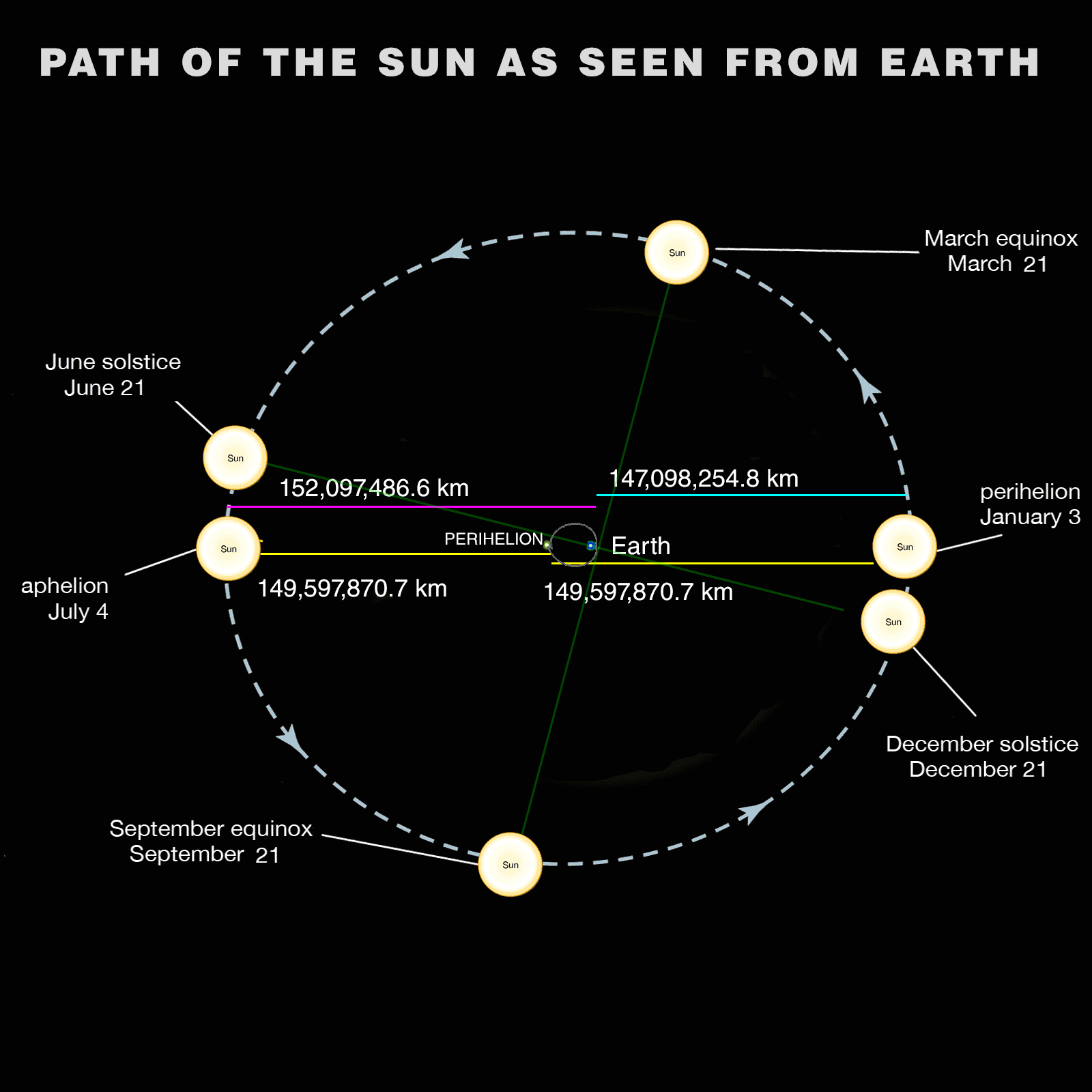
Still heliocentric. The geo-heliocentric construction is a mathematical framing, not a physical claim — the solar system is still heliocentric. All planets have perihelion points near the Sun (not just Earth), and each planet has its own wobble center. Since these points exist for all planets, the Sun remains the logical centre.
Methodology: how the clock is fixed
The clock is not a free parameter we picked. Its J2000 rate is a cited observation, and everything else about it is composed from measured physics.
The clock — 25,771.6 years
The clock’s J2000 rate is the IAU 2006 general precession, 50.288″/yr, taken as an input; one full circle at that rate is 25,771.58 years. The year lengths follow from it through the “coin rotation” identity — the difference between sidereal and tropical year, accumulated over one precession period, equals exactly one tropical year — so the IAU sidereal year and the precession rate together give the J2000 tropical year, 365.242190469 days, derived rather than entered. Through time the rate is composed from the Sun’s and the Moon’s torques on the spin, both following measured histories (Earth’s Clock).
The 1246 AD perihelion–solstice alignment of the IAU mean elements (Meeus’s formula) is a dated event the model reproduces, not a calibration: the model’s own orbital series crosses at 1247.2 AD — the mean-element and secular-element conventions, labelled.
The planets
The other planets’ orbits are not fitted at all: their positions and elements of date are read from the model’s own N-body engine, integrated from one cited J2000 state with zero fitted constants, and gated against JPL Horizons / WebGeoCalc over 1800–2100 (Moon & Planets, N-body Exploration). Their published long-period descriptors now come from that same engine. Each planet’s perihelion and node periods are its leading secular eigenfrequencies read off the chain’s own modes — 1,296,000″ ÷ g and ÷ s — and its inclination and eccentricity are read at whatever epoch you ask for, rather than as a mean and an amplitude. They belong to Ledger 1 with the orbits (Mathematical Foundations); the former integer-fraction reading of these periods is retired (Earth’s Clock).
The Mercury test
The most decisive test is Mercury, where the observed perihelion precession is the best-measured in the solar system.
- The model’s Newtonian rate for Mercury’s perihelion is the N-body chain’s own, measured over 1800–2100 with the relativistic term switched off: 529.0 arcsec/century against the stars. The rate is the primary quantity here and the period follows from it
- Park et al.’s ICRF total minus the same derived relativistic advance gives a Newtonian subtotal of 532.33 arcsec/century, so the model sits ~0.6 % from it
Observers publish Mercury’s perihelion advance in ecliptic longitude: 575.31 arcsec/century relative to the stars (MESSENGER ranging), of which ~43 is the famous “Mercury anomaly” above the Newtonian planetary perturbations. The model’s Newtonian rate in that coordinate is 529.0. The simulation’s Earth-frame export measures a different quantity, the right ascension of the perihelion direction in its equatorial frame, which exceeds the Newtonian rate by 47.16 arcsec/century at J2000 — the equatorial projection of the advance (42.51) plus the obliquity-rate term. That excess is not a tunable parameter — it falls out of the geometry once the period is set — but it is a coordinate effect, not the observed anomaly; see Mercury Precession.
The model’s settled position on the anomaly itself is General Relativity’s: the stated Mercury total is the Newtonian rate plus the relativistic advance derived from the model’s own constants (529.03 + 42.98 = 572.0 arcsec/century), gated against its own N-body engine. The striking ~43-arcsec numerical coincidence of the equatorial projection at Mercury’s particular perihelion longitude was proposed, tested, and closed — see Mercury Precession for the record and the tests that decided it.
What’s an assumption, what’s a measurement
Assumptions (the model takes these as given):
- The J2000 orbital elements from JPL/DE440 are correct
- Earth’s obliquity follows from one precession equation: the spin axis precessing about the orbit normal, both taken from the model’s own dynamics
- The IAU 2006 general precession rate and the IAU sidereal year at J2000 are correct (Mathematical Foundation)
Measurements (the model produces these from the 3D simulation):
- The exact length of each year type (solar, tropical, sidereal, anomalistic, cardinal-point years)
- The exact length of each day type (solar, sidereal, stellar)
- The tropical year derived from the sidereal year and the precession rate
- Each planet’s perihelion advance as seen from Earth, at every epoch
- Mercury’s Earth-frame excess of ~47.16 arcsec/century at J2000 (the equatorial projection of its Newtonian advance; the observed anomaly itself is a longitude quantity)
- All long-period cycles (eccentricity, obliquity, inclination, ascending node) for every planet
The methodology is: cite the J2000 state and rates → compose the clock → fit only the Earth-rotation and climate records → measure everything else. The inputs are kept in three ledgers rather than a single parameter count, and the planetary ledger has no free parameters at all (Mathematical Foundations).
The ledger lock — no isolated knobs. The model has no separate slider for “Mercury anomaly”, “axial precession rate”, “Saturn perihelion”, or any other observable. Each falls out of the same chain. Change any one input — a planet’s mass, the J2000 seed state, or the J2000 precession rate — by even a small amount, and the change propagates through every downstream observable. Perturb Jupiter’s GM by one percent and every planet’s apsidal rate moves together. The values across this site (year lengths, day lengths, perihelion rates, ascending nodes, eclipse timings, ice-age periods) are all the same chain, evaluated at different epochs. That is the lock: because every layer derives from the same three ledgers, there is no tuning surface where one quantity can be matched at the expense of another, and no observable can be made to agree with reality unless all of them do.
For the mathematical foundations that emerged from this methodology, see Mathematical Foundation; for the cross-checks against established astronomy, Supporting Evidence; for testable predictions, Predictions.
Next steps
- Earth’s Clock — the clock the wobble centre sets, and the five periods against it
- Precession — axial, apsidal and perihelion precession explained
- Obliquity — how axial tilt varies between ~22.08° – ~24.45°
- Eccentricity — Earth’s eccentricity as the engine’s series, and the apsidal period (~111,635 years) that turns the perihelion
- Days & Years — how precession affects time measurements