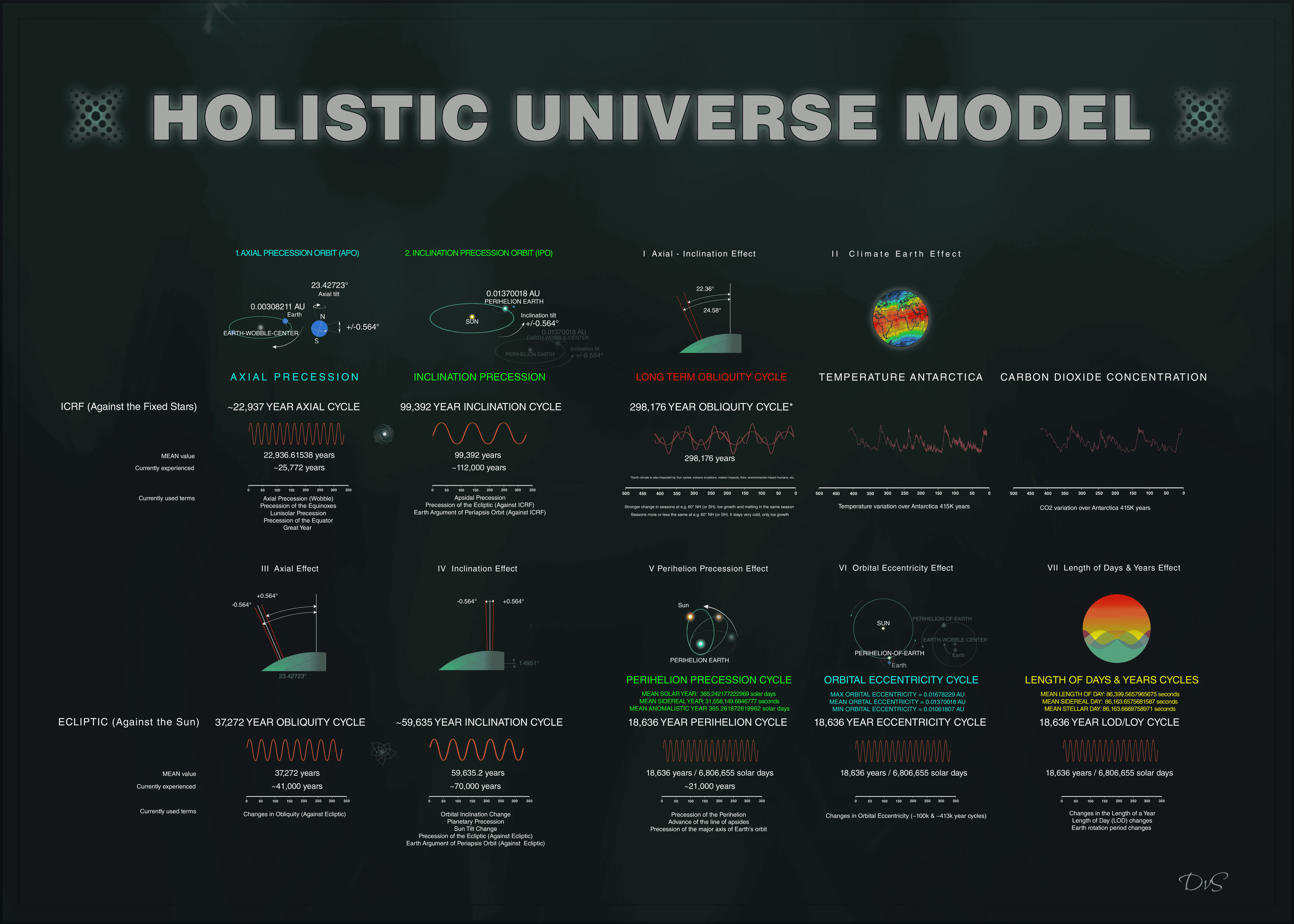
Configuration
The active configuration is based on the perihelion alignment year of 1246 AD — the last time the December solstice aligned with Earth’s perihelion.
Key Parameters
| Parameter | Value |
|---|---|
| Perihelion Alignment Year | 1246 AD |
| Earth Fundamental Cycle | 335,317 years |
| Axial Precession | ~25,794 years (mean) |
| Inclination Precession | ~111,772 years |
| Perihelion Precession | ~20,957 years |
| Obliquity Cycle | ~41,915 years |
All cycle durations above are J2000 anchor values used by the simulation in its observational window. The Fibonacci-divisor structure (H/3, H/5, H/8, H/13, H/16) is invariant at any epoch; the literal year counts rescale at geological time — see Expanding Resonance for the deep-time evolution layer.
Simulation Input Constants
The 3D software simulation uses these exact input constants. All other values in the model are derived from these inputs — nothing is hardcoded except these foundational parameters. These form the model’s 6 free parameters — all governing the Earth simulation; the planet configuration below adds no additional degrees of freedom (a unique mirror-symmetric solution emerges from the exhaustive search).
How it works: The simulation calculates everything from these constants. Change any input value and all derived values (day lengths, year lengths, precession rates, orbital positions) automatically update. This ensures internal consistency - the model cannot contradict itself.
View in the simulation: Open the About folder in the Tweakpane panel to see the Six Laws, all 6 Free Parameters, the 20 Calibration Inputs, and the full list of 125 Model Parameters — all with their live values.
For detailed explanations of what each parameter represents and how it’s used, see the Technical Guide: Input Parameter Reference.
Core Cycle Parameters
| Constant | Value | Description |
|---|---|---|
holisticyearLength | 335,317 | Length of Earth Fundamental Cycle in years |
perihelionalignmentYear | 1246 | Last year longitude of perihelion aligned with solstice (J. Meeus) |
perihelionalignmentJD | 2,176,153 | Same alignment date in Julian Day format |
temperatureGraphMostLikely | 14.5 | Position in obliquity cycle (0-16 scale, determines Balanced Year) |
Year & Day Length Parameters
| Constant | Value | Description |
|---|---|---|
inputmeanlengthsolaryearindays | 365.2422 | Reference solar year length in days (input) |
meansiderealyearlengthinSeconds | 31,558,149.76 | Sidereal year in seconds (J2000 anchor; modern-era scope — drifts at deep time per Expanding Resonance) |
TROPICAL_YEAR_HARMONICS | 12 terms | Fourier harmonics for tropical year |
SIDEREAL_YEAR_HARMONICS | 5 terms | Fourier harmonics for sidereal year |
ANOMALISTIC_YEAR_HARMONICS | 8 terms | Fourier harmonics for anomalistic year |
Model Start Position
| Constant | Value | Description |
|---|---|---|
startmodelJD | 2,451,716.5 | Model start date in Julian Day (June 21, 2000 00:00 UTC) |
startmodelYear | 2000.5 | Model start year (mid-2000) |
whichSolsticeOrEquinox | 1 | Start alignment: 0=March, 1=June, 2=Sept, 3=Dec |
startAngleModel | 89.91949879° | Earth’s orbital angle at start (just before 90° solstice) |
correctionDays | -0.8288 | Fine-tuning for exact solstice alignment |
correctionSun | 0.49715° | Correction because start is 00:00 UTC, not 01:47 UTC solstice |
Obliquity (Axial Tilt) Parameters
| Constant | Value | Description |
|---|---|---|
earthtiltMean | 23.41353° | Mean obliquity (optimized for IAU 2006) |
earthInvPlaneInclinationAmplitude | 0.63607° | Amplitude of obliquity oscillation |
earthInvPlaneInclinationMean | 1.48113° | Mean inclination to invariable plane |
earthRAAngle | ~1.255° | Right ascension correction (derived from cycle position) |
Eccentricity Parameters
| Constant | Value | Description |
|---|---|---|
eccentricityBase | 0.015386 | Law-5 balance base eccentricity; the one H/3 law’s mean base′ is derived from the observed J2000 value (see Eccentricity) |
eccentricityAmplitude | 0.001356 | The Law-4 input A — the 1246 triangle closure, shown as the wobble-marker distance; not an eccentricity amplitude |
Physical Constants
| Constant | Value | Description |
|---|---|---|
currentAUDistance | 149,597,870.698828 km | 1 Astronomical Unit |
speedOfLight | 299,792.458 km/s | Speed of light |
deltaTStart | 55.16 s | Delta-T correction at model start |
Planet Configuration
The Fibonacci Laws assign three quantities to each planet: an oscillation period (an integer divisor of the Solar System Resonance Cycle 8H, with Earth’s periods specifically at H/Fibonacci per Law 1), a quantum number d (determining amplitude via amplitude = ψ / (d × √m)), and a balance group (in-phase or anti-phase). The periods and balance groups are observationally constrained; the d-assignment is uniquely determined by the mirror-symmetry constraint and so adds no additional degree of freedom.
| Planet | Ecliptic Period | Formula | d | Fibonacci | Group | Mirror pair |
|---|---|---|---|---|---|---|
| Mercury | 243,867 | 8H/11 | 21 | F₈ | In-phase | ↔ Uranus |
| Venus | 447,089 | −8H/6 (ecliptic-retrograde) | 34 | F₉ | In-phase | ↔ Neptune |
| Earth | ~20,957 | H/16 | 3 | F₄ | In-phase | ↔ Saturn |
| Mars | 74,515 | 8H/36 | 5 | F₅ | In-phase | ↔ Jupiter |
| Jupiter | 68,783 | 8H/39 | 5 | F₅ | In-phase | ↔ Mars |
| Saturn | 41,270 | −8H/65 (ecliptic-retrograde) | 3 | F₄ | Anti-phase | ↔ Earth |
| Uranus | 111,772 | H/3 | 21 | F₈ | In-phase | ↔ Mercury |
| Neptune | 670,634 | 2H | 34 | F₉ | In-phase | ↔ Venus |
Config #4 is the unique mirror-symmetric solution from an exhaustive search of 7,558,272 possible assignments of Fibonacci divisors and phase groups. Four successive physical constraints — inclination balance ≥ 99.994%, eccentricity balance ≥ 99%, Laplace–Lagrange bounds, and direction match with rate error ≤ 6″ — narrow the candidates from 7,558,272 to 15 viable configurations, of which only one is mirror-symmetric. Each candidate is evaluated at its own optimal anchor position and ascending node integers, making the comparison fair. Inner and outer planets share the same Fibonacci divisors in reverse order (3, 5, 21, 34 ↔ 34, 21, 5, 3), with the asteroid belt acting as the mirror axis. Because the configuration is uniquely determined by the constraints, it adds no additional degree of freedom to the 6 Earth parameters above. See the Fibonacci Laws for the complete derivation.
Why 1246 AD?
According to J. Meeus’s formula, on December 14, 1245 AD, the December solstice was almost fully aligned with Earth’s perihelion. This means the longitude of perihelion was approximately 90° (measured from the vernal equinox in the direction of Earth’s orbital motion).
By June 2000 AD, the longitude of perihelion had grown to ~102.947° - a shift of ~12.947° in 754 years.
This alignment date determines where we are in the perihelion precession cycle, which in turn determines all other cycle positions.
Why 335,317 Years?
The Earth Fundamental Cycle length of 335,317 years is determined by six factors:
- Solstice-perihelion alignment in 1246 AD - must be exactly at a cycle boundary
- Fibonacci ratios - precession cycles must relate as 3:13 (inclination:axial)
- Climate cycles - three ~112k year cycles visible in ice core data
- Planet orbital periods - all major planets must complete whole orbits
- Moon cycles - lunar periods must align with the master cycle
- Observed precession rates - current measurements must fit within the cycle
335,317 is the smallest number satisfying all constraints.
Fibonacci Breakdown
| Divisor | Cycle | Duration |
|---|---|---|
| 1 | Earth Fundamental Cycle | 335,317 years |
| 3 | Inclination Precession | ~111,772 years |
| 5 | Ecliptic Inclination | ~67,063 years |
| 8 | Obliquity | ~41,915 years |
| 13 | Axial Precession | ~25,794 years |
| 16 | Perihelion Precession | ~20,957 years |
These Fibonacci divisors also govern the relationships between planetary eccentricities and inclination amplitudes — see Fibonacci Laws Derivation for six independent laws connecting all eight planets through Fibonacci numbers and the mass-weighted quantity .
Match Quality
What This Configuration Explains Well
| Aspect | Quality | Details |
|---|---|---|
| Precession cycles | Excellent | All three precession types match observations |
| Moon cycles | Good | Synodic, sidereal, nodal periods all fit |
| Obliquity | Good | Oscillation between 22.21° - 24.72° matches data |
| Climate patterns | Good | ~112k year cycles visible in ice cores |
Known Limitations
| Aspect | Quality | Details |
|---|---|---|
| Eccentricity | Partial | Matches short-term (under 500 years), diverges long-term |
| Delta-T | Partial | General trend correct, specific values vary |
| Historic year lengths | Partial | Some discrepancy with ancient observations |
These limitations are being investigated. Alternative alignment years may be explored in the future to improve these matches.
Predictions
This configuration makes the following testable predictions which contradict the current theory:
- Sun at max declination: the RA value (in ICRF) will shift from 6h to less than 6h
- Eccentricity will decrease until 32,682 AD, then increase
- Mercury’s “missing” advance will decrease over the coming century
These can be verified against future observations. For the complete list of 27 testable predictions organized by timeframe (near-term decades through deep-time Gyr-scale), see Predictions.
Resources
- 3D Simulation: Interactive 3D Solar System Simulation (uses this configuration)
- Data Explorer: Browse all values in the dashboard
- Source Code: github.com/dvansonsbeek/3d
How It All Connects