Supporting Evidence
The Holistic model makes several claims that depart from established theory. This page collects external evidence — published results, unresolved problems, and recent observations — that independently align with the model. None of this evidence was used to develop the model.
An open framework — invitation to test
The model is offered as a framework for testing scientific theories, not as a closed theory. Every observable in the published literature is reproduced (see the next section); six deliberate departures from current consensus are catalogued explicitly, each with a discriminating empirical test.
All data, formulas, and the interactive 3D simulation are publicly available under AGPL-3.0 on github.com/dvansonsbeek/3d . The deep-time chain, climate-formula fits, and the full Fibonacci-balance verification pipeline are scripted end-to-end and reproducible from raw inputs.
We invite independent replication and contradicting evidence. The framework is most useful when others apply it to their own data and report what they find — including findings that falsify any of its claims. Concrete invitations:
- Mercury’s anomaly is RESOLVED to General Relativity — the model now carries the relativistic advance as a derived supplement, gated against its own N-body engine; the once-proposed reference-frame reading is closed as a 0.6 % coincidence (see Mercury Precession). BepiColombo (April 2027) remains the shared consistency check and sharpens the solar-J₂ separation.
- Apply the L1 lattice (33 integer divisors of 8H) to a Devonian, Permian, or Cretaceous cyclostratigraphic spectrum. If the Earth-family integer-label invariance holds (Expanding Resonance), the same integers should fit at every epoch with only the absolute periods rescaling per H(t).
- Reproduce the Wells 1963 / Wu 2024 paleo-day-count match independently — via a different paleontological technique (bivalves, rugose corals, novel growth-band counting), or a different cyclostratigraphic inversion method. Devonian H = 306,189 yr is a one-parameter prediction with no Hadean constraint in the fit.
- Test the Lunar Precession Invariant (Prediction 7) via spectral analysis of tidal rhythmites sensitive to the apsidal period (~9.69 yr at Devonian, ~17.15 yr at −2.5 Gyr). The framework predicts
T_apsidal × H≈ 2,966,728 yr² at every epoch. - Find a counter-example to Law 4 (eccentricity amplitude constant K) — a stellar or planetary system whose eccentricity oscillations would violate the closed balance equation. The model’s Planet Nine null is one application of this; the Vera Rubin Observatory survey (2025–2035) provides the discriminating test.
- Replicate the historical eclipse validation on additional pre-1900 events outside the 26-event canonical set, or extend the 267-event Stephenson 2016 lunar timing analysis with newly recovered primary-source observations.
The framework treats contradicting evidence as the most productive form of engagement. Please open an issue at github.com/dvansonsbeek/3d/issues or reach out via the Support page with results, questions, or proposed extensions.
Scope: what the model reproduces, where it differs
Before the section-by-section evidence, here is the explicit scope of the model. The first table lists quantities the model reproduces to within stated tolerances — cross-validated against standard ephemerides and published references. The second lists quantities where the model differs from current scientific consensus and proposes a different explanation.
Reproduces standard astronomy (cross-validated)
| Quantity | Reference / source | Model agreement |
|---|---|---|
| Sun position (1800–2200 AD) | JPL Horizons | RMS < 0.003° |
| Moon position (1800–2200 AD) | Meeus 1998, JPL Horizons | RMS < 0.002° |
| Planet positions (1800–2200 AD) | JPL Horizons | RMS < 0.1° for all eight |
| Solar / lunar eclipse timings | NASA eclipse catalog + Stephenson 2016 primary-source observations | Matched to within minutes (modern); Moon polynomial ±15 min vs NASA Five Millennium Catalog back to 2,500 yr before J2000; model ΔT (pure-tidal + L1-orbital-coupled α(t) GIA) places the framework umbra within the ±4-hour scan window for 20/26 documented solar eclipses (-762 BCE to 2026 CE), with 6/26 pure geographic misses (historical attribution debates rather than model errors); the 267-event Stephenson 2016 lunar timing test reports 20.2-min mean |residual|, matching NASA within 14 s and beating NASA on 118/267 events. See Solar Eclipse Validation and Lunar Eclipse Validation. |
| Earth obliquity + rate of change | Laskar 2004, Chapront et al. 2002 | within published uncertainties |
| Earth eccentricity at J2000 (+ near-J2000 rate) | JPL, NASA | match |
| Earth longitude of perihelion (+ rate) | Meeus 1998 | match; 1246 AD perihelion–solstice alignment exact |
| Year lengths (tropical, sidereal, anomalistic, cardinal) | Chapront et al. | match including the 1-extra-tropical-year-per-axial-cycle identity |
| Day lengths (solar, sidereal, stellar) | IAU 2006 | match including the 1-extra-sidereal-day-per-axial-cycle identity |
| Axial / inclination / perihelion / obliquity / ecliptic precession (Earth) | Chapront et al. | match within published uncertainties |
| Ascending nodes — invariable plane | Souami & Souchay 2012 | match to < 0.0001° after the calibration documented in Ascending Node Calibration |
| Planet inclinations (ecliptic + invariable plane) | JPL J2000 | match |
| Planet eccentricities | JPL J2000 | match |
| Planet obliquities (where measured) | published values | within 0.2–2.5% per Obliquity |
| Laskar 2004 / La2010 secular eigenfrequency periods | published numerical secular solutions | model’s analytical 8H/N matches to 0.04–2.4% |
| Berger 1978 climatic-precession peaks | published spectrum | match 8H/N integer lattice to <0.4% |
Differs from current science (the model proposes a different explanation)
| Topic | Standard view | Model’s view |
|---|---|---|
| Mercury’s ~43″/cy “anomaly” | Confirmation of General Relativity (Einstein 1915) | The model agrees: the relativistic advance, derived from its own constants (531.44 + 42.98 = 574.4″/cy) and gated against its own N-body; the once-proposed frame reading is closed as a tested coincidence. See Mercury Precession. |
| Jupiter–Saturn Great Inequality | Required to explain Saturn’s retrograde perihelion phase | Confirmed by the model’s own N-body — the retrograde is the window phase of the GI epicycle (mean prograde, g₆); the model’s −8H/65 is the window-epoch descriptor. See Supporting Evidence §12. |
| Length of Day pre-1900 (ΔT) | Monotonic tidal slowing requires a Munk-MacDonald-scale (~5-6 ms/cy) non-tidal Earth-rotation speedup component to fit the historical eclipse record; Stephenson empirical polynomial captures this | The full Munk-MacDonald-scale postulate is rejected by the historical record. A much smaller GIA-scale channel (dLOD/dt = -0.35 ms/cy at J2000, from Cox & Chao 2002 satellite anchor) is included via the L1-orbital-coupled α(t) correction, plus a 4-flag lattice ΔT stack (Bond + Hallstatt + Jose5 + Jose4) and the Core-mantle swing episode (the millennial core–mantle channel) — compared out-of-sample against Bond 2001 IRD at r = +0.37 — an open correspondence that fails its null tests, not a validation. Full derivations: Timekeeping (closed-form ΔT formula + Bond IRD cross-validation), Solar Eclipse Validation (26-event audit), Lunar Eclipse Validation (267-event L-5b + α(t) GIA physics + three-component residual decomposition). |
| Earth’s eccentricity decline | Continues toward a deep minimum (~27,000 AD, La2004) | The model agrees at depth: its own N-body engine forecasts the deep minimum; the H/3 law is the exact epoch-local chart of the decline (matching value and rate at J2000, bit-exact across the observation window). See Eccentricity. |
| 100,000-year glacial cycle origin | Direct eccentricity forcing | Multi-planet eigenmode-beat signal modulating Earth’s orbital plane. See Climate Formula. |
| Earth’s H/3 inclination cycle | Standard secular theory (Laskar/Berger) treats inclination ICRF rate as derived from planet ecliptic perihelion rates | The model uses planet ecliptic-inclination rates of change as the INPUT for perihelion ICRF period changes — a different attribution that produces the same H/3 cycle but with a different mechanism |
Same data, different interpretation
The model uses every observation that Berger, Laskar, Meeus, Chapront, Souami, and others use. Where the model and standard science disagree about a specific value, it is the explanation that differs, not the data. The structure that emerges from this re-interpretation — six Fibonacci Laws connecting all eight planets through a single timescale — is what gets new explanations.
Where the model and standard science disagree about a specific future or past value, that’s the falsifiable prediction. Several such discriminating tests are catalogued in Predictions.
Relationship to prior theoretical work
Every observation the model reproduces comes from established astronomy. The model adopts the work of the established authors below in full; where the interpretation of a specific observation differs, that’s flagged in the right column.
| Source | Used by the model | Where the model differs (if anywhere) |
|---|---|---|
| Kepler — orbital geometry, three laws | Adopted in full | — |
| Newton — universal gravitation | Adopted in full | — |
| Le Verrier / Newcomb — Mercury ~43″/cy measurement | Adopted as the observation | Adopted as the observation — attributed, in the model too, to General Relativity (the derived supplement); Le Verrier’s meridian series, re-solved as pure longitudes, was one of the findings that closed the frame reading |
| Einstein 1915 — general relativity | Adopted | Mercury’s excess advance is the relativistic term, carried by the model as a derived supplement from its own constants and gated against its own N-body engine (see Mercury Precession) |
| Berger 1978 — Milankovitch Fourier decomposition | Adopted as the standard reference spectrum | Attribution of which planet drives each peak differs — same periods exist in both, with different responsible planets |
| Laskar 2004 / La2010 / Laskar–Joutel–Boudin 1993 — numerical secular solutions | Adopted as cross-validation | The model’s analytical 8H/N periods match Laskar’s secular eigenfrequencies to 0.04–2.4%; the model derives them from a single timescale rather than from numerical integration |
| Meeus 1998 — Astronomical Algorithms | Adopted for Moon position (RMS < 0.002°), longitude-of-perihelion comparison, and the 1246 AD anchor | — |
| Capitaine, Wallace & Chapront 2003 — IAU 2000/2006 precession expressions | Adopted as the standard formulation for Earth precession comparison | — |
| Chapront et al. 2002 — lunar orbital parameters and ecliptic reference frame | Adopted (with Meeus 1998) for Moon position and ecliptic-frame consistency | — |
| Souami & Souchay 2012 — invariable plane orientation | Adopted as ground truth for the ascending-node calibration (model matches to < 0.0001°) | — |
| IAU 2006 P03 precession — current axial precession rate (~26k years) | Adopted as the current-epoch observation | The model treats this as the current value of a cycle whose long-term mean is ~25,794 years (H/13); the IAU value being below the mean and decreasing is a falsifiable prediction (trend will reverse) |
Bottom line: every observation is identical to standard astronomy. The Fibonacci-lattice structure that emerges when those observations are re-organized into a single timescale (H, 8H) is new, and the explanations for a few specific anomalies (Mercury, Saturn ecliptic-retrograde perihelion, 100-kyr cycle origin) are new. Everything else converges with established science.
1. The 100,000-Year Problem
The dominant ~100-kyr glacial cycle is one of paleoclimatology’s longest-standing open problems. Eccentricity changes Earth’s annual insolation by only ~0.2% — too small to drive ice ages without unverified amplification — and three discriminating failure modes hold against direct eccentricity attribution: the spectral shape is a broad single peak, not eccentricity’s split (95k+125k) structure (Muller & MacDonald 1997 ); the 405-kyr term is essentially absent post-MPT (amplitude ratio 0.12 vs the 100-kyr peak); and no bispectral 95k+125k phase coupling is detected (bicoherence 0.507 below the null 95th percentile of 0.555).
The model’s resolution and the full 33-integer lattice fit is canonical at Climate Formula. In brief: the 100-kyr band is a broad single peak carried by three adjacent multi-planet eigenmode beats on the 8H lattice — n=22 (s₂−s₄, 121.9 kyr), n=25 (s₁−s₄, 107.3 kyr empirical centroid), n=28 (g₄−g₅, 95.8 kyr) — not Earth’s own H/3 = 111.77-kyr apsidal precession, which the L1 fit places at near-zero amplitude. The MPT (~1 Ma) is a sensitivity change in the climate system, not a forcing change. Two candidate MPT mechanisms have empirical support: (1) ice sheet threshold — progressive CO₂ decline and removal of easily-erodible regolith allowed ice sheets to grow past a critical size where they could survive obliquity maxima (Willeit et al. 2019 ); (2) interplanetary dust concentration — Helium-3 measurements in deep-sea sediments show a real increase in interplanetary dust accretion beginning at ~1 Ma (Farley 1995, Nature 376, 153). Muller & MacDonald (1997) originally proposed dust accretion as the climate mechanism for inclination forcing; the community rejected the specific dust-climate coupling, though Farley’s ³He evidence for the dust-flux increase remains unchallenged. Recent reviews keep the problem open: Barker et al. 2025, Science ; Mitsui et al. 2025, ESD ; Lisiecki 2023, Nat. Geo. .
Ice core dating methodology
The 100-kyr signal claim depends on the timescale being right. Modern ice-core chronologies use several methods that are largely independent of orbital tuning — which is what makes the LR04 vs Cheng2016 cross-check (below) meaningful.
Methods used in modern Antarctic and Greenland chronologies:
- Annual layer counting — visual stratigraphy, seasonal chemistry, electrical conductivity. Precision: ±1% Holocene, ±2–3% glacial. Resolvable to ~60–100 kyr before layers compact below detection.
- Volcanic markers — sulfate spikes and tephra (Toba 74 ka, Laacher See 12.9 ka, Campanian Ignimbrite 39 ka) provide absolute tie points.
- Gas synchronisation — methane is globally synchronous within ~50 yr; links Greenland and Antarctic chronologies (±50–200 yr).
- O₂/N₂ ratio dating (Kawamura et al. 2007 ) — trapped-air O₂/N₂ correlates with local summer insolation; provides an independent orbital constraint at the precession band (~23 ka), not the 100-kyr band.
- Radiometric — ¹⁴C to ~50 ka; U-Th on synchronised speleothems to 640 ka (Cheng et al. 2016). Fully independent of orbital assumptions.
- Orbital tuning — adjusts the chronology to match calculated insolation. Circular if used to test Milankovitch theory.
| Chronology | Cores | Period | Reference |
|---|---|---|---|
| AICC2012 | EPICA DC, Vostok, EDML, TALDICE, NGRIP | 0–800 ka | Veres et al. 2013 |
| EDC3 | EPICA Dome C | 0–800 ka | Parrenin et al. 2007 |
| GICC05 | NGRIP, GRIP, GISP2 | 0–60 ka | Rasmussen et al. 2014 |
| DFO-2006 | Dome Fuji | 0–340 ka | Kawamura et al. 2007 |
| Period | Uncertainty | Primary methods |
|---|---|---|
| 0–60 ka | ±1–2% | Layer counting + volcanic markers |
| 60–150 ka | ±2–4% | Volcanic markers + gas sync |
| 150–400 ka | ±4–6% | Gas sync + modelling + limited tuning |
| >400 ka | ±5–10% | Modelling + orbital tuning |
The circularity test: the orbitally-tuned LR04 stack and the U-Th-dated Cheng2016 speleothem record — chronologies built from completely independent timescales — place the dominant cycle in the same FFT bin (k = 6, centroid ≈ 107 kyr). The 107-kyr centroid is real, not a tuning artifact.
2. Fibonacci Ratios in Orbital Mechanics
The model’s Fibonacci structure has a rigorous theoretical basis in the KAM theorem (Kolmogorov–Arnold–Moser, 1954–1963): orbits with frequency ratios closest to the golden ratio φ are maximally stable against perturbation, because φ is the irrational number hardest to approximate by ratios of small integers. Mean-motion resonances (Kirkwood gaps, Saturn ring divisions) demonstrate this in visible form — and successive Fibonacci ratios converge to φ. Empirical surveys confirm the preference: Pletser 2019 finds ~60% Fibonacci clustering in solar system period ratios; Aschwanden & Scholkmann 2017 finds 73% of 932 exoplanet pairs preferring Fibonacci harmonics. Full derivation: Physical Origin. The six Fibonacci Laws extend the structure beyond period ratios: Fibonacci Laws.
Resonance chains as the formation-epoch norm — Huang et al. 2025
Huang, Ormel, Portegies Zwart, Kokubo & Yi (2025, ApJ) — “A Resonant Beginning for the Solar System Terrestrial Planets” (arXiv:2506.04164 ) — provide independent, mainstream N-body support for the premise this framework builds on: the inner planets were locked in a mean-motion resonance chain when the gas disk dispersed. Their proposed chain is 2:3:4:6 (Venus / proto-Earth / Theia / Mars), disrupted at ~10 Myr by the Giant Planet Instability; the disruption then triggered the Moon-forming giant impact. Their headline observational anchor is the present Mars-Venus period ratio of 3.05, which they show emerges naturally as a relic of the former chain (their simulation distribution peaks near 3.01, consistent with the observed 3.05) rather than being coincidental under traditional late-formation models.
The mechanism is different from ours — they invoke gas-disk migration and drag, not KAM optimality — but the conclusion converges: today’s orbital spacing is a formation-epoch resonance relic. Their falsifiable predictions include (a) Venus retaining a primordial ¹⁸²W-enriched mantle (no violent impact), (b) Theia impact velocity ≲ 1.5 v_escape, (c) Moon-forming event 40–120 Myr after CAI, and (d) evolved exoplanet resonance chains (TRAPPIST-1, TOI-178, HD110067) lacking outer gas giants. Prediction (d) is where the two frameworks use “resonance” differently: Huang et al. mean a live mean-motion chain with actively librating resonance angles (which they argue an outer gas giant would destabilise), whereas the Fibonacci structure we describe is a KAM-stabilised quasi-resonance — proximity to golden-mean frequency ratios, not live libration — a configuration that can coexist with gas giants (as our own Solar System does). Upcoming exoplanet surveys should be able to distinguish which flavour of “resonance” dominates in systems that host both inner chains and outer giants.
3. Earth’s Rotation Speedup (2020–present)
The model predicts that LOD’s growth is cyclically modulated by the 4-cycle 8H-lattice stack (Bond + Hallstatt + Jose5 + Jose4) plus the Core-mantle swing episode: LOD itself only grows, but its rate currently runs below the secular baseline (descending stack phase), with the modulation’s next trough near ~2,207 AD and next peak near ~2,741 AD, and short-term fluctuations superimposed on the long-term tidal trend.
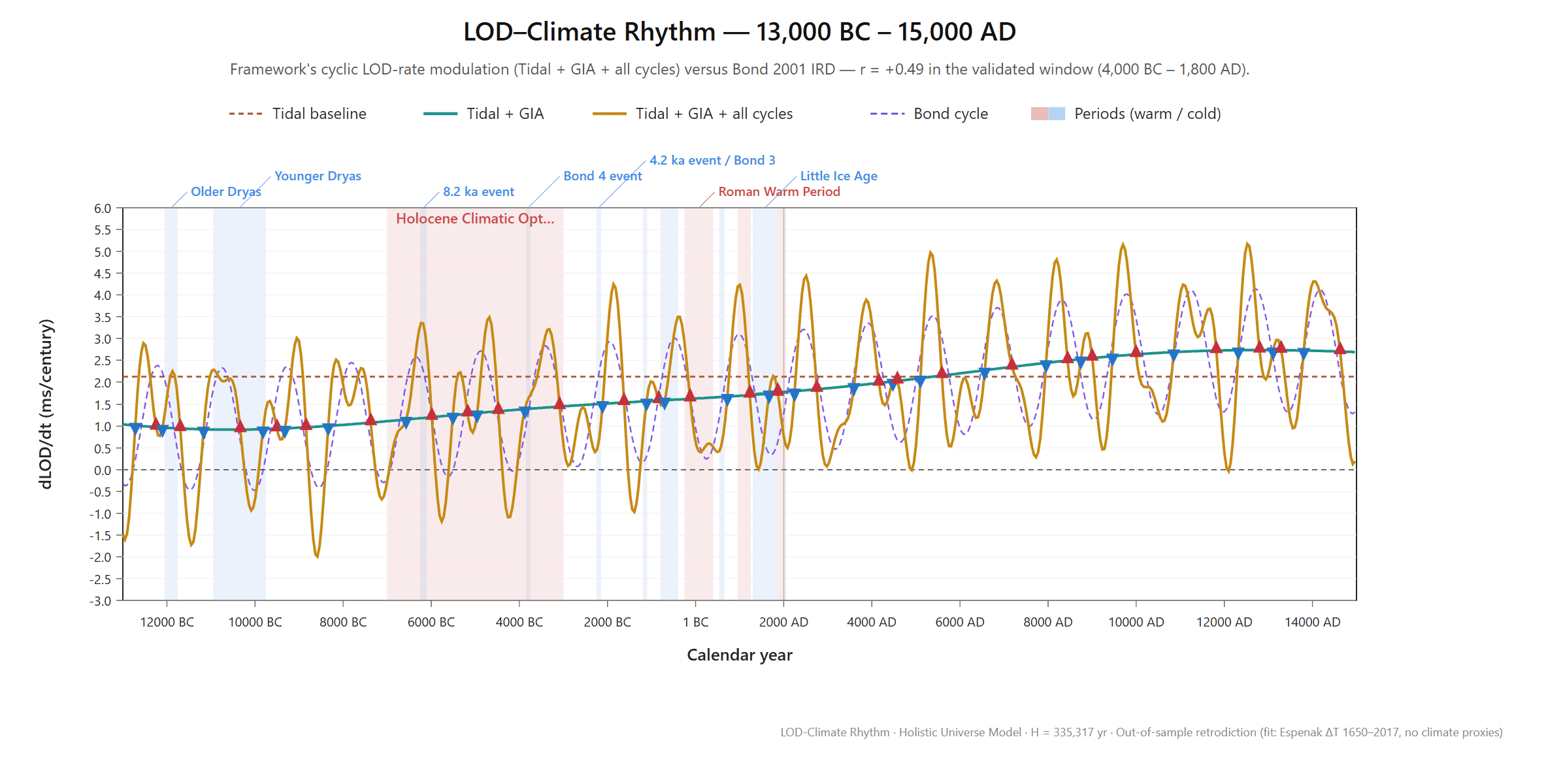
Starting in 2020, Earth began rotating faster than IERS predictions. 2020 saw the 28 shortest days since atomic-clock measurements began; July 5, 2024 set the all-time record at 1.66 ms under 24 hours. The IERS Directing Board has acknowledged trouble predicting more than 6–12 months ahead . The short-term speedup is qualitatively consistent with the model’s cyclical-LOD prediction; it is not yet evidence of the long-term trend reversal, which only continued observation over decades can confirm.
4. Day Length Stalled for 1 Billion Years
Mitchell & Kirscher (2023, Nature Geoscience 16, 567) showed that Earth’s day length stalled at ~19 hours for roughly 1 billion years during the mid-Proterozoic (2.0–1.0 Ga) — atmospheric thermal tides balanced the decelerative torque of lunar oceanic tides. The implication for the model: complex, non-monotonic LOD dynamics are not unprecedented. If atmospheric tides could halt rotational slowing for a billion years, additional mechanisms can produce the cyclical millennial-scale variation the model proposes.
Tidal rhythmites: complementary evidence. Sedimentary records preserving ancient tidal cycles (“tidal rhythmites”) provide independent geological constraints on ancient Length of Day. They show discrepancies with simple tidal-deceleration models — additional evidence that complex rotational dynamics beyond monotonic lunar tidal slowing have shaped Earth’s rotation history. The Holistic framework now embeds a quantitative deep-time LOD evolution via ESSRT Driver 1 (Earth-Moon tidal evolution; Farhat 2022 polynomial — see Expanding Resonance), reproducing the Devonian / Cretaceous tidal-rhythmite day-count record to within ~1 %.
5. Solar Oblateness Uncertainty
The standard Mercury GR test assumes the Sun’s quadrupole moment J₂ is precisely known. J₂ is not constant — it varies on the ~11-year solar activity cycle — and historical estimates have ranged from ~10⁻⁵ (oblateness-based) to ~10⁻⁷ (helioseismology). A 2022 study found that a periodic J₂ component exceeding 0.04% of J₂, if unmodelled, could falsely confirm or contradict GR in BepiColombo’s data. The model does not claim GR is wrong, only that the standard Mercury test carries a rarely-discussed systematic. Reference: MDPI Remote Sensing 2022 .
6. BepiColombo: The Second Ranging Epoch
Mercury orbit insertion is 21 November 2026; routine science operations begin April 2027. The MORE radio-science experiment will measure Mercury’s orbit by ranging with 1–2 orders of magnitude better precision than MESSENGER. The model’s prediction is General Relativity’s — ~575.31″/cy again, since the model carries the relativistic advance as its derived supplement — so BepiColombo is a consistency check for both, plus a second precise epoch bounding any secular change of the advance and a much sharper separation of the solar-J₂ systematic (§5). Canonical: Mercury Precession.
7. Solstice RA Oscillation
The model predicts that the Sun’s Right Ascension at June solstice, measured in ICRF coordinates, oscillates around 6h with ~±12.5-minute (RA time units; ~±3.125°) amplitude, crossing its mean value at 1246.03 AD. The mechanism is a superposition of two co-equal H-lattice cycles, distinguishing the model’s prediction from single-mechanism obliquity-only estimates.
Two-mechanism decomposition — H/3 inclination + H/8 obliquity
Both components share the same driver amplitude A = 0.63607° (the earthInvPlaneInclinationAmplitude constant in the reference code). This is not a coincidence — the same A appears in the model’s two-component obliquity formula ε(t) = ε̄ − A·cos(2π·t/(H/3)) + A·cos(2π·t/(H/8)) (see Earth § Mean Obliquity and Obliquity & Inclination), which structurally couples the H/3 inclination and H/8 obliquity Fibonacci divisors. Both terms enter the RA formula with the same sensitivity coefficient 1/sin(ε̄), giving the closed form implemented in computeSolsticeRA for all four cardinal points:
RA(t) = base − ρ/sin(ε̄) + (A/sin(ε̄)) · [ −sin(2π·t/(H/3)) + sin(2π·t/(H/8)) ]where base = 90°/270°/0°/180° for SS/WS/VE/AE, ρ = earthRAAngle is a small mean offset, and t = year − balancedYear. Empirical LSQ fit against model-computed SS events sampled at 1-year cadence across one full Earth Fundamental Cycle (H = 335,317 yr) recovers exactly the two-harmonic structure with RMSE = 2.1 arcmin for the two-term basis. Extending to a three-term basis with the H/16 candidate below improves RMSE only to 1.94 arcmin, and returns an H/16 amplitude of 0.02° — 80× smaller than the two dominant terms.
Component 1 — H/3 inclination shift (co-equal amplitude, ~111,772-yr period). Earth’s orbital-plane inclination in ICRF oscillates ±0.63607° at the H/3 period. This tilts the ecliptic-plane reference frame relative to ICRF, shifting the RA at which the max-declination solstice event occurs. Contribution: A/sin(ε̄) ≈ 1.60° = 96 arcmin peak amplitude.
Component 2 — H/8 obliquity variation (co-equal amplitude, ~41,915-yr period). Earth’s axial tilt oscillates over the H/8 obliquity cycle with the same 0.63607° driver, contributing an equal A/sin(ε̄) ≈ 1.60° term with opposite sign. The two terms superpose to give the ±12.5-min RA (~±3.125°) peak deviation from mean, reached when both sinusoids reinforce.
Period: H(t)/3 = ~111,772 years and H(t)/8 = ~41,915 years at J2000, both scaling with H(t) at deep time.
Superposition and anchor at balancedYear = 1246.03 AD
The (−sin + sin) shape makes the harmonic sum vanish at t = 0, i.e. at balancedYear = 1246.03 AD, so the SS RA passes through its mean value there by anchor choice. Peak-to-peak envelope reaches its maximum swing of ±12.5 min RA (~±3.125°) at phase combinations where both sinusoids reinforce. The H/3 and H/8 periods sit at an exact 8:3 ratio (since (H/3)/(H/8) = 8/3 by the Fibonacci divisor structure), so the composite signal is exactly H-periodic (period H = 335,317 yr) with an inner beat envelope at H/5 = ~67,063 yr — Earth’s own ecliptic precession period on the Fibonacci lattice. Both components track the H(t) chain at deep time.
Secondary mechanisms (H(t) deep-time integration, general precession H/13, tropical-calendar drift over long baselines) contribute the residual ~2-arcmin RMSE beyond the two-term closed form.
Falsifiable spectral signature
Berger’s traditional obliquity-only derivation (Laskar et al. 1993 ) uses the ±1.2° Milankovitch obliquity range and predicts a single spectral peak at the ~~41k-year obliquity period. The Holistic model predicts two co-equal spectral peaks in SS-RA — the H/3 inclination peak at ~111,772 yr and the H/8 obliquity peak at ~41,915 yr, in an 8:3 harmonic ratio — plus a much smaller H/16 EoC sub-peak.
H/16 Equation of Center — the residual sub-arcmin signal. The Kepler equation of center Δλ_EoC = 2e(t)·cos(ϖ(t)), with ϖ precessing at 2π/(H/16), would in principle displace the sun’s true ecliptic longitude at solstice by up to 2·0.01675 = 1.92°, giving a potential RA displacement 2e/cos(ε̄) ≈ 2.09° at maximum coherence. In practice, the SS event is located by maximum declination — i.e. ∂δ/∂t = 0 — which coincides with true ecliptic longitude 90° regardless of eccentricity, so the EoC displacement is absorbed into event location and does not translate to an SS RA shift. What remains at H/16 in the model output is a residual 0.02° (~5 arcsec) sub-signal, consistent with the small H/16 modulation of e(t) itself. This is a testable prediction — an observational H/16 peak larger than a few arcsec would falsify the model’s SS event definition.
Long-baseline VLBI or historical solstice records could distinguish these — the model’s specific claim is the 8:3 spectral ratio between the H/3 and H/8 peaks with matched amplitudes, not a single obliquity peak nor an H/16 EoC peak. Current shift rate is order tens of arcseconds per century (well within modern astrometric precision) with sign dominated by the H/8 phase near J2000.
8. Jupiter and Saturn Secular Eigenfrequencies Are Stable
The model’s 8H-lattice values for Jupiter’s and Saturn’s perihelion motions (8H/39, −8H/65) are window-epoch descriptors of the present era’s motion as seen in Earth’s frames — exact for the window they name, with the true long-term means the secular eigenfrequencies (g₅ ≈ 426″/cy, g₆ prograde). Laskar’s secular theory confirms those eigenfrequencies are stable over ≥50 Myr, and an independent cross-validation pins the model’s analytically-derived periods to within 0.04–0.12% of Laskar’s numerical values. The apparent “pattern changes” that short-window ephemeris tools display are the Great Inequality’s window phase, not a change in the underlying dynamics — the model’s own N-body engine agrees with that mechanism (see The Six Fibonacci Relations — Law 6).
The Great Inequality: why short-window tools show “pattern changes”
Jupiter and Saturn sit in a near 5:2 mean-motion resonance, producing the Great Inequality — a ~883-year quasi-periodic oscillation first identified by Kepler and explained by Laplace in 1786. The oscillation amplitude in Saturn’s longitude of perihelion is large enough to dominate century-scale fits:
| Fit window | Jupiter ϖ̇ (°/cy) | Saturn ϖ̇ (°/cy) |
|---|---|---|
| 1800–2050 AD (JPL Table 1) | +0.213 | −0.419 |
| 3000 BC–3000 AD (JPL Table 2a) | +0.182 | +0.542 |
Saturn’s fitted rate changes sign between the two intervals. JPL’s own documentation cautions: “The elements are not valid outside the given time-interval over which they were fit.” WebGeocalc and similar tools that display the raw ephemeris over centuries will show these Great-Inequality oscillations as apparent trend changes.
Secular theory: the long-term dynamics are stable
Laskar’s orbital solutions (La2004 , La2010 ) decompose planetary eccentricity into eigenmodes g₁–g₈. Each planet’s perihelion motion is a superposition — for Jupiter, g₅ dominates with significant g₆ admixture (~2.8:1); for Saturn, g₆ dominates but g₅ contributes nearly as strongly (~1.4:1), which is why Saturn’s instantaneous rate can reverse sign. Laskar found that g₅, g₆, and s₆ are practically stable over at least 50 Myr — the giant-planet system is far less chaotic than the inner planets, and the average precession trends do not change.
Brouwer & van Woerkom (1950) showed that eliminating the Great Inequality from the Hamiltonian introduces small correction modes (g₉, g₁₀) that modify but do not destabilise the fundamental rates. Laplace’s 1786 proof that the Great Inequality is truly periodic — averaging to zero over ~10 full cycles — closes the argument: the oscillation does not produce a net secular drift.
Ascending node periods: integer divisors of 8H
Each planet’s ascending node period takes the form 8H/N for integer N. Jupiter and Saturn share N=36 (locked). Across the seven fitted planets the 8H/N integers reproduce JPL’s J2000 ascending-node trends with cumulative residual ~5.8″/century (~0.8″/century per planet).
| Planet | Period | Note |
|---|---|---|
| Mercury | −8H/9 | |
| Venus | −8H/1 | full Solar System Resonance Cycle |
| Earth | −H/5 = −8H/40 | coincides with ecliptic precession |
| Mars | −8H/64 | |
| Jupiter | −8H/36 | locked with Saturn |
| Saturn | −8H/36 | locked with Jupiter |
| Uranus | −8H/11 | |
| Neptune | −8H/3 |
The model derives all eight from a single constant H. Laskar’s secular theory measures them as 8 independent eigenfrequencies with no structural relationship to each other.
Independent cross-validation: Laskar and the model converge
The model derives the 8H-lattice secular periods 8H/39 and 8H/65 analytically — from the Fibonacci cycle architecture (Law 1) combined with the gas-giant lock (Law 6). The derivation makes no use of Laskar’s numerical secular theory or LR04 spectral analysis. Two independent lines of evidence then converge on the same numerical values:
| Source | Earth’s nodal precession | Obliquity beat |
|---|---|---|
| Holistic model (analytical, this work) | 8H/39 = 68,783 yr | 8H/65 = 41,270 yr |
| Laskar (2004) numerical secular theory | |s₃| = 68,750 yr | k + s₃ = 41,220 yr |
| Empirical LR04 climate peak (fine-grid sweep) | — | 40,950 ± 50 yr |
The analytical and numerical methods agree to 0.04% for the nodal precession and 0.12% for the obliquity beat. The empirical LR04 peak lands within one Rayleigh resolution element of both. This is convergence, not calibration: the model does not consult Laskar’s eigenfrequencies, and Laskar’s eigensystem does not consult Earth’s Fibonacci hierarchy.
A second independent cross-validation comes from Jupiter’s inclination trend. Using the 8H-lattice secular period 8H/39 for Jupiter’s perihelion ecliptic produces an inclination-trend error of ~3 arcsec/century vs JPL’s observed values. Using the secular theory’s ~305,000-year g₅ period instead jumps the error to ~8.5 arcsec/century — nearly 3× worse. The 8H-lattice value outperforms the standard g₅ period on independent JPL data — read as a window-epoch consistency test: the trend baseline is a few centuries, so it adjudicates the present-era rate, not the long-term period (quantity types per 3d doc 109 §9).
9. Obliquity Amplitude: Berger (1978) Dominant Term
The model’s obliquity decomposition gives both the axial-tilt and inclination-tilt components an amplitude of ±0.63607°, combining to produce the full obliquity range ~22.21° – ~24.72°. Independent support comes from Berger’s standard Fourier decomposition. (The two-component formula and the H/3 retraction are canonical at Obliquity.)
Berger’s dominant term
Berger (1978) decomposed Earth’s obliquity into 47 quasi-periodic terms. The dominant term (frequency s₃ + k) has:
| Property | Value |
|---|---|
| Amplitude | 2462.2 arcsec = 0.684° |
| Period | ~41k years |
| Frequency | s₃ + k (orbital plane precession + axial precession) |
The 0.684° amplitude is within 8% of the model’s 0.63607°. The five largest terms:
| Term | Period (yr) | Amplitude | % of dominant |
|---|---|---|---|
| s₃ + k | ~41,000 | 0.684° | 100% |
| s₄ + k | ~39,730 | 0.238° | 35% |
| s₆ + k | ~53,615 | 0.175° | 26% |
| s₃ + k (nearby) | ~40,521 | 0.115° | 17% |
| s₁ + k | ~28,910 | 0.087° | 13% |
The dominant term is roughly 3× the next; Berger & Loutre (2001) and Laskar et al. (2004) confirm the value in updated solutions. The frequency s₃ + k matches the same two counter-rotating motions the model identifies: axial precession k (~50.47″/yr, prograde) and the s₃ eigenmode for Earth’s orbital plane (~−18.85″/yr, retrograde). Their rates add to 69.32″/yr, giving a full cycle ~37.4 kyr; the canonical ~41k-yr period emerges once secondary terms (s₄+k, s₆+k) are included.
No published work explains from first principles why the dominant amplitude is ~0.684° (or the model’s 0.63607°). It emerges from the full coupled spin–orbit–planetary perturbation solution; without the Moon’s stabilising torque obliquity could vary chaotically between 0° and 85° (Laskar, Joutel & Robutel 1993 ).
Climatic-precession peaks match integer divisors of 8H
Berger’s climatic-precession spectrum (e × sin ϖ̄) has multi-peak structure across ~19–24 kyr with no single dominant term. The natural comparison frame is the Solar System Resonance Cycle (2,682,536 yr): every Berger climatic-precession peak matches an integer-fraction divisor of 8H within <0.4% — including Saturn, which falls outside the conventional ~19–24 kyr “climatic precession band” but is recovered by the same framework.
| Berger period (yr) | Eigenmode (Berger label) | Amplitude (rel.) | Integer n | 8H / n (yr) | Match | Holistic top-1 attribution |
|---|---|---|---|---|---|---|
| 23,716 | g₅ + k (Jupiter) | 100% | 113 | 23,739 | 0.10% | Earth.Axial(104) + Mercury.Obliq(3) + Saturn.Axial(6) |
| 22,428 | g₂ + k (Venus) | 88% | 120 | 22,354 | 0.33% | Earth.Axial(104) + Jupiter.Obliq(16) (clean 2-term) |
| 23,159 | g₁ + k (Mercury) | 34% | 116 | 23,125 | 0.15% | — (not in canonical L1) |
| 19,155 | g₃ + k (Earth) | 46% | 140 | 19,161 | 0.03% | — (not in canonical L1) |
| 18,976 | g₄ + k (Mars) | 50% | 141 | 19,025 | 0.26% | Earth.Axial(104) + Jupiter.Axial(21) + Jupiter.Obliq(16) |
| 16,469 | g₆ + k (Saturn) | ~10–15% | 163 | 16,457 | 0.07% | — (not in canonical L1) |
Berger names each peak after a single planet (g_j + k); the model derives the same lattice peaks via multi-planet beats from PLANET_CYCLES — typically Earth.Axial combined with one or two Jupiter/Saturn elements. The two frameworks agree on which periods exist and disagree on which planet drives each beat (the eigenmodes themselves are mathematical objects accepted by both — see Eigenfrequencies). The ”— (not in canonical L1)” peaks sit between adjacent lattice integers and the model does not recognise them as distinct lines. Full attribution table for all 33 L1 components: L1 attribution.
Structural decomposition: each integer splits as n = 104 + δ, where 104 = 8 × 13 is the integer corresponding to axial precession (k = H/13 → 104 sub-divisions of 8H), and δ is the planet’s eigenfrequency contribution. The model’s natural Fibonacci centroid sits at n = 128 (equivalent to H/16 = ~20,957 yr — Earth’s perihelion precession; the Berger climatic-precession spectrum is the observable signal that emerges from H/16 beating against the per-planet g_j eigenfrequencies). Largest planetary offsets are direct Fibonacci numbers (Mars +13, Venus −8); inner-planet offsets sit within ±1–2 of Fibonacci; Saturn’s +35 offset is the non-Fibonacci outlier.
Planetary perihelion periods cluster in the same band
Each planet’s ICRF perihelion period (model values) sits in the same 16–42 kyr band that contains the Berger climatic-precession spectrum and the obliquity cycle:
| Planet | ICRF perihelion period | 8H integer n | Where it falls |
|---|---|---|---|
| Mercury | 28,844 yr | 93 | Climatic-precession band |
| Venus | 24,387 yr | 110 | Edge of climatic-precession band |
| Earth | 111,772 yr | 24 (= H/3) | Outlier — inclination cycle |
| Mars | 39,449 yr | 69 | Between bands |
| Jupiter | 41,270 yr | 65 | Equals k+s₃ obliquity beat |
| Saturn | 15,873 yr | 169 | Just below climatic band |
| Uranus | 33,532 yr | 80 (= H/10) | Between bands |
| Neptune | 26,825 yr | 100 | Climatic band |
Excluding Earth, every planet’s ICRF perihelion period lands within 16–42 kyr. The dual identity at 8H/65 = 41,270 yr is the structural punchline: Jupiter’s ICRF perihelion period and Saturn’s (ecliptic-retrograde) perihelion period both sit at the same 8H-lattice secular period, which coincides with Earth’s climate-recorded k+s₃ obliquity beat. Earth’s own obliquity Fibonacci anchor is H/8 = 8H/64 = 41.91 kyr, one lattice integer off the gas-giant lock at 8H/65 = 41.27 kyr — and the climate-recorded beat lands at the gas-giant period. This is the structural identity Law 6 names; full statement and proof at Fibonacci Laws §Law 6.
References:
- Berger, A. (1978). “Long-term variations of daily insolation and Quaternary climatic changes.” J. Atmos. Sci., 35, 2362–2367.
- Berger, A. & Loutre, M.F. (2001). “Amplitude and Frequency Modulations of the Earth’s Obliquity.” J. Climate, 14(6), 1043–1054.
- Laskar, J. et al. (2004). “A long-term numerical solution for the insolation quantities of the Earth.” A&A, 428, 261–285.
- Laskar, J., Joutel, F. & Robutel, P. (1993). “Stabilization of the Earth’s obliquity by the Moon.” Nature, 361, 615–617.
10. Why Equal Amplitudes? The Physics of Balanced Systems
The model’s claim that the two obliquity components carry equal ±0.63607° amplitudes is the dynamical statement that they behave as equivalent coupled oscillators. In classical mechanics, two coupled oscillators with the same restoring torque and effective moment of inertia have normal modes of exactly equal amplitude — unequal amplitudes require fundamental asymmetry. The same balance appears in linearly polarised light (equal left- and right-circular components), Zeeman splitting (σ⁺/σ⁻), Cassini states, and degenerate molecular modes; in every case equal amplitudes reflect a symmetry, and unequal amplitudes signal a broken one.
Applied to Earth’s obliquity: equal amplitudes in two counter-rotating modes produce zero net angular momentum transfer — consistent with Noether’s theorem on a system with rotational symmetry. An unbalanced amplitude would imply a net angular momentum flux requiring an external source or sink. Energy equipartition and the virial theorem both predict equal-amplitude attractors for equivalent degrees of freedom in equilibrium; Bayesian model selection then prefers the equal-amplitude model over a two-parameter version with no compensating data demand (Jiang et al. 2022, J. R. Soc. Interface).
The model does not derive why the amplitudes are equal — only that they are equal, and that equality is the natural, symmetric, energy-conserving state for coupled counter-rotating systems.
References:
- Goldstein, Poole & Safko (2002), Classical Mechanics, 3rd ed.
- Noether, E. (1918). “Invariante Variationsprobleme.”
- Laskar, Joutel & Robutel (1993). Nature, 361, 615.
- Jiang et al. (2022). J. R. Soc. Interface, 19, 20220324.
11. Milankovitch Beat Frequency Structure
Standard orbital mechanics (Vervoort et al. 2022 ) derives two of the five Milankovitch cycles as beat frequencies of the others:
Obliquity period:             1/P_axial  −  1/P_nodal    =  1/P_obliquity
Perihelion precession period: 1/P_axial  +  1/P_apsidal  =  1/P_perihelion
Expressing all five cycles as H/n, the beat of H/a and H/b is H/(a−b) — again an H/n cycle whenever a−b is meaningful. The Fibonacci subtraction property (each number = difference of the next two) is exactly the condition the physical beat equations need to close inside the H/n system:
| Physical equation | Model form | Fibonacci arithmetic |
|---|---|---|
| f_obliquity = f_axial − f_nodal | 8/H = 13/H − 5/H | 13 − 5 = 8 |
| f_perihelion = f_axial + f_apsidal | 16/H = 13/H + 3/H | 13 + 3 = 16 |
| f_apsidal = f_obliquity − f_nodal | 3/H = 8/H − 5/H | 8 − 5 = 3 |
| f_nodal = f_axial − f_obliquity | 5/H = 13/H − 8/H | 13 − 8 = 5 |
Non-Fibonacci indices would fail: with 17, 14 − 7 ≠ 10 and 14 + 3 ≠ 17. With Fibonacci indices, any two of the five cycles determine the other three.
A concise headline: standard astronomy needs 5 independent measurements to characterise the 5 Milankovitch cycles; the model needs one number (H) plus the Fibonacci indices 16 — the other four periods then become predictions, all matching to 0.3–2.8%. Three orders of magnitude in timescale are organised by the same constant. The full Fibonacci-closure derivation and eigenfrequency convergence at H/3 and H/5 are canonical at Fibonacci Laws.
Fibonacci multiples: deep-time cycles
The Fibonacci ladder extends beyond H itself. Fibonacci multiples of H match established deep-time geological cycles:
| Multiple | Value (yr) | Matched cycle | Standard period | Diff |
|---|---|---|---|---|
| 3H | 1,005,951 | g₁−g₅ eccentricity (Mercury–Jupiter) | ~980,000 yr | 2.6% |
| 13H | 4,359,121 | Secular resonance libration | ~4,500,000 yr | ~3.1% |
3H ≈ 1 Myr: The beat between Mercury’s and Jupiter’s apsidal eigenfrequencies (g₁ = 5.579″/yr and g₅ = 4.258″/yr in La2004 ) produces an eccentricity modulation with period g₁−g₅ ≈ 980,000 yr. This ~1 Myr cycle appears in geological records as a modulation of the short eccentricity signal. 3H = 1,005,951 yr matches it within 2.6%.
13H ≈ 4.4 Myr: The ~4.5 Myr cycle arises from the resonant argument θ = 2(g₄−g₃) − (s₄−s₃), a nonlinear coupling between the eccentricity and inclination systems of Earth and Mars. Unlike the simpler beat-frequency cycles, this is a libration period — the timescale on which the resonant angle oscillates rather than circulating. Boulila et al. (2018, EPSL) measured it at ~4.5 Myr (range 3.7–4.8 Myr) in Mesozoic–Cenozoic sedimentary records. 13H = 4,359,121 yr falls within this range at ~3.1% from the central estimate.
Both 3 and 13 are Fibonacci numbers, extending the pattern from sub-divisions (H/3, H/5, H/8, H/13) to multiples. The 5H and 8H multiples do not match known present-epoch cycles — the pattern is selective, not universal. (The deep-time Fibonacci-multiple cycles 3H ≈ 1 Myr and 13H ≈ 4.4 Myr are quoted at the J2000 anchor; over the matched geological records — Mesozoic onwards — H(t) drifts by ~1–8 %, see Expanding Resonance. The integer-multiple structure is invariant; the literal year counts in the table rescale at deep time.)
References:
- Vervoort et al. 2022, AJ 164, 130
- Laskar et al. 2004, A&A 428, 261
- Boulila et al. 2018, EPSL 486, 94-107
12. Saturn’s Ecliptic-Retrograde Perihelion Precession
Status. This section records the model’s original proposal — a permanently retrograde Saturn perihelion — and its resolution. The claim was made falsifiable, tested with the model’s own N-body engine, and retired: the retrograde is the window phase of the ~900-yr Great-Inequality epicycle (long-term mean prograde, g₆ ≈ +2,824″/cy), the window rate itself is span-dependent (−1,600″/cy over the 300-yr fit vs ~−3,400 over century sub-windows), and the −8H/65 divisor is a window-epoch descriptor of the present era’s motion. The section is kept as the history of a falsifiable claim honestly resolved; 3d doc 109 is the evidence record.
A clearly-observed phenomenon: Saturn’s longitude of perihelion moves retrograde in the ecliptic frame at the current epoch, opposite to orbital motion, while secular perturbation theory’s long-term mean is prograde for all planets. This section records the observation, the standard explanation, and how the model’s own N-body engine settled the question in the standard explanation’s favour.
The observation
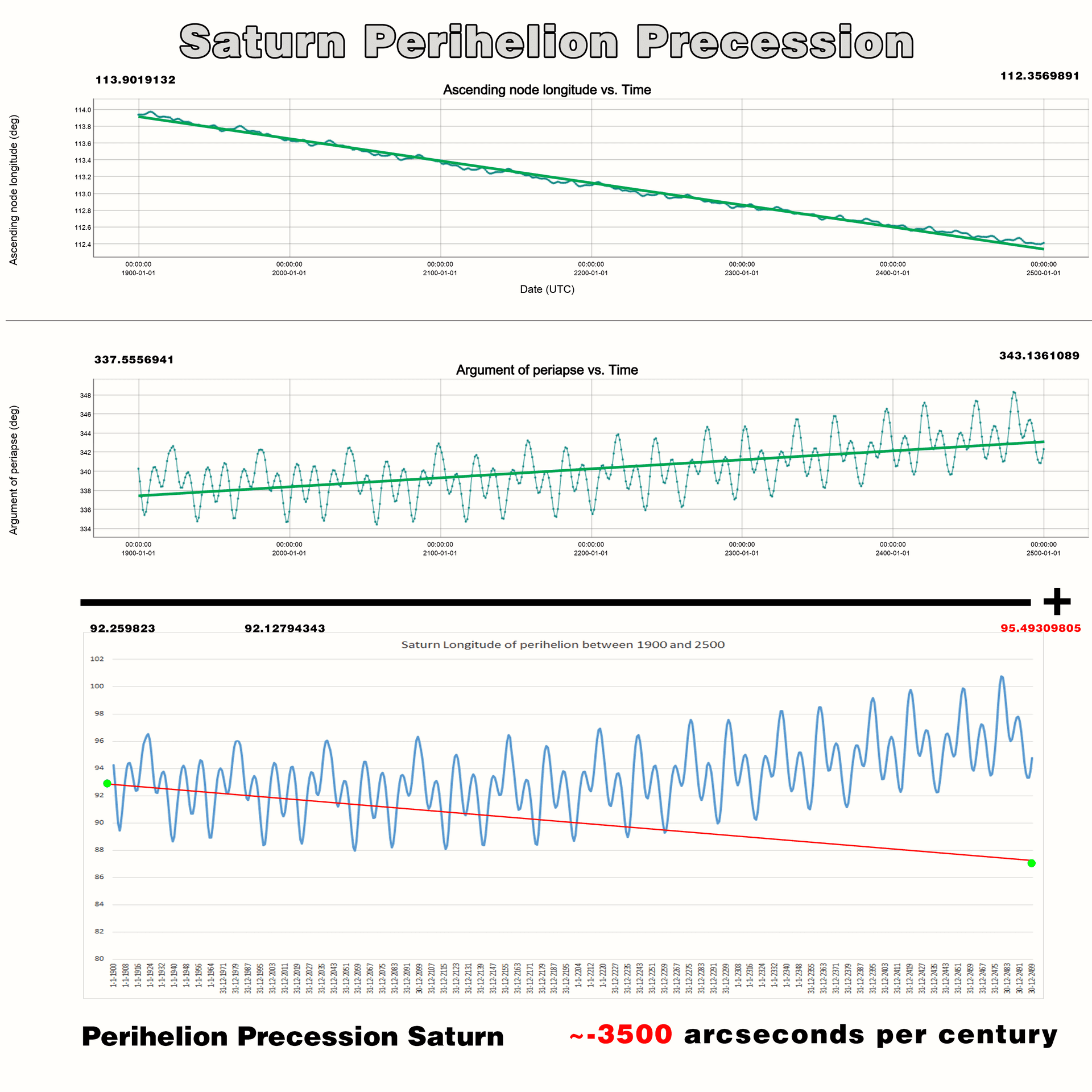
JPL’s WebGeoCalc — computing geometric quantities directly from SPICE ephemeris kernels — shows Saturn’s longitude of perihelion (ϖ = Ω + ω) decreasing over 1900–2000 AD. The two components move oppositely:
| Element | Direction (1900–2000) | Rate |
|---|---|---|
| Ascending node Ω | Retrograde (decreasing) | Smooth, steady |
| Argument of perihelion ω | Oscillating (Great Inequality) | Large ~900-yr oscillation |
| Longitude of perihelion ϖ = Ω + ω | Retrograde | ~-3,400 arcsec/century |
Confirmed by JPL’s Keplerian elements (Standish & Williams 1992 ): Saturn dϖ/dt = −0.419 deg/century in the 1800–2050 fit — the only major planet (along with Neptune) with a negative rate.
Where the disagreement lies: ω, not Ω. Decomposing ϖ across the two JPL fit windows reveals the ascending node is uncontested — both intervals show it retrograde:
| Element | 1800–2050 (Table 1) | 3000 BC–3000 AD (Table 2a) | Change |
|---|---|---|---|
| Ω̇ (ascending node) | −0.289°/cy | −0.250°/cy | ~15%, same direction |
| ω̇ (argument of perihelion) | −0.130°/cy (retrograde) | +0.792°/cy (prograde) | Reverses |
| ϖ̇ = Ω̇ + ω̇ | −0.419°/cy (retrograde) | +0.542°/cy (prograde) | Reverses |
The argument of perihelion completely reverses between the two intervals. The Great Inequality affects the eccentricity eigenfrequencies (g-type, which govern the apsides ϖ) but not the inclination eigenfrequencies (s-type, which govern Ω). The debate concerned ϖ (= Ω + ω): permanently retrograde (the model’s original proposal, since retired) or transiently retrograde via the Great Inequality (standard theory — which the model’s own N-body engine confirms)?
The standard explanation: the Great Inequality
Standard celestial mechanics attributes the retrograde observation to a transient phase of the Great Inequality — the ~900-year oscillation caused by the near-5:2 mean-motion resonance:
| When | Who | Contribution |
|---|---|---|
| ~1625 | Kepler | First noticed positional discrepancies in Jupiter and Saturn |
| ~1695 | Halley | Quantified: Jupiter +3°33’ ahead, Saturn −5°13’ behind over ~2000 years |
| 1748 | Euler | Paris Academy prize — only short-period perturbations found |
| 1766 | Lagrange | Another prize attempt — also failed |
| 1784–86 | Laplace | Solved it: ~900-year oscillation from the near-5:2 resonance (P_S/P_J = 2.483 vs 2.500), not a permanent trend |
Laplace’s theory predicts Saturn’s longitude of perihelion at a long-term secular rate of approximately +19.5 arcsec/yr (prograde) — dominated by g₆ = +22.44 arcsec/yr (Fitzpatrick , Murray & Dermott). The JPL 6000-year fit confirms +19.50 arcsec/yr. Under this view, the current retrograde is a transient phase that should reverse within ~900 years.
Why the theory requires prograde: this is a structural constraint, not a choice. Laplace–Lagrange secular theory decomposes long-term perihelion evolution into eight eigenfrequencies (g₁–g₈) computed from a coupling matrix whose elements depend on planetary masses and orbital distances. The matrix structure — positive diagonals (self-coupling), negative off-diagonals (planet–planet coupling) — produces eigenvalues that are all positive (prograde): g₁ = +5.59″/yr through g₈ = +0.67″/yr. No eigenmode can produce permanent retrograde apsidal precession. If the observation is retrograde, the framework must attribute it to a periodic non-secular perturbation — the Great Inequality is the only available mechanism. The theory drives the interpretation.
The resolution
The original proposal — Saturn’s ecliptic-retrograde perihelion as a permanent feature of the gas-giant lock at 8H/65 (Law 6) — was made falsifiable and tested with the model’s own N-body engine, and the engine sided with Laplace: the retrograde is the window phase of the ~900-year Great-Inequality epicycle, the long-term mean is prograde (g₆ ≈ +2,824″/cy), and the fitted window rate is span-dependent (−1,600″/cy over the 300-yr fit vs −3,400 over century sub-windows). The −8H/65 value stands as a window-epoch descriptor — exact for the present era’s motion, where it matches the WebGeoCalc ecliptic trend (-3,400″/cy, window-dependent) in sign and order. Saturn’s structural roles are untouched by the retirement: it remains the sole anti-phase pivot of Law 3 (99.9974%), Law 5 (99.8636%), and the Law-6 lock with Jupiter’s ICRF perihelion that drives Earth’s obliquity beat k+s₃.
Reading the model’s numbers in the two coordinates:
| Component | Rate (arcsec/century) | Coordinate |
|---|---|---|
| Lattice perihelion rate (−8H/65) | -3,140.3 | (a) ecliptic longitude — comparable with WebGeoCalc |
| Earth-frame RA excess (projection + obliquity-rate term) | -282 | (b) |
| Earth-frame RA rate at J2000 | -3,422 | (b) equatorial — the simulation’s export; not an observable |
In the observers’ coordinate the lattice rate -3,140.3″/cy is the number to compare with WebGeoCalc; the Earth-frame RA value is larger by Saturn’s projection factor and is not. The 3D simulation implements the window-era ecliptic-retrograde motion directly. In the fixed frame the same window-era statement holds — Standish Table 1 (1800–2050, J2000 ecliptic) shows Saturn retrograde at −0.419°/cy — with the same attribution: the Great-Inequality phase, per both standard theory and the model’s own engine.
High-precision ephemeris analyses
Saturn’s perihelion has been studied at milliarcsecond precision. In 2008, Pitjeva detected a small anomalous retrograde residual — the amount left after subtracting all known Newtonian and GR effects:
| Ephemeris | Year | Anomalous residual | Significant? | Reference |
|---|---|---|---|---|
| EPM2008 | 2008 | −6.0 ± 2.0 mas/cy | Yes (~3σ) | Pitjeva (2010) |
| INPOP08 | 2009 | −10 ± 8 mas/cy | Marginal (~1.2σ) | Fienga et al. (2010) |
| INPOP10a | 2011 | +0.15 ± 0.65 mas/cy | No | Fienga et al. (2011) |
| EPM2011 | 2013 | −0.32 ± 0.47 mas/cy | No | Pitjeva & Pitjev (2013) |
Iorio (2009, AJ 137) showed that no standard Newtonian or Einsteinian effect could explain the EPM2008 retrograde residual — not planetary perturbations, solar oblateness, asteroid belt mass, trans-Neptunian objects, GR, or modified gravity theories (MOND, DGP braneworld). Later ephemerides (INPOP10a, EPM2011) found the residual consistent with zero; the EPM2008 anomaly may have been an artifact of the limited early Cassini data span. Modern ephemerides (DE440, EPM2017, INPOP19a) report no significant residual.
Scale distinction: the residual analyses operate at the milliarcsecond/century level — the leftover after subtracting the standard predicted rate of +1950 arcsec/century. The model’s statement operates at the arcsecond/century level — that the total ecliptic ϖ is retrograde at -3,400 arcsec/century throughout the observed era (the original permanence claim is retired; the long-term mean is prograde, g₆). These are fundamentally different questions: the residual analyses assume the standard prograde framework is correct and look for tiny deviations; the model questions the ecliptic-frame rate itself.
References:
- Standish & Williams (1992), JPL Keplerian Elements
- Fitzpatrick, “Secular Evolution of Planetary Orbits” (Table 10.1)
- Brouwer & van Woerkom (1950), Astronomical Papers 13, 81
- Wilson (1985), Archive for History of Exact Sciences 33, 15
- Iorio (2009), AJ 137, 3615
- Pitjeva (2010), IAU Symp. 261, 170
- Pitjeva & Pitjev (2013), MNRAS 432, 3431
- Fienga et al. (2011), CeMDA 111, 363
- Iorio (2010), Open Astronomy Journal 3, 1
13. Cheng 2016 Cross-Proxy Validation
A strong structural test of the 8H lattice is whether it fits a paleoclimate record built on a completely independent chronology and recording a different physical mechanism. The Cheng et al. 2016 Asian Monsoon δ¹⁸O record (U-Th-dated speleothems, 0–640 kyr) is the cleanest such test.
| Property | Cheng 2016 | LR04 |
|---|---|---|
| Recording mechanism | Asian Monsoon precipitation (cave δ¹⁸O) | Ocean ice volume + deep-water temperature (benthic δ¹⁸O) |
| Chronology | U-Th radiometric — no orbital tuning | Tuned to obliquity / precession insolation |
| Period range | 0–640 kyr | 0–5,320 kyr |
| Sampling | Lomb-Scargle (irregular sampling) | Uniform 1-kyr grid |
The same 33-integer 8H lattice that fits LR04 at R² = 0.874 (post-MPT regime) and 0.94 (stitched three-regime fit across the full 5.3-Myr window) also fits Cheng 2016 Asian Monsoon δ¹⁸O at R² = 0.68. Of the top 5 lattice lines fitted to each record, only n = 66 (obliquity-band lattice integer at 8H/66 ≈ 40.6 kyr) is shared between Cheng 2016 and LR04 — per-integer amplitudes differ because monsoon strength and ice volume are sensitive to different beats — yet the full 32-integer lattice fits Cheng 2016 at R² = 0.68.
The structural agreement is independent of the orbital-tuning question. Cheng 2016’s U-Th chronology is built from radiometric ages of speleothem layers and carries no insolation assumption; if Cheng’s record is well-fitted by the same 33-integer lattice — even with different per-integer amplitudes from LR04’s — those lattice positions cannot be tuning artifacts. The L1 lattice is the structure that survives the cross-proxy translation. §1 above made the same point qualitatively for the 100-kyr centroid alone; the R² = 0.68 result extends it to the full 32-integer lattice on a different physical recording mechanism.
Method and per-integer dual attribution at Climate Formula and L1 attribution. The lattice’s time-evolution layer at Expanding Resonance.
14. Paleo-Day-Count Validation
The model’s structural relation H = 13 × axial precession period ties H to Earth’s rotation rate (Length of Day). The proper-physics two-layer LOD formula — derived from angular-momentum conservation applied to Farhat 2022’s Moon-distance polynomial fit — then predicts days per year at any past geological epoch. The predictions are testable against direct paleontological day-counts (coral growth rings, bivalve daily increments, tidal rhythmites) preserved in the fossil record.
Independent multi-source validation (0–620 Ma)
| Age (Ma) | Source | Method | Observed days / yr | Framework | Match |
|---|---|---|---|---|---|
| 0 | IERS modern | Atomic clock | 365.242 | 365.242 | exact (anchor) |
| 70 | de Winter et al. 2020 | Torreites rudist bivalve | 372 | 371.53 | −0.13 % ✓ |
| 90 | Pannella 1972 / Scrutton 1978 | Bivalves (23.5-hr day) | 372.6 | 373.33 | +0.20 % ✓ |
| 200 | Triassic compilation | Various | 385.9 | 383.31 | −0.67 % ✓ |
| 380 | Wells 1963 | Devonian corals | ~400 | 399.96 | −0.01 % ✓ |
| 620 | Williams 2000 | Elatina tidal rhythmites (21.9-hr day) | 400.3 | 423.11 | +5.70 % ⚠️ |
Phanerozoic match (0–380 Ma): all tabulated points within 0.7 %, with a mean absolute deviation of ~0.3 % — and the flagship Wells 1963 Devonian anchor essentially exact (−0.01 %). The framework’s structural relation reproduces the directly-counted fossil record across the Phanerozoic without any free parameters fit to day-count data. The full Wells 1963 series (extracted via Arbab 2001 review) across nine geological stages 65–600 Ma matches within 0.3 % at every Phanerozoic stage and within 0.7 % at 600 Ma.
The mid-Precambrian record (1–3.5 Ga)
Beyond the cyclostratigraphic era above, the regime-aware recession history (Expanding Resonance §Driver 1½) is tested against the published mid-Precambrian record — cyclostratigraphy, tidal rhythmites and tidal bundles:
| Age (Ma) | Source | Quantity | Observed | Model | Match |
|---|---|---|---|---|---|
| 1100 | Nanfen Fm (J. Geol. Soc. 2023) | LOD | 18.94 ± 0.39 h | 18.74 h | −1.05 % ✓ |
| 1215 | Zhou et al. 2024 (Yemahe) | LOD | 18.86 ± 0.17 h | 18.66 h | −1.05 % ✓ |
| 1215 | Zhou et al. 2024 (Yemahe) | Earth-Moon distance | 53.52 ± 0.27 R⊕ | 53.23 R⊕ | −0.55 % ✓ |
| 1400 | Meyers & Malinverno 2018 (Xiamaling) | LOD | 18.68 ± 0.25 h | 18.48 h | −1.06 % ✓ |
| 1480 | Zhou et al. 2024 (Wumishan) | LOD | 18.12 ± 0.19 h | 18.26 h | +0.75 % ✓ |
| 1634 | Zhou et al. 2024 (Chuanlinggou) | LOD | 17.82 ± 0.15 h | 17.68 h | −0.80 % ✓ |
| 2460 | Lantink et al. 2022 (Joffre BIF) | LOD | 16.98 ± 0.50 h | 17.01 h | +0.16 % ✓ |
| 2450 | Weeli Wolli rhythmites | LOD | 17.95 ± 1.32 h | 17.01 h | −5.24 % ✓ |
| 3200 | Moodies Group tidal bundles | Earth-Moon distance | 46.45 ± 1.50 R⊕ | 46.44 R⊕ | −0.03 % ✓ |
Every anchor is reproduced within its published uncertainty. The two solar angular-momentum channels — the ocean solar-tide leak and the insolation-driven thermal-tide pump — are part of this fit; the pump’s mechanism is debated in the literature (Mitchell & Kirscher 2023 vs Zhou et al. 2024) and the fit lets the data decide.
The complete anchor set — 41 published measurements with per-anchor tolerances, including the documented deviations — is machine-checked in the public repository on every change: the Deep-Time Validation Dossier and its paleo-anchors verification gate recompute every prediction from the engine, and a documented miss that silently improves fails the check too (it would mean the formula changed).
Williams 2000 (620 Ma) discrepancy
The Williams 2000 Elatina tidal-rhythmite measurement (400.3 days/yr at 620 Ma) sits +5.70 % below the framework’s prediction (423.11 days/yr). This is a known small-epoch discrepancy of the smooth two-layer formula: Farhat 2022’s globally-smoothed ocean-tidal-Q curve dips shallower than Williams’s direct rhythmite count suggests, possibly because the Ediacaran-Cryogenian Snowball Earth interval (~720–635 Ma) had unusual ocean-tidal dissipation that the smooth fit averages over. The Mitchell-Kirscher 2023 thermal-tide-lock framework places the transition out of the Proterozoic tidal-resonance regime at this same interval — see §4 above on the 1-billion-year day-length stall.
For Phanerozoic work (≤500 Ma) the proper-physics formula is uniformly better than a linear LOD approximation. For Snowball-boundary epochs the discrepancy is documented honestly rather than papered over.
The proper-physics two-layer formula, its calibration against Farhat 2022, and the full Hadean back-projection (Moon at 1.48 R_E at Patterson’s Pb-Pb Earth age of 4.54 Gyr) are canonical at Expanding Resonance.
15. The Mass Counterfactual
A numerical fit like DE440 and a published integration like La2010 can each tell you what the solar system does — neither can tell you what it would do if a constant were different. This model can, because its planets hang off one causal chain: constants → N-body engine → governed artifact → every rendered and published element. That chain is now measured, not asserted.
The experiment (re-runnable in seconds: tools/explore/k6-mass-counterfactual.mjs in the simulation repo ): set GMJupiter × 1.01 and integrate the 1800–2100 window fresh, twice — baseline and counterfactual — with an independent readout.
- The baseline closes on the shipped artifact. The freshly integrated window rates reproduce the governed artifact’s banked values (worst case 0.02% relative) — the elements every surface displays are exactly what an integration of the constants gives, with no adjustable layer in between.
- Mercury answers +1.536 ″/cy — first-order secular theory expects ≈ +1.54. One percent of Jupiter’s classical Laplace–Lagrange share of Mercury’s precession, landed on without any fitting.
- The whole system responds in character. Saturn’s rate goes more retrograde (a heavier Jupiter deepens the Great-Inequality window phase), Uranus barely moves (its perihelion rides Jupiter’s own g₅ mode, which shifts with its carrier), and near-circular Neptune’s apse swings hypersensitively — each response the dynamics demands.
The same engine, run against Laskar’s La2010 on Earth’s inclination to the invariable plane over the last 500,000 years, agrees to 0.003° RMS — two independent integrations from nothing but the J2000 state vectors and the DE440 mass ratios. The injection plumbing is enforced by a permanent gate (test:counterfactual): a perturbed artifact must change the evaluated elements, untouched planets must stay bit-identical, and the counterfactual must reproduce.
16. The Rendered Planets vs JPL — Published, Not Tuned
Since the legacy-chain excision the seven planets in the 3D simulation are rendered from the N-body element chain alone — zero observation-fitted terms — so comparing the rendered sky against the JPL Horizons ephemeris measures the model’s raw dynamics. The comparison is published either way it falls; nothing is tuned to it. Measured over ~108,000 cached JPL samples (joint RA+Dec RMS, banked as a gate-guarded artifact in the simulation repo):
| Body | 2000–2099 | Earliest full cache century |
|---|---|---|
| Mercury | 25.6″ | 81.8″ (1600-1699) |
| Venus | 44.9″ | 93.9″ (1600-1699) |
| Mars | 41.4″ | 65.2″ (1600-1699) |
| Jupiter | 20.4″ | 16.9″ (1600-1699) |
| Saturn | 22.4″ | 33.7″ (1700-1799) |
| Uranus | 27.6″ | 21.9″ (1600-1699) |
| Neptune | 21.2″ | 16.7″ (1600-1699) |
| Moon (lunar series) | 4.4″ | — |
Two readings. First, the reference-century numbers — tens of arcseconds — come from dynamics with no fitted display layer, and the extrapolation centuries degrade gently rather than unravelling: the chain extrapolates. Second, the residuals that remain are themselves published model content: the difference between the model’s causally-derived system and the fitted ephemeris is part of what the model claims, not something to be calibrated away.
17. The Deep-Time Metronome from Gravity Alone
The geological record carries a famous clock: the ~405-kyr long-eccentricity cycle (the g2−g5 beat), phase-coherent in rocks over hundreds of millions of years. A pre-registered test asked whether the model’s own N-body dynamics — integrated over ±20000000 ÷ 2 years from the JPL J2000 state with zero observation-fitted terms — produce that metronome as their strongest deep-time eccentricity line, with the ~124-kyr and ~95-kyr companions present. The registered acceptance window was 395–415 kyr, a criterion an epoch-local single-line law can never meet.
Measured result: the strongest line of the engine’s deep Earth eccentricity spectrum is 405.6 kyr, with companions at 123.8 kyr and 94.9 kyr, correctly ranked. For reference (labelled as theory, never used as input): the same beat computed from Laskar 2004’s published frequencies is 405.7 kyr; the rock-record value is 405.6 kyr, and the rock value remains the model’s falsification reference. The engine’s g5 (Jupiter’s mode, 4.2574″/yr) matches Laskar to four significant figures; the residual ~1% beat gap sits in g2 (7.4524″/yr) and decomposes into the deliberately minimal ingredient list (Earth–Moon merged into its barycenter, no asteroids) plus g2’s own measured chaotic wander — an attribution experiment is queued, not a correctness question.
The verdict, mode tables and run diagnostics (energy conservation 1.3e-8) are banked as a gate-guarded artifact in the simulation repo; every number on this page reads live from it.
18. Earth’s Obliquity from One Equation
Earth’s axial tilt oscillates — the ~41,000-year cycle that paces the ice ages. The model derives that history from a single averaged precession equation with zero fitted constants: the spin axis precesses about the moving orbit normal, where the orbit normal comes from the model’s own N-body node modes (the same ±10-Myr run as §17) and the only anchor is the model’s axial-precession rate (the H/13 relation), giving a precession constant of 54.811″/yr (the literature value is ~54.9).
Measured results. The derived obliquity rate at J2000 is -48.00″/cy against the IAU reference of -46.84″/cy — a quantity the simulator’s scene machinery previously had to fit now falls out as a derivation. The dominant obliquity beat emerges at 41.2 kyr — the 41-kyr band — as the difference between the axial-precession rate and the strongest nodal mode (s₃), which is exactly the model’s H/8 identity, produced natively by the dynamics. Against Laskar 2004 (labelled as theory): 50″ rms over the last 13,000 years — an order of magnitude better than the fitted harmonic law’s 711″ — and a flat 687″ (~0.1°) profile with correlation 0.948 across the full million years, where fitted local laws decorrelate entirely.
Together with §17 this closes a loop: the deep e-spectrum (the 405-kyr metronome) and the obliquity band (the 41-kyr cycle) — the two orbital pacemakers of the climate record — both emerge from the model’s own gravity, with the H-lattice supplying exactly one number each time (the seed’s dynamics, and the H/13 spin rate).
19. The Solar System’s Spin Landscape on the Model’s Own Frequencies
The spin histories of the planets hang on a handful of nodal eigenfrequencies — and the model’s own N-body chain derives that frequency table from one J2000 seed, with zero fitted constants. Reading it against the observed spin states (all citations; never model inputs) reproduces the landmark results of the field in one table:
| body | observed spin state | the model’s own line |
|---|---|---|
| Mercury | Cassini-locked (Margot 2007) | follows its proper node, -5.584″/yr |
| Moon | Cassini state 2 — closed by this model’s own Euler-integration campaign | — |
| Mars | precession -7.606″/yr (Konopliv/InSight) | inside the model’s dense inner node-multiplet → the chaotic-obliquity regime; integrating Mars’s spin on the model’s own plane history gives the Laskar-class ±6° band |
| Jupiter | ≈ -2.8″/yr (Saillenfest 2020) | adjacent to the model’s s₇ = -2.992″/yr — the entering-resonance story |
| Saturn | long-term pole rate -0.662″/yr (Ward & Hamilton 2004) | on the model’s s₈ = -0.692″/yr to ~4% — the origin of the 27° obliquity; started at 26.73° the high state holds on the model’s modes, started low it is never entered (capture needs migration — exactly the published mechanism) |
| Earth | p = 50.29″/yr | 1.9× above the model’s highest node line — no spin resonance reachable |
The Earth row carries the deepest point: remove the Moon (its two-thirds of the precession constant) and Earth’s spin rate falls into the band — the obliquity envelope doubles in the model’s own integration. The famous “the Moon stabilizes Earth’s climate” result becomes a statement about this model’s own frequency table — and it is the same frequency table that produces the 405-kyr metronome (§17) and the 41-kyr obliquity band (§18). One engine, one seed: the climate pacemakers and the solar system’s spin-stability map are a single derived object read twice.
(The individual mechanisms are established literature — Ward & Hamilton 2004; Saillenfest et al. 2020; Laskar & Robutel 1993; Margot et al. 2007. What is the model’s contribution is deriving the frequency table they all hang on from one seed with zero fitted constants, inside the same engine that carries the eclipse record and the deep-time climate spectrum.)
Summary
| Evidence | Source | Supports |
|---|---|---|
| 100-kyr centroid at s₁ − s₄ nodal eigenmode beat (n=25 = 107.3 kyr) | LR04 spectral analysis | Inclination-side family; planet-pair coupling, not eccentricity beat |
| 405-kyr absence — amplitude ratio 0.120 vs 100-kyr peak | MTM on full LR04 | Direct eccentricity attribution fails |
| No bispectral 95k+125k phase coupling — bicoherence 0.507 < null-95 0.555 | Hinich bispectrum on LR04 | Replicates Muller & MacDonald 1997 |
| Cheng2016 (U-Th, no orbital tuning) = LR04 (orbitally tuned) | Same FFT bin (k=6, centroid ≈ 107 kyr) | 107-kyr centroid is real, not a tuning artifact |
| Cheng2016 full 33-integer L1 lattice fit R² = 0.68 | Same lattice on independent chronology + different physical mechanism (monsoon vs ice volume) | Cross-proxy validation of the entire lattice, not just the dominant peak |
| Forward projection: next natural glaciation ~60,500 AD | Canonical 3-layer climate formula, post-MPT regime | Consistent with Berger-Loutre 2002 within ~16% |
| 60% Fibonacci preference in solar system | Pletser (2019, Ap&SS) | KAM-based Fibonacci structure |
| 73% Fibonacci in exoplanet pairs | Aschwanden & Scholkmann (2017, Galaxies) | KAM-based Fibonacci structure |
| Earth speedup 2020–present | IERS observations | LOD growth cyclically modulated (model prediction) |
| Day length stalled for 1 Gyr | Mitchell & Kirscher (2023, Nat. Geo.) | Complex LOD dynamics |
| Paleo-day-count 0–380 Ma match within 0.7 % at every paleontological point (Wells −0.01 %) | Wells 1963 corals, de Winter 2020 Torreites bivalves, Pannella 1972 bivalves | Proper-physics LOD formula validated against directly-counted fossil record |
| Solar J₂ varies with activity | MDPI Remote Sensing (2022) | Mercury GR test uncertainty |
| BepiColombo precision improvement | ESA (orbit insertion Nov 2026) | Mercury consistency check + solar-J₂ separation |
| Solstice RA oscillation mechanism | Capitaine et al. (2003), Laskar (1993) | RA shift prediction (period + amplitude) |
| Secular eigenfrequencies stable over 50 Myr | Laskar (La2004, La2010) | Jupiter/Saturn perihelion trends continue |
| 8H/39 vs Laskar |s₃| agree to 0.04% | Analytical vs numerical convergence | Independent cross-validation |
| 8H/65 vs Laskar k+s₃ agree to 0.12% | Analytical vs numerical convergence | Independent cross-validation |
| Berger dominant obliquity amplitude = 0.684° | Berger (1978), Berger & Loutre (2001) | 8% match with model’s ±0.63607° |
| Berger climatic-precession peaks match 8H/n within <0.4% | Berger 1978 vs lattice | Two frameworks agree on periods, disagree on planet attribution |
| Equal amplitudes in coupled systems | Noether, virial theorem, normal modes | Balance principle |
| Milankovitch beat frequencies are Fibonacci identities | Vervoort et al. (2022, AJ) | H/n produces all 5 cycles (0.3–2.8% match) |
| Saturn perihelion observed ecliptic-retrograde ~-3,400“/cy | JPL WebGeoCalc / Standish Table 1 | Model lattice rate -3,140.3“/cy in ecliptic longitude (−8H/65) |
| Great Inequality never directly verified for ϖ | Wilson (1985); Brouwer & van Woerkom (1950) | Standard explanation incomplete |
| No standard physics explains retrograde residual | Iorio (2009); Pitjeva (2010) | Even the milliarcsecond anomaly lacks a known cause |
For the model’s specific predictions, see Predictions. For the underlying mechanism, see Climate Formula and Fibonacci Laws.