The Six Fibonacci Relations — Technical Background
Looking for the accessible version? See Fibonacci Laws for a plain-language overview of what the six laws predict and why they matter. This page contains the full technical derivation.
What this page shows
Every planet has two key orbital properties that change slowly over hundreds of thousands of years:
- Eccentricity — how elongated the orbit is (0 = perfect circle, 1 = extreme ellipse). Earth’s is currently about 0.017, meaning its orbit is nearly circular.
- Inclination — how tilted the orbit is relative to the average plane of the Solar System. All planets wobble up and down slightly over long timescales; the oscillation amplitude measures how far each planet tilts.
When each value is multiplied by (where is the planet’s mass), both eccentricities and inclinations snap onto Fibonacci ratios across all eight planets. The weighting is not arbitrary — it is the unique exponent that arises in the Angular Momentum Deficit (AMD), the conserved quantity governing long-term orbital stability. In AMD-natural variables ( for eccentricity, for inclination), ratios between planets become simple Fibonacci fractions.
The six laws documented below are:
- Law 1 — Fibonacci Cycle Hierarchy: Earth’s major precession periods divide by Fibonacci numbers — H/3, H/5, H/8, H/13 — a hierarchy unique to Earth
- Law 2 — Inclination constant: with a single universal constant and pure Fibonacci divisors (all eight planets)
- Law 3 — Inclination balance: angular-momentum-weighted inclination amplitudes of seven planets balance against Saturn alone (99.9974% with phase-derived base eccentricities)
- Law 4 — Eccentricity amplitude constant: with a single universal constant derived from Earth (all eight planets)
- Law 5 — Eccentricity balance: mass- and distance-weighted eccentricities of seven planets balance against Saturn alone — using the same Fibonacci divisors and phase groups as Law 3 (99.8636% with phase-derived base eccentricities)
- Law 6 — Saturn-Jupiter-Earth Resonance: Earth’s obliquity cycle equals Jupiter’s ICRF perihelion and Saturn’s ecliptic perihelion at the Fibonacci-anchor level; on the 8H lattice the identity sits at — maintained by the Jupiter-Saturn mutual resonance lock
Two empirical constants, both derived from Earth, predict all oscillation amplitudes:
= 0.003307 (inclination amplitudes)
= 3.4143 × 10⁻⁶ (eccentricity amplitudes)
From these two constants, all eight planets’ inclination and eccentricity amplitudes are predicted with zero free parameters. Combined with the balance laws, the model connects orbital shapes and tilts of all eight planets through Fibonacci divisors rooted in a single timescale — the Earth Fundamental Cycle 335,317 years (J2000 anchor; the Fibonacci-divisor structure is invariant at any epoch, the literal year count rescales at geological time — see Expanding Resonance), which also determines each planet’s precession period (Law 1; see also Precession).
Prediction summary
Precession periods — Law 1 shows that Earth’s major precession periods are for Fibonacci . The beat frequency rule is an algebraic identity from the Fibonacci recurrence.
Inclination amplitudes — predicted from the single constant (derived from Earth) with pure Fibonacci divisors. All 8 planets fit within their Laplace-Lagrange secular theory bounds. The configuration is the unique mirror-symmetric solution (Config #4) among 15 surviving a five-stage selection pipeline from 7,558,272 tested — see Law 2 and Finding 2 for details.
Eccentricity amplitudes — predicted from the single constant (derived from Earth) using Fibonacci divisors, mass, distance, and axial tilt. See Law 4.
Saturn’s base eccentricity — predicted by Law 5 from the other seven planets via the eccentricity balance equation (~0.27% accuracy). The remaining seven base eccentricities are derived from the System Reset phase (n=7) — see Finding 4.
Predictive system status
| Parameter | Free parameters | Planets predicted | Accuracy |
|---|---|---|---|
| Precession periods | 0 (from / Fibonacci) | 6 cycles | exact (algebraic identity) |
| Inclination | 0 (from + balance condition) | 8 of 8 | all within LL bounds |
| Eccentricity amplitudes | 0 (from + tilt + Fibonacci) | 8 of 8 | 0.00% (by construction) |
| Saturn base eccentricity | 0 (from Law 5 balance equation) | 1 of 8 | 0.27% |
| Resonance loop | 0 (from Fibonacci addition) | 3 periods | exact (algebraic identity) |
Input Data
Masses and semi-major axes are derived from the Holistic computation chain ( 335,317, orbit counts, Kepler’s third law). Eccentricities are J2000 values except Earth, where the oscillation-midpoint base eccentricity (0.015386) from the 3D simulation is used. Inclinations are to the invariable plane at J2000 (Souami & Souchay 2012). Inclination amplitudes are derived from the Fibonacci formula .
| Planet | Mass () | (AU) | J2000 (°) | J2000 (°) | ||
|---|---|---|---|---|---|---|
| Mercury | 0.3871 | 0.20564 | 6.3472858 | 32.83 | ||
| Venus | 0.7233 | 0.00678 | 2.1545441 | 54.70 | ||
| Earth | 1.0000 | 0.01539 | 1.57869 | 284.51 | ||
| Mars | 1.5237 | 0.09339 | 1.6311858 | 354.87 | ||
| Jupiter | 5.1996 | 0.04839 | 0.3219652 | 312.89 | ||
| Saturn | 9.5310 | 0.05386 | 0.9254704 | 118.81 | ||
| Uranus | 19.1408 | 0.04726 | 0.9946692 | 307.80 | ||
| Neptune | 29.9282 | 0.00859 | 0.7354155 | 192.04 |
Assignments
Planet Configuration
| Planet | Ecliptic Period | Formula | Fibonacci | Group | |
|---|---|---|---|---|---|
| Mercury | 243,867 | 8H/11 | 21 | In-phase | |
| Venus | 447,089 | −8H/6 (ecliptic-retrograde) | 34 | In-phase | |
| Earth | ~111,772 | 3 | In-phase | ||
| Mars | 74,515 | 8H/36 | 5 | In-phase | |
| Jupiter | 68,783 | 8H/39 | 5 | In-phase | |
| Saturn | 41,270 | −8H/65 (ecliptic-retrograde) | 3 | Anti-phase | |
| Uranus | 111,772 | H/3 | 21 | In-phase | |
| Neptune | 670,634 | 2H | 34 | In-phase |
Cycle Anchors and Balance Groups
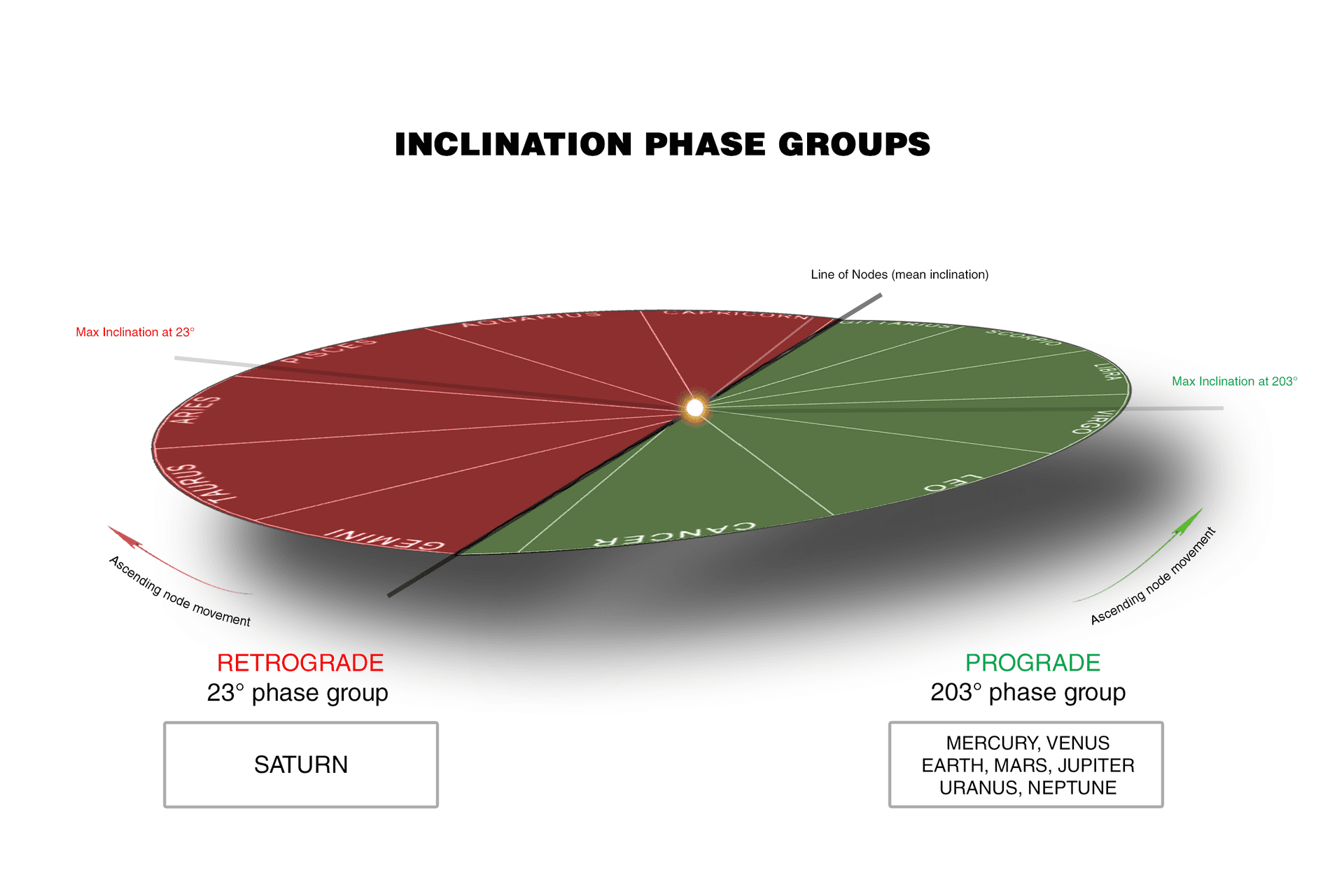
Each planet has a per-planet cycle anchor — the ICRF perihelion longitude that defines its inclination oscillation. The anchors are set so that at the balanced year (302,635 BC), all eight planets simultaneously reach minimum inclination. Saturn is anti-phase: its cosine sign is flipped in the formula, giving it the opposite contribution to the balance sum — but its inclination still lands at the minimum alongside the others at the balanced year. This synchronised minimum recurs once per Solar System Resonance Cycle (8H).
| Group | Planets |
|---|---|
| In-phase | Mercury, Venus, Earth, Mars, Jupiter, Uranus, Neptune |
| Anti-phase | Saturn (sole member) |
The group assignment is constrained by: (1) each planet’s oscillation range must fall within the Laplace-Lagrange secular theory bounds, (2) the inclination structural weights must balance (Law 3), and (3) the eccentricity weights must balance (Law 5).
Precession Periods
| Planet | Period (years) | Expression |
|---|---|---|
| Mercury | 243,867 | 8H/11 |
| Venus | 447,089 | −8H/6 (ecliptic-retrograde) |
| Earth | ~111,772 | |
| Mars | 74,515 | 8H/36 |
| Jupiter | 68,783 | 8H/39 |
| Saturn | 41,270 | −8H/65 (ecliptic-retrograde) |
| Uranus | 111,772 | H/3 |
| Neptune | 670,634 | 2H |
Law 1: The Fibonacci Cycle Hierarchy
Earth’s major precession periods divide the Earth Fundamental Cycle 335,317 by Fibonacci numbers — (inclination), (ecliptic), (obliquity), (axial). The Fibonacci addition rule connects them: , . The Fibonacci-divisor identities are structural and invariant at any epoch; the literal year counts in the table below are J2000 snapshots that rescale at geological time (see Expanding Resonance).
| Fibonacci | Period (years) | Earth’s astronomical cycle | |
|---|---|---|---|
| ~111,772 | Apsidal precession (ICRF) | ||
| ~67,063 | Ecliptic precession | ||
| ~41,915 | Obliquity cycle | ||
| ~25,794 | Axial precession | ||
| 15,967 | Beat frequency () | ||
| 9,862 | Beat frequency () |
Beat frequency rule
The beat frequencies of consecutive Fibonacci-divided periods satisfy the Fibonacci recurrence:
This is an algebraic identity, not an empirical fit. For example:
- (i.e., )
- (i.e., )
- (i.e., )
The empirical content of Law 1 is that Earth’s major precession periods — inclination (), ecliptic (), obliquity (), axial () — are all related to a single timescale through Fibonacci denominators. The higher-order periods (, ) then follow as beat frequencies. The structural balance that locks Jupiter’s ICRF perihelion period to Saturn’s ecliptic perihelion period — Fibonacci anchor at , 8H-lattice secular at , with Earth’s obliquity one lattice step away — is the subject of Law 6. See also Precession for the physical meaning of each cycle.
Connection to Laws 2–5: The Fibonacci numbers that organize the timescale hierarchy (3, 5, 8, 13, 21, 34) reappear as the divisors in Laws 2–5. The period denominators , , directly determine the -constant via — see The Universal Constants ψ and K.
Law 2: Inclination Amplitude
Each planet’s mass-weighted inclination amplitude, multiplied by its Fibonacci divisor, equals the universal -constant:
Equivalently:
This holds for all 8 planets with a single universal = 3.3070 × 10⁻³.
Why the symbol ? A notation choice — appears in the AMD energy formula , where the Fibonacci divisor takes the role of an integer index, an algebraic form reminiscent of how integer quantum numbers appear in quantum-mechanical energy partitions — see Physical meaning of . The resemblance is purely formal; the model makes no claim about quantum physics.
Predictions and Laplace-Lagrange validation
| Planet | Predicted amp (°) | Mean (°) | Range (°) | LL bounds (°) | |
|---|---|---|---|---|---|
| Mercury | 21 | 0.386501 | 6.703228 | 6.32 – 7.09 | 4.57 – 9.86 |
| Venus | 34 | 0.062168 | 2.151359 | 2.09 – 2.21 | 0.00 – 3.38 |
| Earth | 3 | 0.63607 | 1.48113 | 0.845 – 2.117 | 0.00 – 2.95 |
| Mars | 5 | 1.164287 | 1.833263 | 0.67 – 3.00 | 0.00 – 5.84 |
| Jupiter | 5 | 0.021405 | 0.321086 | 0.30 – 0.34 | 0.24 – 0.49 |
| Saturn | 3 | 0.065196 | 0.984969 | 0.92 – 1.05 | 0.797 – 1.02 |
| Uranus | 21 | 0.023832 | 1.015183 | 0.99 – 1.04 | 0.90 – 1.11 |
| Neptune | 34 | 0.013552 | 0.743803 | 0.73 – 0.76 | 0.55 – 0.80 |
The equation holds by construction. The non-trivial test is that every predicted range (mean amplitude) falls within the Laplace-Lagrange secular theory bounds — and all 8 do.
Worked example: Earth’s inclination amplitude
Earth has Fibonacci divisor (). Step by step:
| Quantity | Expression | Value |
|---|---|---|
| (from Earth) | 3.3070 × 10⁻³ | |
| 3 | ||
| Earth mass (Holistic chain) | ||
| amplitude | 0.63607° |
The mean is computed from the J2000 constraint:
Substituting Earth’s values:
| Input | Value |
|---|---|
| 1.57869° | |
| amplitude | 0.63607° |
| 102.947° | |
| (cycle anchor) | 21.77° |
| cos(102.947° − 21.77°) | |
| mean | 1.57869° − 0.63607° × 0.1534 = 1.48113° |
Physical meaning of : mass-independent AMD partition
Substituting the Law 2 formula into the standard Angular Momentum Deficit gives each planet’s inclination oscillation AMD:
Mass cancels exactly. Law 2 appears to depend on mass — heavier planets tilt less. But that apparent mass dependence is precisely what removes mass from the energy budget: is the unique exponent that makes this cancellation work. Each planet’s inclination oscillation energy depends only on its orbital distance () and Fibonacci quantum number (), not on how massive the planet is. This is not an approximation — it is an algebraic identity (see Why ).
The formula separates into three independent factors:
| Factor | Meaning |
|---|---|
| Orbital geometry (Kepler) | |
| Fibonacci partition — higher means less oscillation energy | |
| Universal scale — the total oscillation energy budget |
Summing over all planets and solving for gives a budget equation that determines ‘s magnitude:
This means is fixed by two things: the total inclination oscillation energy (set by formation physics) and the geometric sum (set by Fibonacci structure and Kepler spacing). Neither can be changed independently.
How this differs from Law 3: Law 3 says the amplitudes cancel between phase groups (vector balance). The budget equation says what determines the magnitude of — why it equals 3.3070 × 10⁻³ and not some other value. Law 3 constrains the geometry; the budget equation constrains the scale.
The scaling gives the role of a quantum number: each planet is assigned a Fibonacci slot that determines its share of the eight-planet inclination oscillation energy:
| Planet | Share | ||
|---|---|---|---|
| Mercury | 21 | 0.0014 | 0.2% |
| Venus | 34 | 0.0007 | 0.1% |
| Earth | 3 | 0.1111 | 18.2% |
| Mars | 5 | 0.0494 | 8.1% |
| Jupiter | 5 | 0.0912 | 14.9% |
| Saturn | 3 | 0.3430 | 56.1% |
| Uranus | 21 | 0.0099 | 1.6% |
| Neptune | 34 | 0.0047 | 0.8% |
Saturn dominates (56.1%) not because of mass (Jupiter is heavier) but because combined with a large orbit maximizes . Earth carries more oscillation energy than Jupiter (18.2% vs 14.9%) despite being lighter — its beats Jupiter’s in the scaling. The Earth–Saturn pair () carries 74% of the eight-planet total, and the E–J–S resonance triad (Law 6) carries 89% — consistent with their role as the dynamically dominant subsystem. (Shares are relative to the eight major planets, which carry 99.994% of the system’s orbital angular momentum; TNOs contribute the remainder.)
Connection to Law 3: The same structural properties that make Saturn the dominant energy carrier — and a large orbit — also make it the sole counterweight in the inclination balance (Law 3). In the mass-independent energy partition above, Saturn carries 56.1%. In the mass-dependent balance of Law 3, Saturn carries exactly 50% (by definition — it equals the other seven combined). The gap is absorbed by mass: Jupiter is heavier than Saturn, which boosts Jupiter’s balance weight relative to its energy share, redistributing the load to an exact 50/50 split.
Law 3: Inclination Balance
The angular-momentum-weighted inclination amplitudes cancel between the two phase groups, conserving the orientation of the invariable plane:
Physical motivation
The invariable plane is the fundamental reference plane of the solar system, perpendicular to the total angular momentum vector. For this plane to remain stable, the angular-momentum-weighted inclination oscillations must cancel between the two balance groups. If they didn’t, the total angular momentum vector would wobble — violating conservation of angular momentum.
Substituting the Fibonacci formula
With and :
Since is a single universal constant, it cancels from both sides:
where is the structural weight for each planet.
Structural weights
| Planet | Group | ||
|---|---|---|---|
| Mercury | In-phase | 21 | |
| Venus | In-phase | 34 | |
| Earth | In-phase | 3 | |
| Mars | In-phase | 5 | |
| Jupiter | In-phase | 5 | |
| Uranus | In-phase | 21 | |
| Neptune | In-phase | 34 | |
| Saturn | Anti-phase | 3 |
Balance: 99.9974% (with phase-derived base eccentricities)
Jupiter () contributes the dominant in-phase weight (). Saturn () alone carries the entire anti-phase contribution. The remaining six in-phase planets collectively contribute to match the Saturn–Jupiter difference. The eccentricity enters through the angular momentum factor ; the phase-derived base eccentricities are the values at which this balance approaches exactness.
TNO contribution
The balance considers only the 8 major planets, which carry 99.994% of the solar system’s orbital angular momentum. Trans-Neptunian Objects (TNOs) contribute the remaining ~0.006%, tilting the invariable plane by approximately 1.25″ (Li, Xia & Zhou 2019 ).
Law 4: The Eccentricity Amplitude Constant
A single universal constant predicts all eight eccentricity oscillation amplitudes from Fibonacci divisors, mass, distance, and axial tilt:
3.4143 × 10⁻⁶, derived from Earth’s eccentricity amplitude and axial tilt. This is the eccentricity analog of (Law 2) for inclination amplitudes.
Both and are empirical constants derived from Earth, and both predict all 8 planets with zero free parameters. additionally uses semi-major axis and axial tilt, coupling the spin and orbital domains. Earth’s own input is derived rather than fitted: it closes the 1246 triangle with 1246.03 = 12.95° — the arm-to-arm phase since the perihelion–solstice alignment — giving = 0.0013559 against the stored 0.001356; under the one-law eccentricity (Eccentricity) it is an of-date-class quantity that does not enter . This coupling is bidirectional: a planet’s mean obliquity determines its eccentricity amplitude, and its eccentricity amplitude reveals its obliquity. Together, and link all three oscillation parameters — inclination amplitude, eccentricity amplitude, and axial tilt — through just two constants.
Worked example: Earth’s eccentricity amplitude
Earth has Fibonacci divisor , mean obliquity 23.41353°, and semi-major axis AU. Step by step:
| Quantity | Expression | Value |
|---|---|---|
| Earth’s eccentricity amplitude (input) | 0.001356 | |
| Earth’s mean obliquity | 23.41353° | |
| 23.41353° | 0.39714 | |
| 3 | ||
| 1.73205 | ||
| Earth mass (Holistic chain) | ||
| 1.000 | ||
| 3.4143 × 10⁻⁶ |
Verification — plugging back into the formula recovers the input amplitude:
| Step | Expression | Value |
|---|---|---|
| ratio | ||
| 3.4143 × 10⁻⁶ 397.02 | 0.001356 |
The same value then predicts all other planets’ eccentricity amplitudes — using each planet’s own obliquity, , mass, and semi-major axis — with zero additional free parameters.
Note on base eccentricities: Laws 2 and 4 predict oscillation amplitudes. The base (mean) eccentricities are partially constrained by Law 5, which predicts Saturn’s from the other seven. The remaining seven base eccentricities are derived from the System Reset phase (n=7) with balance-group phase offsets (90° in-phase, 270° Saturn) — see Finding 4.
Law 5: Eccentricity Balance
The mass- and distance-weighted eccentricities of seven planets balance against Saturn’s alone — using the same Fibonacci divisors and phase groups as Law 3:
where
Or equivalently, in terms of orbital period :
Eccentricity balance weights
| Planet | Group | ||
|---|---|---|---|
| Mercury | In-phase | 21 | 4.403 × 10⁻⁶ |
| Venus | In-phase | 34 | 1.272 × 10⁻⁶ |
| Earth | In-phase | 3 | 1.539 × 10⁻⁵ |
| Mars | In-phase | 5 | 4.379 × 10⁻⁵ |
| Jupiter | In-phase | 5 | 7.928 × 10⁻³ |
| Uranus | In-phase | 21 | 5.705 × 10⁻³ |
| Neptune | In-phase | 34 | 1.733 × 10⁻³ |
| Saturn | Anti-phase | 3 | 1.547 × 10⁻² |
= 1.543 × 10⁻², = 1.547 × 10⁻²
Balance: 99.8636% (with phase-derived base eccentricities)
Saturn alone carries the entire anti-phase contribution. The in-phase group is dominated by Jupiter (7.928 × 10⁻³), Uranus (5.705 × 10⁻³), and Neptune (1.733 × 10⁻³), with the four inner planets contributing only 6.5 × 10⁻⁵ combined.
The ~0.14% residual — two-channel decomposition
The eccentricity balance reaches 99.8636% but not exactly 100%. Sensitivity analysis on the 8-planet sum rules out mis-measurement of any single planet’s mass or orbit: the required shifts are 4–6 orders of magnitude larger than DE440/JPL precision. The residual decomposes into two physically-motivated channels:
(i) Minor-body contributions (~96% of the residual). Substituting Law 4 (e_amp = K · sin(tilt) · √d / (√m · a^(3/2))) into the Law-5 weight v = √m · a^(3/2) · e / √d produces a striking cancellation: every body following Law 4 contributes a uniform v = K · sin(tilt) ≈ 1.7 × 10⁻⁶ to the eccentricity balance, independent of mass and distance (the a^(3/2) and √m factors cancel exactly). Random ± in-phase/anti-phase aggregation across N ≈ 625 such bodies gives σ ≈ 4.3 × 10⁻⁵, matching the observed residual. The relevant population is sub-200 km low-eccentricity classical-belt KBOs, where the body’s actual oscillation amplitude approximates the Law-4 intrinsic prediction. Named TNOs (Pluto, Eris, Haumea, Sedna, …) are not part of this aggregation: their actual eccentricity amplitudes are dominated by external forcing (Neptune resonance, scattering, galactic tides), not by intrinsic Law-4 dynamics. For Pluto specifically, long-term numerical integrations (Williams & Benson 1971, Malhotra & Williams 1997) give actual e_amp ≈ 0.025, whereas Law 4’s intrinsic prediction is ~0.001 — a 1:24 intrinsic-to-external split, with Law 4 correctly capturing the intrinsic baseline while Neptune’s 3:2 resonance pumps the amplitude by ~25×.
(ii) Mass uncertainty (~4% of the residual). Uranus and Neptune masses are currently constrained only by Voyager 2 flybys (relative uncertainties ~5 × 10⁻⁴); the other six are known to 10⁻⁶ – 10⁻⁸ from orbiters and ranging. A 10⁵-trial Monte Carlo perturbation gives a combined σ ≈ 1.5 × 10⁻⁶ contribution to the Law-5 gap, dominated by Uranus.
Testable predictions. (a) The Vera Rubin Observatory (LSST, 2025–2035) is expected to constrain rotation poles for ~10³ small TNOs; a statistical clustering of small classical-belt KBO obliquities near arcsin(K · √d · a^(-3/2) · √m / e) would empirically support the bidirectional reading of Law 4 beyond the eight planets. (b) A future Uranus or Neptune orbiter (e.g., NASA’s proposed Uranus Orbiter and Probe, ~2032) would shrink the mass-uncertainty channel by ~100×, leaving the minor-body signature largely intact — discriminating the two channels in the budget.
Law-4 closure as a quantitative criterion for planethood. The pattern of which bodies satisfy Law-4 closure (actual e_amp ≈ intrinsic Law-4 prediction) and which are externally dominated maps onto the IAU’s 2006 third criterion: “has cleared the neighborhood around its orbit.” Bodies that have cleared their neighborhood evolve under their own dynamics — their secular e_amp is set intrinsically by Law 4. Bodies that have not (Pluto and the plutinos, scattered-disk objects, Sedna, comets, asteroids) have their secular evolution dominated by external coupling, exactly as the IAU criterion implies. The two formalisations partition the same eight bodies. Soter (2006) proposed a mass-discriminant Λ to formalise the IAU criterion quantitatively, but Λ never became canonical. Law-4 closure provides a different quantitative formalisation that returns a clean pass/fail and matches the same 8-body partition. The agreement is not tautological: all proposed Planet Nine candidates fail Law-4 closure by 4–7 orders of magnitude independent of how the observed eccentricity is interpreted (see Planet Nine prediction), making Law-4 closure a predictive criterion rather than a post-hoc relabelling.
Comparing the two balance conditions
| Property | Inclination weight | Eccentricity weight |
|---|---|---|
| Formula | ||
| scaling | ||
| scaling | ||
| role | Weak () | Direct (linear in ) |
The half-power difference in Fibonacci divisor scaling ( vs ) and the shift from to reflect that the eccentricity balance operates at a different order in secular perturbation theory.
The eccentricity balance is not a structural artifact — see Finding 3 for three independence tests.
Connection to AMD theory
The established AMD formula of Laskar (1997) couples eccentricity and inclination through a single conserved quantity: . For small and : .
The eccentricity balance operates on linear rather than , suggesting it captures a first-order secular constraint distinct from the quadratic AMD conservation. The physical mechanism producing this linear balance remains an open question.
Law 6: The Saturn-Jupiter-Earth Resonance
Jupiter’s ICRF perihelion period and Saturn’s ecliptic perihelion period lock to a single period: yr — a structural balance of the solar system, not a coincidence, and the obliquity beat recorded in Earth’s climate. Earth’s own obliquity sits one -lattice step away at the Fibonacci value (= ): obliquity is Earth’s axial precession () beating against the ecliptic, so beating against the gas giants’ actual ecliptic period gives , while beating against Law 1’s Fibonacci anchor gives . The single-integer shift in the ecliptic period () propagates one-for-one into the obliquity beat (). The gas giants drive Earth’s spin-axis dynamics through their mutual resonance lock. At the Fibonacci-anchor level all three quantities collapse onto , closing through .
Saturn’s perihelion precesses obviously retrograde in the ecliptic frame (period ). JPL’s WebGeoCalc confirms this at ~-3,400 arcsec/century from SPICE ephemeris data, consistent in sign and order with the model’s lattice rate of -3,140.3 arcsec/century in ecliptic longitude (the WebGeoCalc magnitude is window-dependent). Standard celestial mechanics attributes the observed ecliptic-retrograde motion to a transient phase of the ~900-year Great Inequality (Laplace 1784) — and the model’s own N-body engine agrees with that mechanism: the retrograde is the window phase of the epicycle, with the long-term mean prograde (), so is a window-epoch descriptor of the present era’s motion. See Supporting Evidence §12 for the full record.
The Fibonacci anchors that place Jupiter and Saturn in this resonance are Earth’s own precession periods — ecliptic precession () and obliquity (), the first terms of Law 1’s hierarchy where and . Jupiter’s perihelion falls near Earth’s and Saturn’s near Earth’s , which is why the anchors are Fibonacci-clean — but the planets’ actual secular periods are and , one lattice integer off on the 8H lattice. The clean triangle is therefore Earth’s internal precession hierarchy (Law 1), not a relation among the planets’ true periods.
Why Earth, Jupiter, and Saturn hold special roles
The genuine three-body relation is the 8H-lattice secular lock: Jupiter’s ICRF perihelion and Saturn’s ecliptic perihelion coincide at — the period at which they drive Earth’s obliquity (the climate-recorded beat; Earth’s own obliquity cycle is , one step off). This is why these three planets recur throughout the Fibonacci Laws: they also dominate the inclination balance (Law 3) and the eccentricity balance (Law 5), three independent structural arguments converging on the same trio. Earth’s (shared only with Saturn) feeds the universal inclination constant directly.
Findings
Findings are empirical observations and consequences that follow from the six laws.
Finding 1: Mirror Symmetry
As shown in the Planet Configuration table, each inner planet shares its with its outer counterpart across the asteroid belt: Mars ↔ Jupiter (), Earth ↔ Saturn (), Venus ↔ Neptune (), Mercury ↔ Uranus (). Earth–Saturn is the only pair with opposite balance groups (in-phase vs anti-phase). The divisors form two consecutive Fibonacci pairs: for the belt-adjacent planets and for the outer planets.
Finding 2: Configuration Uniqueness
The exhaustive search tested 7,558,272 configurations through a pipeline of successively stricter physical constraints:
| Filter | Surviving |
|---|---|
| Inclination balance ≥ 99.994% (TNO margin) | 767 |
| + Eccentricity balance ≥ 99% | 96 |
| + Per-config optimised anchor gives LL bounds 8/8 | 51 |
| + Direction match + rate error ≤ 6″ (Jupiter–Saturn shared ascending node) | 15 |
| + Mirror symmetry | 1 |
Per-config optimisation. The Laplace–Lagrange bounds and direction-trend checks depend on two parameters that are not determined by the -values alone: the anchor position (where in the 8H Solar System Resonance Cycle the balanced year falls — this sets all cycle anchors) and the ascending node integer per planet ( regression period ). Each of the 96 candidates passing both balance thresholds is evaluated at its own optimal , making the comparison fair. Jupiter and Saturn are constrained to share the same , preserving their lockstep ascending node regression.
Of the 15 survivors, only one is mirror-symmetric: Config #4 (0.0000132% of the search space). Since Earth is locked at , only Scenario A (Saturn ) can produce the Earth↔Saturn mirror pair. It ranks #4 of 15 by eccentricity balance (99.8636%).
The search space covers:
- Fibonacci divisors: for Mercury, Venus, Mars, Uranus, Neptune
- Balance group: in-phase or anti-phase for each planet (2 options each). Each planet’s inclination cycle anchor is its ICRF perihelion longitude at the System Reset (where the planet reaches its inclination extremum).
- 4 scenarios for Jupiter and Saturn: A: Ju=5, Sa=3 — B: Ju=8, Sa=5 — C: Ju=13, Sa=8 — D: Ju=21, Sa=13
- Earth: locked at , in-phase group, cycle anchor ~21.77°
- Total: 7,558,272 configurations
The mirror symmetry was not assumed — it emerged from the exhaustive search as the unique configuration surviving all five physical filters. All 15 surviving configurations are available for comparison in the interactive Balance Explorer .
Finding 3: Eccentricity Balance Independence
The eccentricity balance (Law 5) is genuinely independent from the inclination balance (Law 3). Three tests confirm it is not a structural artifact:
- Coefficient test: The weight formula without eccentricities () gives only 74% balance — the actual eccentricity values contribute 26 percentage points of improvement
- Random test: Substituting random eccentricities into the same weight formula gives 50–85% balance across 1,000 trials
- Power test: The balance peaks sharply at (99.8636%), dropping substantially for other powers — linear eccentricity is special
Additionally, the ratio varies by a factor of ~150 across planets, confirming the two balance conditions are not proportional.
Finding 4: Saturn Eccentricity Prediction and Law Convergence
Since Saturn is the sole anti-phase planet, the eccentricity balance directly predicts its eccentricity from the other seven:
Law 5 predicts Saturn’s eccentricity from the other seven planets:
| Source | vs base | |
|---|---|---|
| Law 5 (eccentricity balance, all eight planets) | 0.05372 | 0.27% |
| Base eccentricity (model midpoint) | 0.05387 | — |
Why this is significant: Saturn’s eccentricity oscillates secularly between ~0.01 and ~0.09 (a factor-of-9 dynamic range). The Fibonacci divisors were originally chosen to match precession periods (Law 1) and inclination balance (Law 3); the eccentricity prediction was never optimized for. Law 4 predicts all eight eccentricity amplitudes; Law 5 additionally predicts Saturn’s base eccentricity to ~0.27% of the observed value. The remaining seven base eccentricities are phase-derived at runtime from K, J2000 observations, and the System Reset anchor (n=7) with balance-group phase offsets (90° in-phase, 270° Saturn).
Finding 5: No Universal Eccentricity Base Constant
A comprehensive search across ~30 physical and Fibonacci parameters confirms that no combination yields a planet-universal constant for base eccentricities analogous to the inclination .
The search tested all power-law combinations of: semi-major axis, orbital period, mass, apsidal precession period, perihelion precession period, AMD, Hill radius, orbital angular momentum, secular eigenfrequencies (- and -modes), Kozai integral, mean inclination, eccentricity half-angle , Fibonacci divisors (, ), and cross-parameter ratios — across 1-, 2-, 3-, and 4-parameter combinations with fractional exponents.
Results (excluding tautologies that restate the inclination law):
| Best spread | Formula | Interpretation |
|---|---|---|
| 0.54% | Reduces to — a mathematical identity for small with no discriminating power | |
| 23% | where | Best genuine physics combination; Earth is a 19% outlier |
| 195% | Best single-parameter result; proven to be an identity where eccentricity cancels |
The fundamental reason: the inclination divisors span only 11× (from 3 to 34), allowing a single to work. The eccentricity multipliers span 141× (from 1 to 141) with no smooth dependence on any present-day observable.
Script: fibonacci_eccentricity_constant.py — modular search engine with ~30 parameters, 9 search strategies, and fine-grid refinement.
Law 4 Details: The K Constant
The K constant formula and derivation are described in Law 4 above. Additional details:
Eccentricity at any time:
where and . Verification: at the formula reduces to (minimum), at to (maximum), and at to . The asymmetric dependence preserves the Law 5 eccentricity balance at every epoch, not only at the extrema.
Balance preservation. The Law 5 weight change from eccentricity oscillation simplifies to — mass and distance cancel completely. This ensures the eccentricity balance is preserved at every epoch.
J2000 eccentricity phase angles (for the formula). Each planet’s phase is determined by its position in the eccentricity oscillation cycle at J2000, using the System Reset (n=7) as the common timing anchor with a balance-group phase offset (90° for in-phase planets, 270° for Saturn). At n=7, every planet simultaneously passes through its mean eccentricity — in-phase planets rising, Saturn falling — mirroring the inclination alignment:
| Planet | Wobble period | |
|---|---|---|
| Mercury | 104.12° | 31,935 yr |
| Venus | 11.77° | 141,186 yr |
| Earth | 192.95° | ~20,957 yr (= H/16) |
| Mars | 235.89° | 51,587 yr |
| Jupiter | 268.83° | 60,967 yr |
| Saturn | 318.84° | 16,457 yr |
| Uranus | 120.59° | 33,532 yr |
| Neptune | 38.24° | 26,825 yr |
The wobble period is the beat frequency of each planet’s axial precession and ICRF perihelion precession. For the seven planets other than Earth, the phase determines the base eccentricity (oscillation midpoint) via the law of cosines with the J2000 observed eccentricity and K-derived amplitude. Earth is the exception: its eccentricity rides the one H/3 law with a derived mean (see Eccentricity); its wobble beat is the perihelion-direction cycle.
The Universal Constants and
Both and are empirical constants derived from Earth’s fitted parameters:
= 3.3070 × 10⁻³
= 3.4143 × 10⁻⁶
Given , a planet’s mass, and its Fibonacci divisor , the inclination amplitude is fully determined. Given , the same parameters plus distance and axial tilt determine the eccentricity amplitude.
The ratio (0.04% error) is a striking near-integer, but whether this reflects deeper structure is an open question.
Physical Foundations
Why : the Angular Momentum Deficit connection
The quantity (or ) has a direct connection to the Angular Momentum Deficit (AMD), the standard dynamical quantity in celestial mechanics:
where and are exactly the mass-weighted quantities used in the Fibonacci laws. The exponent is uniquely determined by the AMD decomposition — no other mass power produces this sum-of-squares form.
A deeper consequence: substituting Law 2 into the AMD formula causes mass to cancel entirely, revealing that the Fibonacci divisor acts as a quantum number governing mass-independent energy partition — see Physical meaning of under Law 2.
Connection to KAM theory
The appearance of Fibonacci numbers in mass-weighted orbital parameters has a theoretical explanation through KAM theory (Kolmogorov 1954, Arnold 1963, Moser 1962): orbits survive if their frequency ratio satisfies a Diophantine condition — a quantitative measure of irrationality — and the golden ratio (whose convergents are the Fibonacci ratios ) is the hardest irrational to approximate by rationals (Hurwitz 1891). Greene (1979) showed the last invariant torus to break as perturbation increases has frequency ratio ; Morbidelli & Giorgilli (1995) proved golden-ratio KAM tori have superexponentially long stability times.
Over 4.6 Gyr of evolution, orbits near low-order rational resonances are disrupted (Kirkwood gaps); orbits near golden-ratio KAM tori survive. The surviving population is organised around Fibonacci ratios. The AMD-natural variables and are the action-like variables in the secular Hamiltonian, and KAM stability constrains these to Fibonacci ratios — providing the theoretical foundation for why Fibonacci numbers specifically appear. Full conceptual treatment: Physical Origin; empirical evidence: Supporting Evidence §2.
Time independence
The Fibonacci laws use oscillation amplitudes (secular eigenmode properties), not instantaneous orbital elements. The -constants and balance conditions use amplitudes — properties of secular eigenmodes that are exactly time-independent by construction. Base eccentricities are phase-derived at runtime from the K amplitude, J2000 observations, and the System Reset anchor (n=7) with balance-group phase offsets, encoding a formation-epoch constraint preserved in the eigenmodes since the dissipative era.
Statistical Significance
Molchanov’s 1968 work was criticized by Backus (1969) for not proving statistical significance. To address this, a comprehensive significance analysis was performed using three independent null models and eleven test statistics covering all six laws, explicitly accounting for the look-elsewhere effect.
Methodology. Eleven test statistics are computed for the real Solar System and compared against random planetary systems:
- Law 1 — Fibonacci denominators — The 8 inclination-cycle periods have the form . How many of the denominators fall in the Fibonacci set ? Observed: 7/8 (Mercury’s is the only non-Fibonacci).
- Law 2 — full 8-planet — How constant is across all 8 planets using the model amplitudes? Observed: 0.0000% spread (exact by construction of ; permutation still meaningful).
- Law 3 — Inclination balance — With the model’s Fibonacci -values, phase groups, and phase-derived base eccentricities, how well do the structural weights cancel? Observed: 99.9974%.
- Law 4 — K amplitude constant — Can a single constant predict all 8 eccentricity amplitudes via ? Observed: 0.0000% error (exact by construction of ; permutation test is still valid).
- Law 5 — Eccentricity balance — With the same -values, phase groups, and phase-derived base eccentricities, how well do the eccentricity weights cancel? Observed: 99.8636%.
- Law 6 — E–J–S resonance — Do Jupiter’s ICRF perihelion and Saturn’s ecliptic perihelion coincide at the same period (Earth’s obliquity beat)? Holds at J2000 in the model’s frames: exact (both ) — a lattice identity, not an observation (nothing at 41-kyr periods is directly observed).
- Finding 1 — Mirror symmetry — How many of the 4 inner–outer mirror pairs share the same -value? Observed: 4/4 pairs match.
- Finding 1b — d-set Fibonacci clustering — Does the set of distinct -values form exactly two consecutive Fibonacci pairs? Observed: yes — .
- Finding 4 — Saturn eccentricity prediction — The eccentricity balance predicts Saturn’s base eccentricity from the other 7 planets. Observed: 0.27% error.
- Finding 6 — Solo planet identification — For each planet, compute the residual and take the minimum across all 8 planets. Saturn uniquely minimizes this. Observed: 0.27% min residual.
- Year-length beat identity — Do the sidereal/tropical and anomalistic/tropical year beats match the Fibonacci integers and ? Observed: 0.0048% max error (both beats match to better than ).
Tautology of Laws 2 and 4: The model defines the inclination amplitudes as and the eccentricity amplitudes as . So and the -amplitude relation hold identically by construction, not approximately. Both report 0.0000% — exact by construction, not measurements. Substituting external secular-theory amplitudes (e.g.\ Laskar) would not fix this — those values are themselves -body simulation outputs, not measurements; comparing one theoretical fit against another is not an independent statistical test. Laws 2 and 4 are reported as internal consistency checks but cannot contribute to the combined -value.
Structural vs. empirical tests. 7 of the 11 tests are structural and yield in the permutation null by construction. These fall into two groups.
Multiset-invariant (5 tests) — permutation cannot disturb them because the test sees only the multiset of values (or a single scalar):
- Law 1 (Fibonacci denominators — multiset invariant)
- Law 6 (E–J–S resonance — scalar integer identity)
- Finding 1 (Mirror symmetry — identity-dependent)
- Finding 1b (d-set clustering — multiset invariant)
- Year-length beat (single scalar)
Tautological (2 tests) — the model defines the test relation to hold identically:
- Law 2 ( full 8-planet) — amplitudes are defined as
- Law 4 ( amplitude constant) — eccentricity amplitudes are defined from
These 7 structural tests are reported in the table for transparency but excluded from the combined -value. The remaining 4 tests (Laws 3, 5; Findings 4 and 6) are empirical — sensitive to permutation — and form the basis of the combined statistic. They are not statistically independent: all four use the same fundamental quantity , so the combined -value absorbs a correlation penalty (see below).
Three null distributions were tested:
- Permutation (exhaustive, trials): same values, randomly reassigned to planets.
- Log-uniform Monte Carlo ( trials): random eccentricities from , amplitudes from , means from (log-uniform). Random -values from , random period denominators from , random year-length ratios.
- Uniform Monte Carlo ( trials): same ranges, flat distribution.
Masses are fixed at solar system values throughout (conservative).
Results (permutation: exhaustive ; Monte Carlo: trials):
| Test | Observed | Permutation | Log-uniform | Uniform |
|---|---|---|---|---|
| 1. Law 1 — Fib. denominators ‡ | 7/8 | |||
| 2. Law 2 — full § | 0.0000% | |||
| 3. Law 3 — Incl. balance | 99.9974% | |||
| 4. Law 4 — K amplitude § | 0.0000% | |||
| 5. Law 5 — Ecc. balance | 99.8636% | |||
| 6. Law 6 — E–J–S reson. ‡ | exact | |||
| 7. F1 — Mirror symm. ‡ | 4/4 | |||
| 8. F1b — d-set clustering ‡ | yes | |||
| 9. F4 — Saturn pred. | 0.27% | |||
| 10. F6 — Solo planet ID | 0.27% | |||
| 11. Year-length beat ‡ | 0.0048% | |||
| Joint permutation test (headline) | 1.5 × 10⁻⁴ | 1.0 × 10⁻⁶ | 1.0 × 10⁻⁶ |
‡ Structural / multiset-invariant (Laws 1, 6; Findings 1, 1b; Year-length beat). Permutation yields by construction, so these are excluded from the permutation combined statistic. Under the MC nulls (random solar systems), the tests are meaningful — random -assignments, random period denominators, and random year lengths all produce distinct null distributions — so they are included in the MC joint test.
§ Tautological (Laws 2 and 4). Model amplitudes are defined as and -derived, so the test relations hold identically under any null. Reported as internal-consistency checks; excluded from every combined statistic. See the warning callout above for why no permutation or MC null can test these.
Headline statistic: direct joint permutation test
The headline is a direct joint permutation test over the 4 empirical tests (Laws 3, 5; Findings 4, 6). Each test’s raw statistic is studentized against the null mean and standard deviation computed across all permutations; the four studentized z-scores are summed into a single combined statistic ; and the -value is the fraction of null permutations with .
This is the most defensible combined statistic because:
- Model-independent. No Gaussian, , or distributional assumption is made. The joint null distribution of is computed explicitly from the 40,320 permutations.
- Self-correcting for correlation. The four empirical tests all depend on the quantity , so they are positively correlated. Because the joint null is computed from the same shared permutation that generates the correlation, no explicit correction factor is needed — the correlation is baked into the null by construction. For reference, the measured average pairwise correlation under the permutation null is 0.283 (replacing an earlier estimate of that proved too conservative). Under the MC nulls the measured correlation is much smaller ( 0.032), because random -assignments break the shared dependency.
- No floor-clamp artifact. By construction , so the combined statistic never collapses to zero even for deeply significant results.
The joint test is computed under each of the three null distributions:
| Null | tests | Combined | Sigma equivalent | Interpretation |
|---|---|---|---|---|
| Permutation (headline) | 4 empirical | 1.5 × 10⁻⁴ | 3.62 | Most conservative; conditions on observed values, tests only the planet→value assignment |
| Log-uniform MC | 9 (emp. + MC-testable) | 1.0 × 10⁻⁶ | 4.75 | Tests against fully randomized planetary systems |
| Uniform MC | 9 (emp. + MC-testable) | 1.0 × 10⁻⁶ | 4.75 | Same, with flat distributional assumptions |
The MC combined statistics include five additional tests (Laws 1, 6; Findings 1, 1b; year-length beat) that are permutation-invariant but become meaningful under random solar systems. Laws 2 and 4 remain excluded under all nulls because they are tautological.
The permutation result (3.62) is the figure to cite. It makes no assumption about “what counts as a random planetary system” and is computed entirely from the observed planetary data. The Monte Carlo results (4.75 and 4.75) test the more general question — “would random systems reproduce this?” — and give a stronger answer (roughly 1 in 500,000 vs 1 in 10,000 for permutation). The two MC nulls agree to within , indicating insensitivity to the choice between log-uniform and uniform sampling.
Comparison with supporting approximations. Two older combining methods are reported for transparency but are approximations of the joint test:
- Stouffer’s with measured (permutation: 1.8 × 10⁻⁵, 4.1). Converts each per-test -value to a one-tailed and sums with a variance inflation factor . Uses the measured correlation 0.283 (previously hard-coded at 0.5, which was too conservative).
- Fisher’s method (permutation: 8.6 × 10⁻⁸). Combines log--values into a statistic. Highly sensitive to extreme small -values and to the floor-clamp at ; reported as a cross-check only.
Both give stronger apparent results than the direct joint test, but both rely on Gaussian / distributional assumptions that the direct test avoids. The gap is a useful indicator of how much the distributional approximations are contributing versus the raw data.
Jackknife: robustness to dropping any single planet
A leave-one-out jackknife re-runs the direct joint permutation test (now over permutations) with each planet removed from the system in turn. This quantifies how much of the combined signal rides on any one body.
| Planet dropped | Joint | Sigma | Notes |
|---|---|---|---|
| Mercury | Moderate contribution | ||
| Venus | Minor contribution | ||
| Earth | Minor contribution | ||
| Mars | Minor contribution | ||
| Jupiter | Load-bearing | ||
| Saturn | F4 becomes undefined; only 3 tests used | ||
| Uranus | Load-bearing | ||
| Neptune | Important | ||
| — full 8-planet suite — | 1.5 × 10⁻⁴ | 3.62 |
Dropping Jupiter collapses the signal to , and dropping Uranus collapses it to . This is consistent with — and required by — the model’s structural claims: the balance is global (each side of the Fibonacci -ladder must contribute), so removing any high- planet destroys the balance. The pattern matches what the six laws predict: a cooperative structure in which all eight planets participate, with the outer planets (Jupiter, Saturn, Uranus, Neptune) carrying the largest -weights.
Reaching the full 3.62 requires all eight planets. No individual planet alone drives the result.
Bottom line
All 4 empirical tests reach under the permutation null, and all 9 MC-combinable tests reach under both Monte Carlo nulls. The direct joint combined -value is robust across the three null distributions, comfortably exceeds the conventional “evidence” threshold, and lies just below the particle-physics “discovery” threshold (). Cited as a single figure, the model’s statistical signal is 3.62 under the most conservative null and 4.75–4.75 under the more general Monte Carlo nulls.
Exoplanet Context
Compact multi-planet exoplanet systems raise the question of whether Fibonacci patterns appear more broadly than the Solar System. TRAPPIST-1 (7 planets, TTV-measured) shows 5 of 6 adjacent period ratios near Fibonacci fractions (8:5, 5:3, 3:2, 3:2, 3:2) — 83% Fibonacci content; Kepler-90 (8 planets) shows 5 of 7 (71%). Consistent with broader exoplanet findings (Pletser 2019, Aschwanden 2018).
Neither system can test the deeper Fibonacci Laws: TRAPPIST-1 is a mean-motion resonance chain (so Fibonacci-like period ratios are partly a by-product of the resonance structure), with eccentricities spanning only ~0.002–0.01 (vs the Solar System’s 141× range), so Laws 3 and 5 are essentially untestable, and transit inclinations measure viewing geometry rather than dynamical amplitudes (so Law 2 is inaccessible). Kepler-90 has only two TTV-measured masses and eccentricities. TTV uncertainties (typically 5–8%) are larger than any fine structural match. The period-ratio observations are therefore suggestive rather than confirmatory and are not used as support for any of the eleven significance tests above, which rest entirely on Solar System data.
Relation to Prior Work and What’s Novel
Existing Fibonacci research in planetary science
Molchanov (1968) — Integer resonances in orbital frequencies
Molchanov proposed that planetary orbital frequencies satisfy simultaneous linear equations with small integer coefficients. His framework used general small integers — not specifically Fibonacci numbers — and dealt exclusively with orbital frequencies. He did not incorporate planetary masses, eccentricities, or inclinations.
Key difference: Molchanov found approximate integer relations among frequencies. Our laws use specifically Fibonacci numbers, applied to mass-weighted eccentricities and inclinations.
Aschwanden (2018) — Harmonic resonances in orbital spacing
Aschwanden identified five dominant harmonic ratios governing planet and moon orbit spacing, achieving ~2.5% accuracy on semi-major axis predictions. The analysis is purely kinematic — planetary mass, eccentricity, and inclination do not appear.
Key difference: Aschwanden analyzed distance/period ratios between consecutive pairs. Our laws analyze mass-weighted values of individual planets.
Pletser (2019) — Fibonacci prevalence in period ratios
Pletser found ~60% alignment of period ratios with Fibonacci fractions, with the tendency increasing for minor planets with smaller eccentricities and inclinations. He used eccentricity and inclination only as selection filters.
Key difference: Pletser did not analyze whether eccentricities or inclinations themselves form Fibonacci ratios. Mass-weighting is entirely absent. None of our six laws appear in his analysis.
Comparison table
| Aspect | Molchanov (1968) | Aschwanden (2018) | Pletser (2019) | This work |
|---|---|---|---|---|
| Parameters | Frequencies only | Periods/distances | Period ratios | Eccentricity, inclination, mass |
| What is compared | Linear frequency sums | Consecutive pair ratios | Pairwise period ratios | Mass-weighted individual values |
| Uses mass? | No | No | No | Yes () |
| Uses eccentricity? | No | No | As filter only | Yes (primary variable) |
| Predicts elements? | No | Distances only | No | Yes (eccentricities, inclinations) |
For a detailed discussion of what builds on established theory versus what is genuinely novel (9 items), see Relation to Existing Physics.
Assessment
The balance conditions (Laws 3 and 5) combine known conservation principles with a novel Fibonacci structure that modulates the planetary weights. The conservation laws guarantee that inclination and eccentricity oscillations balance around the invariable plane — but they do not predict that integer Fibonacci divisors should preserve that balance to such high precision. Laws 2 and 4 (the amplitude constants and ) are the most genuinely novel claims — no existing theory predicts that Fibonacci divisors should produce universal constants for either inclination or eccentricity amplitudes across all eight planets.
The key unresolved question is why Fibonacci numbers work: do they encode something about the secular eigenmode structure (real physics), or is the Fibonacci restriction a coincidence made possible by having enough number choices? The mirror symmetry and the triple-constraint uniqueness of Config #4 argue against coincidence, but a theoretical derivation from first principles — or a successful prediction for an independent system such as exoplanetary or satellite systems — would be needed to settle the question definitively.
Vector Balance and Eigenmode Analysis
The scalar balance laws (Law 3, Law 5) determine the unique d-value configuration. A separate question is whether the angular momentum perturbation vectors cancel at all times, not just on average. Each planet’s orbital tilt creates a 2D perturbation with ; for the invariable plane to be stable, at every instant.
In the model’s single-mode approximation (one constant 8H/N rate per planet), the vectors rotate at different speeds, and the cancellation geometry breaks over time — vector balance can drop to ~72% at some epochs. In a multi-mode reconstruction (7 eigenmodes per planet matching excluding ), vector balance is maintained at 100% — but this is a mathematical property of the solver (56 free parameters, only 23 constraints; 33 degrees of freedom), not a unique validation of any specific frequency set. The invariable plane is stable by definition; any eigenmode decomposition that reproduces the J2000 state will automatically maintain that.
| Constraint | Status | Laskar equivalent |
|---|---|---|
| Scalar inclination balance (Law 3) = 99.9974% | ✓ Real, selects d-values | None |
| Scalar eccentricity balance (Law 5) = 99.8636% | ✓ Independent constraint | None |
| Fibonacci d-values with mirror symmetry | ✓ Structural prediction | None |
| 8H/N ascending node periods fit JPL J2000 trends | ✓ ~5.8″/cy cumulative residual (7 planets) | N/A (Laskar measures, doesn’t predict) |
Full ascending-node periods (8H/N integer table, JPL J2000-fixed-frame fits, Jupiter–Saturn lockstep at N=36, cumulative residual ~5.8″/cy) are canonical at Invariable Plane §Ascending node periods. The model’s structural advantage there: all 7 periods derive from a single constant , while Laskar’s are 7 independent measurements with no known relationship to each other.
Open Questions
For the full list of open questions, see What Remains Unknown.
References
Fibonacci and orbital resonance
- Molchanov, A.M. (1968). “The resonant structure of the Solar System.” Icarus, 8(1-3), 203-215. ScienceDirect
- Backus, G.E. (1969). “Critique of ‘The Resonant Structure of the Solar System’ by A.M. Molchanov.” Icarus, 11, 88-92.
- Molchanov, A.M. (1969). “Resonances in complex systems: A reply to critiques.” Icarus, 11(1), 95-103.
- Aschwanden, M.J. (2018). “Self-organizing systems in planetary physics: Harmonic resonances of planet and moon orbits.” New Astronomy, 58, 107-123. arXiv
- Aschwanden, M.J., & Scholkmann, F. (2017). “Exoplanet Predictions Based on Harmonic Orbit Resonances.” Galaxies, 5(4), 56. MDPI
- Pletser, V. (2019). “Prevalence of Fibonacci numbers in orbital period ratios in solar planetary and satellite systems and in exoplanetary systems.” Astrophysics and Space Science, 364, 158. arXiv
KAM theory and orbital stability
- Kolmogorov, A.N. (1954). “On the conservation of conditionally periodic motions under small perturbation of the Hamiltonian.” Doklady Akad. Nauk SSSR, 98, 527-530.
- Arnold, V.I. (1963). “Proof of a theorem of A.N. Kolmogorov on the invariance of quasi-periodic motions under small perturbations of the Hamiltonian.” Russian Math. Surveys, 18(5), 9-36.
- Greene, J.M. (1979). “A method for determining a stochastic transition.” J. Math. Phys., 20, 1183-1201.
- Morbidelli, A., & Giorgilli, A. (1995). “Superexponential stability of KAM tori.” J. Stat. Phys., 78, 1607-1617.
- Laskar, J. (1989). “A numerical experiment on the chaotic behaviour of the Solar System.” Nature, 338, 237-238.
- Laskar, J. (1997). “Large scale chaos and the spacing of inner planets.” Astronomy & Astrophysics, 317, L75-L78. — Introduces the Angular Momentum Deficit (AMD) framework underlying the model’s mass-weighted variables.
- Celletti, A., & Chierchia, L. (2007). “KAM stability and celestial mechanics.” Memoirs of the AMS, 187.
Exoplanet data
- Agol, E., et al. (2021). “Refining the Transit-timing and Photometric Analysis of TRAPPIST-1.” Planetary Science Journal, 2, 1. arXiv
- Grimm, S.L., et al. (2018). “The nature of the TRAPPIST-1 exoplanets.” Astronomy & Astrophysics, 613, A68.
Computational verification
The following scripts verify the laws documented above:
fibonacci_significance.py— Monte Carlo and permutation significance testsfibonacci_exoplanet_test.py— Exoplanet tests: TRAPPIST-1 and Kepler-90fibonacci_trappist1_deep.py— TRAPPIST-1 deep analysis: candidate planet i, super-period significancefibonacci_j2000_eccentricity.py— Eccentricity ladder formation constraint analysis (Monte Carlo, AMD)fibonacci_psi_amd.py— AMD interpretation of ψ: mass cancellation proof, budget equation, eccentricity parallelpredict_tilt_from_eccentricity.py— K constant: eccentricity amplitude prediction and tilt inversionfibonacci_eccentricity_scale.py— Eccentricity balance scale visualizationfibonacci_eccentricity_structure.py— Eccentricity structure exploration