The N-body Exploration
The model tests its planetary claims against its own dynamical laboratory: a
nine-body integrator seeded from the observed J2000 state, a Wisdom–Holman
engine able to run millions of years, and a frequency analysis (NAFF). The
planets’ orbits, Earth’s eccentricity included, are what this engine says
they are — the simulator renders the planets from the chains the engine
produces, and every deep-time orbital quantity reads the same source.
Everything below is public in the repository — the instruments live in
tools/explore/
and the full research record, including the lattice-native alternatives that
were integrated and excluded, is
doc 109 .
This page establishes:
- A perihelion rate is either a window rate or a secular eigenfrequency, and the two answer different questions — Two kinds of “perihelion rate”.
- What the audit finds for every planet, and why Mercury needs relativity — What the audit finds.
- Each planet’s eccentricity is the beat of its modes, and the largest mode sets the shape — The eccentricity shapes and the dominance rule.
- Earth’s eccentricity through deep time carries the 405-kyr metronome of the rock record from the engine’s own gravity — Earth’s eccentricity through deep time.
- What this settles for the model’s planetary claims — What this settles.
A rule applied throughout: replaying a theory proves the calculation, not the theory. Every comparison is labelled theory-vs-theory (our integration against another integration or a secular series — agreement shows consistency, nothing more) or theory-vs-observation (transits, ranging-constrained positions, the geological record). An ephemeris is not an observation.
Two kinds of “perihelion rate”
Much confusion about planetary precession comes from one word covering very different quantities:
| Kind | Meaning | Saturn’s value |
|---|---|---|
| Long-term mean | the average over ≥ 100,000 years; the secular eigenfrequency | +2,824 ″/cy (prograde, = g₆) |
| Current window trend | the trendline through the observed era (1900–2026; century-scale windows read −3,100…−3,700) | ~-3,400 ″/cy (retrograde) |
Saturn genuinely moves retrograde in today’s window — and its long-term mean is genuinely prograde. Neither number is wrong; they are different quantities. The outer planets’ window “rates” swing by thousands of arcseconds per century between adjacent windows (the 883-year great inequality, the 59-year conjunction cycle), so no single rate exists for them on centuries-long spans. Any claim about a planetary period must state which kind it means.
What the audit finds
The audit puts the model’s own integration beside the JPL ephemeris, planet by planet, window by window:
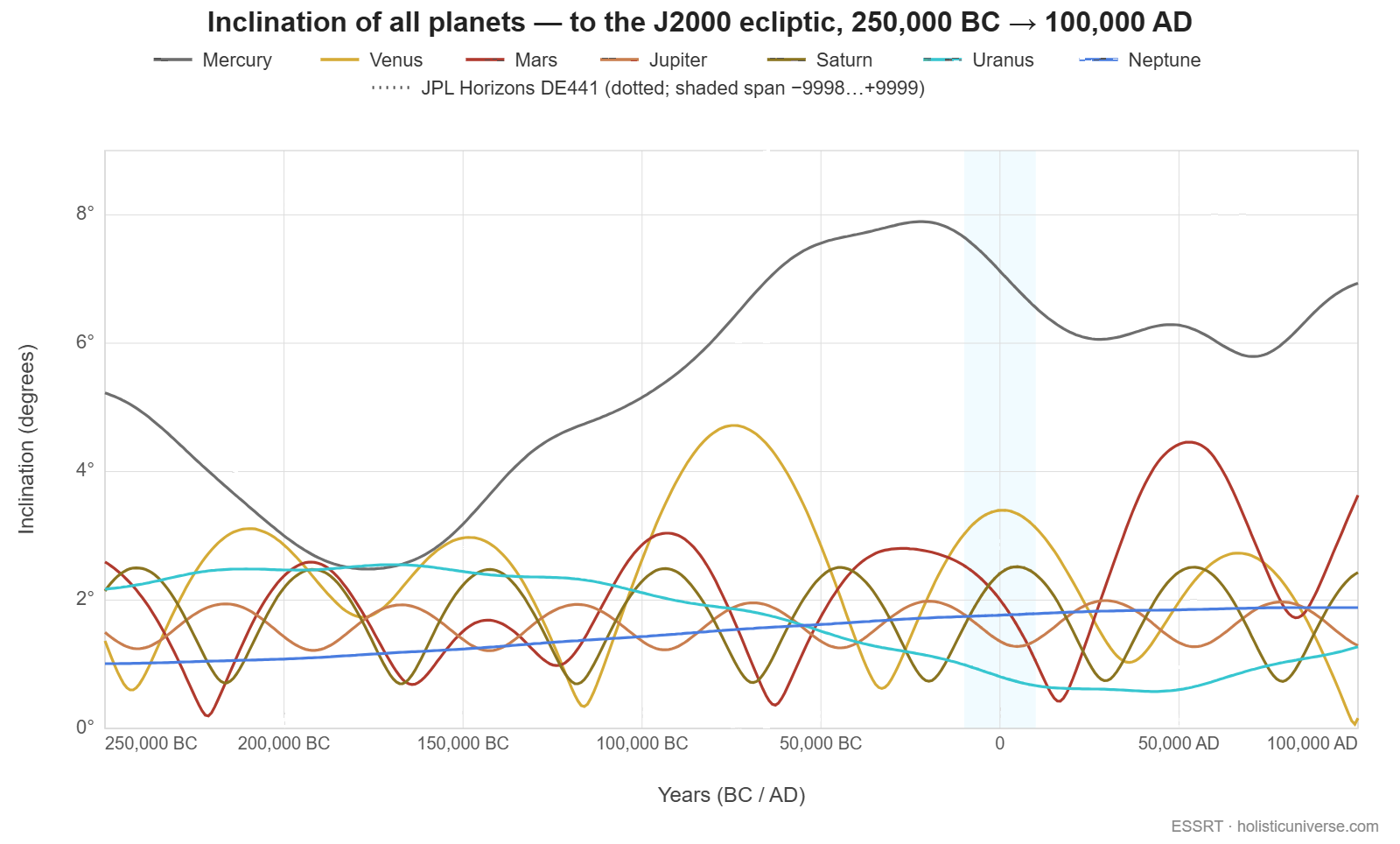
Inclination of date against DE441 over the span the ephemeris covers. The root-mean-square differences across that overlap run from 0.002° for Neptune to 0.023° for Mars (the figure’s own caption lists all seven), and they include the osculating short-period wiggle that the model’s secular curves average out — so the figures bound the disagreement rather than measure it.
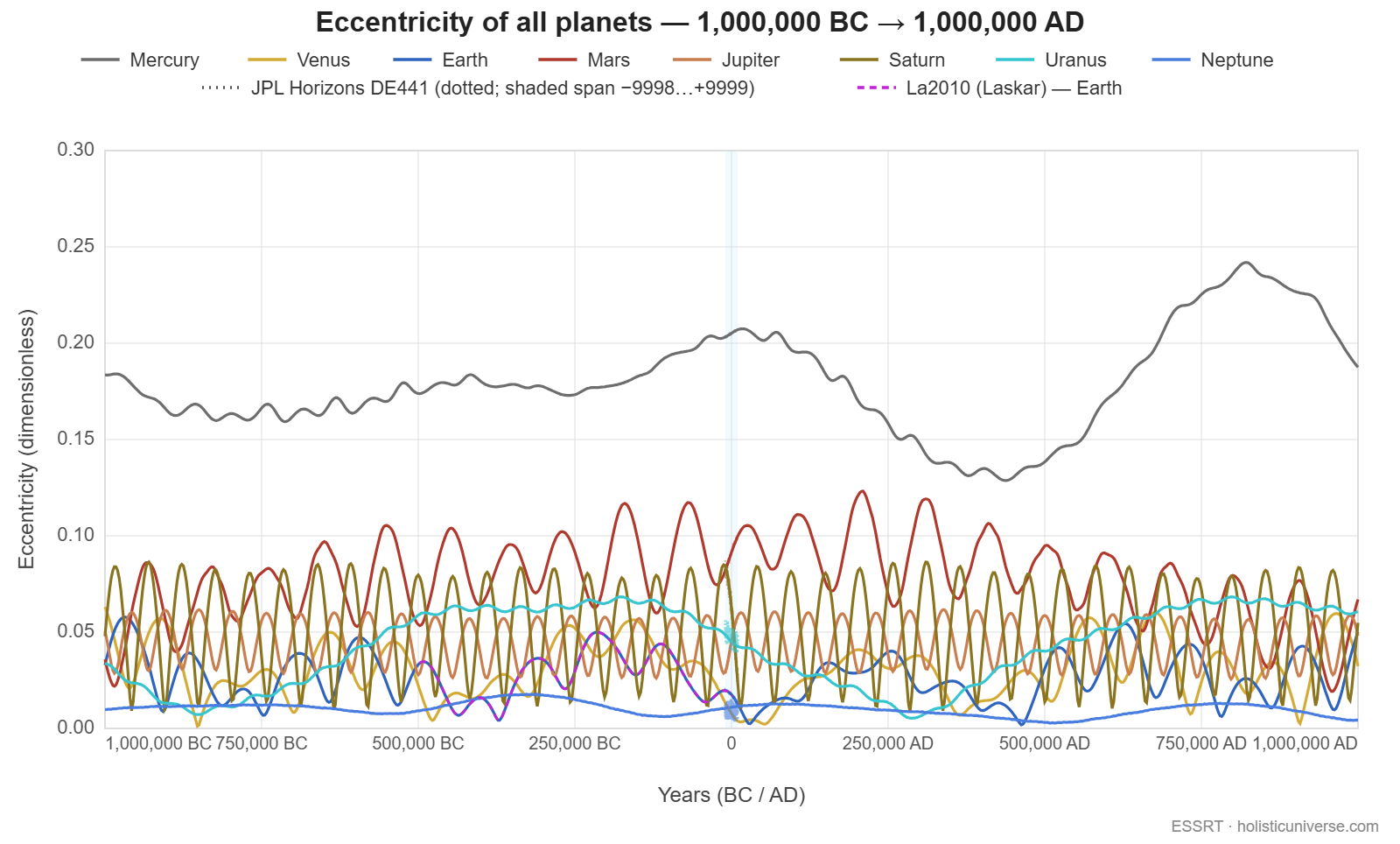
The same chain carried out to ±1 Myr, with DE441 at the present and La2010 for Earth. Mercury’s eccentricity is the one that wanders furthest — the reason it is the planet whose long-term behaviour any secular solution is judged on.
- Newton plus the measured masses reproduce every planet’s window rate and every node rate — except Mercury’s perihelion, which is short by 43.0 ″/cy in both test windows. Switching on the first post-Newtonian (relativistic) term closes exactly that row (−43.0 → −0.0) and moves nothing else.
- Masses cannot carry the 43. A joint mass adjustment exists that fits every perihelion, but it breaks the node rates by 10–65 ″/cy where the measured masses reproduce every node to 0.1. Perihelia and nodes are set by the same masses through different geometry — only Mercury’s perihelion is off.
- A short-range fifth force can mimic relativity on the perihelia (a Yukawa term tuned to Mercury reproduces all four inner-planet residuals) — but it shifts the effective gravitational parameter Mercury feels by five parts in ten million, where ranging fits every planet with one value to one part in ten billion. Excluded by three orders of magnitude, theory-vs-observation.
- The engine reproduces the standard secular frequencies from scratch. The 1-Myr run reads g₅ = 4.2562 ″/yr (Laskar: 4.2575), g₆ = 28.2453 (28.2455), s₆ = −26.3477 (−26.3475); the ±10-Myr run the model uses for deep time reads g₅ = 4.2574 and g₂ = 7.4524 ″/yr. With the relativistic term on, Mercury’s own frequency g₁ moves from 5.103 to 5.576 ″/yr (Laskar: 5.5965) — the “43” seen at the long-term level.
The eccentricity shapes and the dominance rule
Each planet’s eccentricity and perihelion are one object: the vector z = e·e^(iϖ), which traces a shape over time — a large circle for the planet’s own mode with smaller epicycles borrowed from its neighbours (the same two-arrow construction as the Earth wobble-centre diagram on this site). The perihelion “rate” at any moment is just how fast the trace happens to be circling the origin:
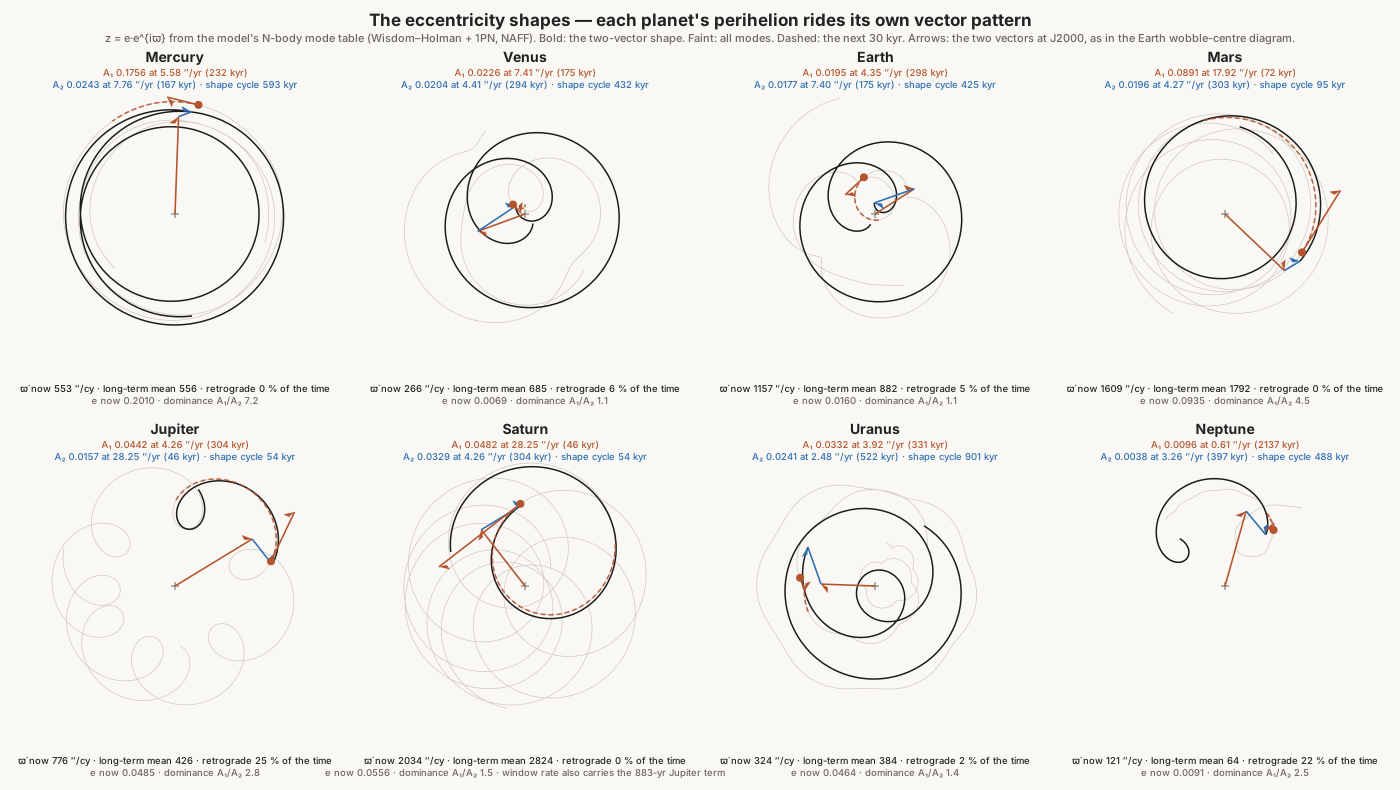
Every planet’s eccentricity vector as a shape, drawn from the planet chains the simulator renders. Mercury is a clean ring far from the origin; Venus and Earth are flowers passing through it — which is why their instantaneous rates carry no structural information. The dominance of a planet’s own vector over the largest borrowed one decides which planets ride near their long-term mean and which wander:
| Planet | Dominance A₁/A₂ (own ÷ largest borrowed) | Behaviour over ±500 kyr |
|---|---|---|
| Mercury | 7.2 | clean ring — never retrograde, within ±15 % of its mean |
| Mars | 4.5 | thick ring — never retrograde |
| Jupiter | 2.8 | near its mean, with brief retrograde flicks (25 % of the time) |
| Neptune | 2.5 | low-eccentricity loop grazing the origin — reverses 27 % of the time |
| Saturn | 1.5 | shares Jupiter’s two vectors; today’s window reading is the far side of the epicycle plus the 883-year term |
| Uranus | 1.4 | loops that graze the origin |
| Venus | 1.1 | passes the origin — the rate swings by thousands of ″/cy |
| Earth | 1.1 | passes the origin — the rate swings by thousands of ″/cy |
“Moves at its mean” is a dominance property: planets that own their shapes ride their means; borrowers wander. Earth today runs above its long-term mean — its present apsidal period of about ~111,635 years is a reading of where the shape currently is, not a permanent rate. Earth’s shape cycle is the beat of its two vectors, g₂ − g₅: the 1-Myr chain window resolves it to 425 kyr (its resolution limit); the ±10-Myr run reads 405.6 kyr — the long-eccentricity metronome of the rock record.
Earth’s eccentricity through deep time — the one measured referee
Every comparison above is theory-vs-theory except one. The deep-time eccentricity metronome is measured: 405.6 ± 2.4 kyr, phase-stable in the geological record for over 200 million years (Triassic lake beds, Mesozoic carbonates, Cenozoic carbon isotopes). The model’s own gravity carries it: the strongest beat of the engine’s Earth vector lands inside the pre-registered 395–415-kyr window, at 405.6 kyr (La2004: 405.7), with the 123.8- and 94.9-kyr companions present and correctly ranked.
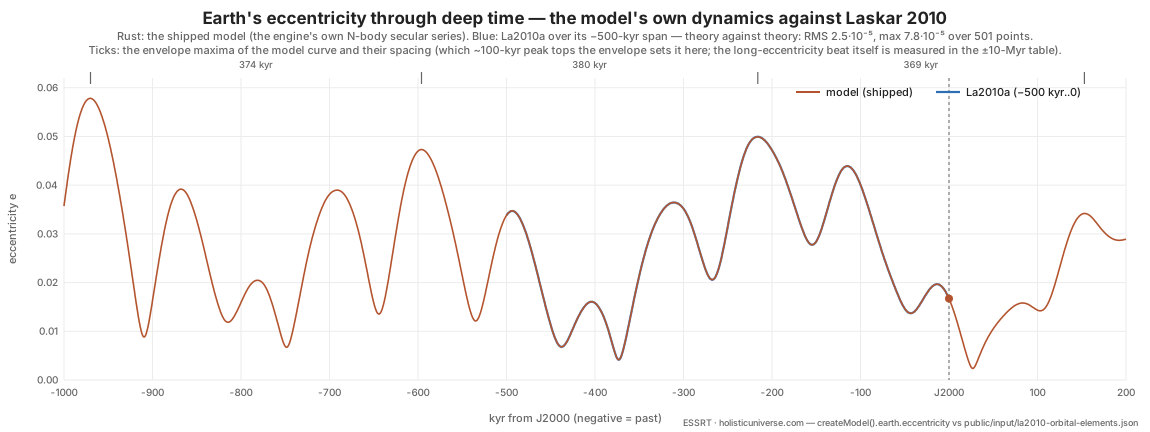
Earth’s eccentricity over the last million years from the model (rust) against the Laskar 2010a solution (blue, theory-vs-theory; La2010a covers the last 500,000 years). The ~100-kyr cycles ride inside the slow envelope whose beat is the metronome. Over the shared span the two curves coincide at the scale of the plot; the figure’s subtitle prints the measured difference.
This is Earth’s eccentricity on every path of the model: the published value, the Sun’s equation of centre behind the eclipse and cardinal-point instants, and the lunar chain (which reads the ±10-Myr mode table, anchored at J2000 to the observed eccentricity and its rate). No lattice ingredient enters Earth’s orbit. Lattice-native alternatives were integrated against the same referee and are excluded by it — every perihelion held at its window rate self-destructs within half a million years, a fixed set of lattice frequencies rings at 447 kyr, and an Earth held on a single eccentricity line loses the metronome entirely; doc 109 §12 holds that record. The 405-kyr component is weak in the most recent ~1 Myr of climate records (the known “400-kyr problem”), but the deep record is where the test lives, and there the line is strong and phase-coherent.
What this settles
A clean division of domains:
- The planets’ orbits belong to the dynamics. The model’s own engine reproduces the standard secular system, and every lattice-native deep-time law for the orbits fails the measured referee.
- Earth’s eccentricity belongs to the dynamics too — the engine’s series, corroborated in-era against Laskar and carrying the rock’s metronome at deep time from gravity alone. The falsification criterion uses the rock metronome, never the engine’s reproduction of it.
- Earth’s rotation family belongs to the spin clock. The axial precession (~25,772 years at J2000, lengthening on the measured tidal history), the length-of-day stack, the eclipse and paleo results — none of them rest on the planetary periods.
- The apsidal period of about ~111,635 years is a J2000 reading, the epoch-local tangent of Earth’s free eccentricity vector — today’s position on the shape, not a lock: no capture, no preferred base period, and not even the statistical mode of the rate distribution (it sits at the 75th percentile of Earth’s perihelion rate over ±500 kyr).
- The Moon’s part in the metronome is measured. The ±10-Myr run carries the Moon’s quadrupole term on the Sun–Earth interaction and the three largest asteroids. With them the engine’s Venus-driven mode g₂ reads 7.4524″/yr against La2004’s 7.452″/yr; with the Earth–Moon pair merged into a single point mass the mode reads low and the beat long. The asteroids’ share is null for Earth, so the shift is the Moon’s.
Related pages: Scientific Background — the model against Laplace–Lagrange, Milankovitch, and General Relativity; Eccentricity — Earth’s eccentricity in the model; Expanding Resonance — the deep-time scaling of Earth’s rotation family.