Obliquity & Inclination
Earth’s obliquity is the angle between its rotational axis and the perpendicular to its orbital plane — the tilt of its equator relative to its orbit. Higher obliquity means hotter summers and colder winters; lower obliquity means milder seasons. In the Holistic Universe Model, the observed obliquity is the combined result of two equal-amplitude tilt effects.
What Is Obliquity?
| Property | Value |
|---|---|
| Current obliquity (J2000) | ~23.4393° |
| Direction | Decreasing |
| Range in model | ~22.21° – ~24.72° |
| Range in standard theory | ~22.1° to ~24.5° (Laskar) |
| Oscillation period | H/8 = ~41,915 years (obliquity cycle) |
| Master pattern period | H = 335,317 years (full axial + inclination phase reset) |
The ~41k-year obliquity cycle is one of the Milankovitch cycles that pace ice ages. The H/8 oscillation period and the H master pattern are J2000 anchor values — the integer-divisor structure is invariant at any epoch, but the literal year counts rescale at geological time (see Expanding Resonance).
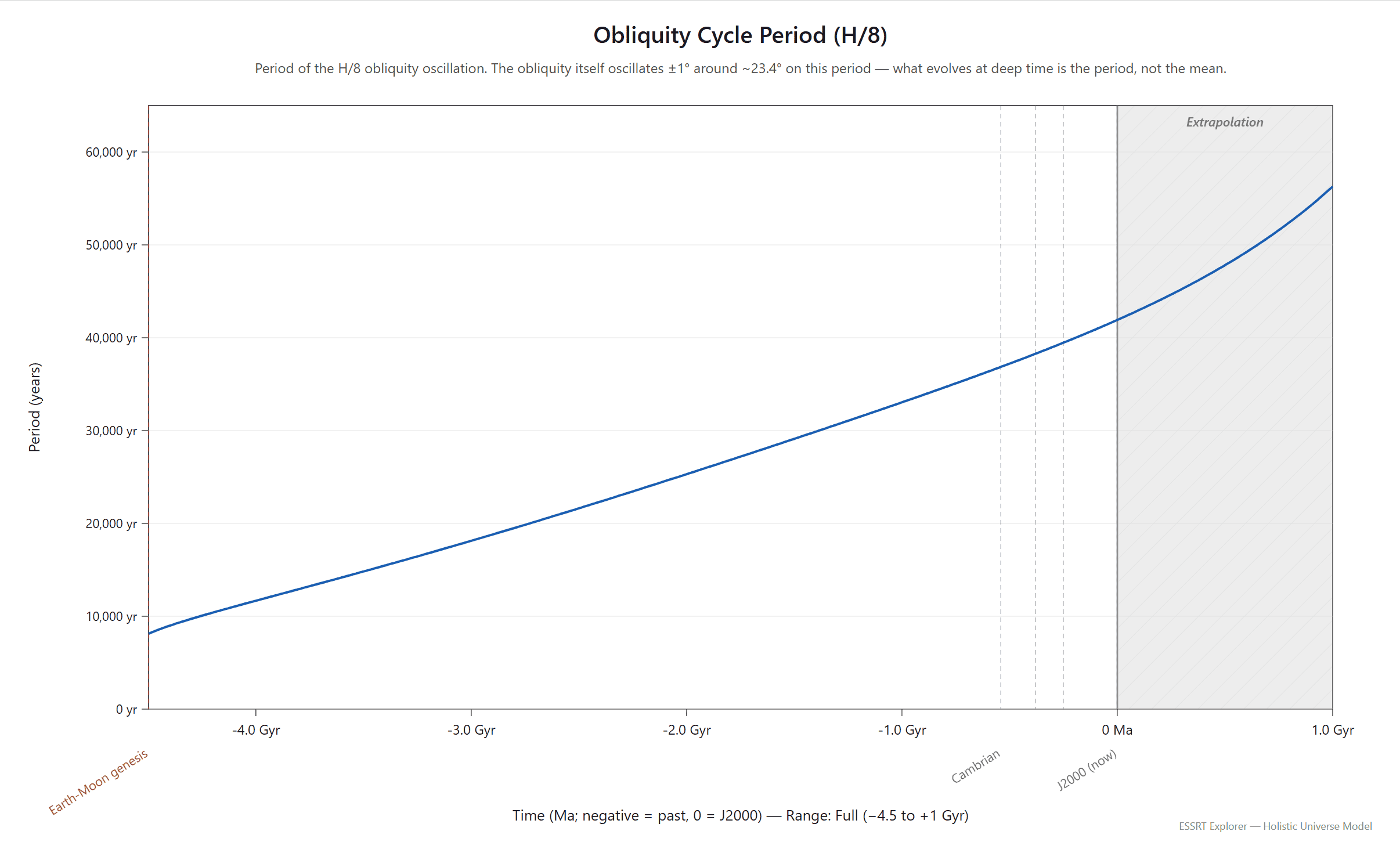
A typing note on the staircase: the curve above scales H/8 itself. The model’s sharper deep-time statement is that the obliquity band follows the beat 2π/(ψ̇(t) − |s₃|) — degenerate with H/8-scaling today (41.3 vs 41.9 kyr) but ~19% apart by 2.46 Ga (24.9 vs 29.7 kyr). See Prediction 8.
The Two-Component Model
Obliquity = Axial Tilt Effect + Inclination Tilt Effect. Both effects oscillate by ±0.63607°. When they add, obliquity is maximum; when they cancel, it is minimum.
| Component | What It Is | Mean | Oscillation |
|---|---|---|---|
| Axial tilt effect | Earth’s rotational axis angle | ~23.41353° | ±0.63607° |
| Inclination tilt effect | Effect from orbital plane oscillation | 0° (effect only) | ±0.63607° |
| Obliquity (what we observe) | The combined signal | ~23.41353° | ±1.27214° (double) |
Why Inclination Must Affect Obliquity
Standard astronomy attributes obliquity variation to a combination of axial precession and orbital-plane changes from planetary perturbations. The geometric reason why orbital inclination must independently contribute follows from a simple chain:
| Step | Reasoning |
|---|---|
| 1 | Obliquity = angle between Earth’s spin axis and the ecliptic normal |
| 2 | The ecliptic = Earth’s orbital plane (by definition) |
| 3 | Earth’s orbital plane oscillates relative to the invariable plane |
| 4 | When the orbital plane moves, the ecliptic reference moves with it |
| 5 | A moving reference plane changes the measured obliquity |
Even if Earth’s spin axis were perfectly fixed in space, the obliquity would still change — because the ecliptic itself is moving. Two independent motions therefore change obliquity:
| Motion | What moves | Cause | Cycle |
|---|---|---|---|
| Axial precession | Earth’s spin axis | Lunisolar torque on Earth’s equatorial bulge | ~25,794 years |
| Apsidal precession | Earth’s orbital plane | Gravitational perturbations from other planets | ~111,772 years |
Geometric proof. The spherical cosine law
cos(i_ecl) = cos(i_inv) · cos(i_earth) + sin(i_inv) · sin(i_earth) · cos(ΔΩ)
proves that every angle measured relative to the ecliptic — including obliquity — depends on Earth’s invariable-plane inclination (i_earth). When i_earth changes, the ecliptic tilts and all ecliptic-referenced angles shift with it. This is geometry, not a model assumption. See Plane Calibration for the full derivation.
How the Two Tilt Effects Combine
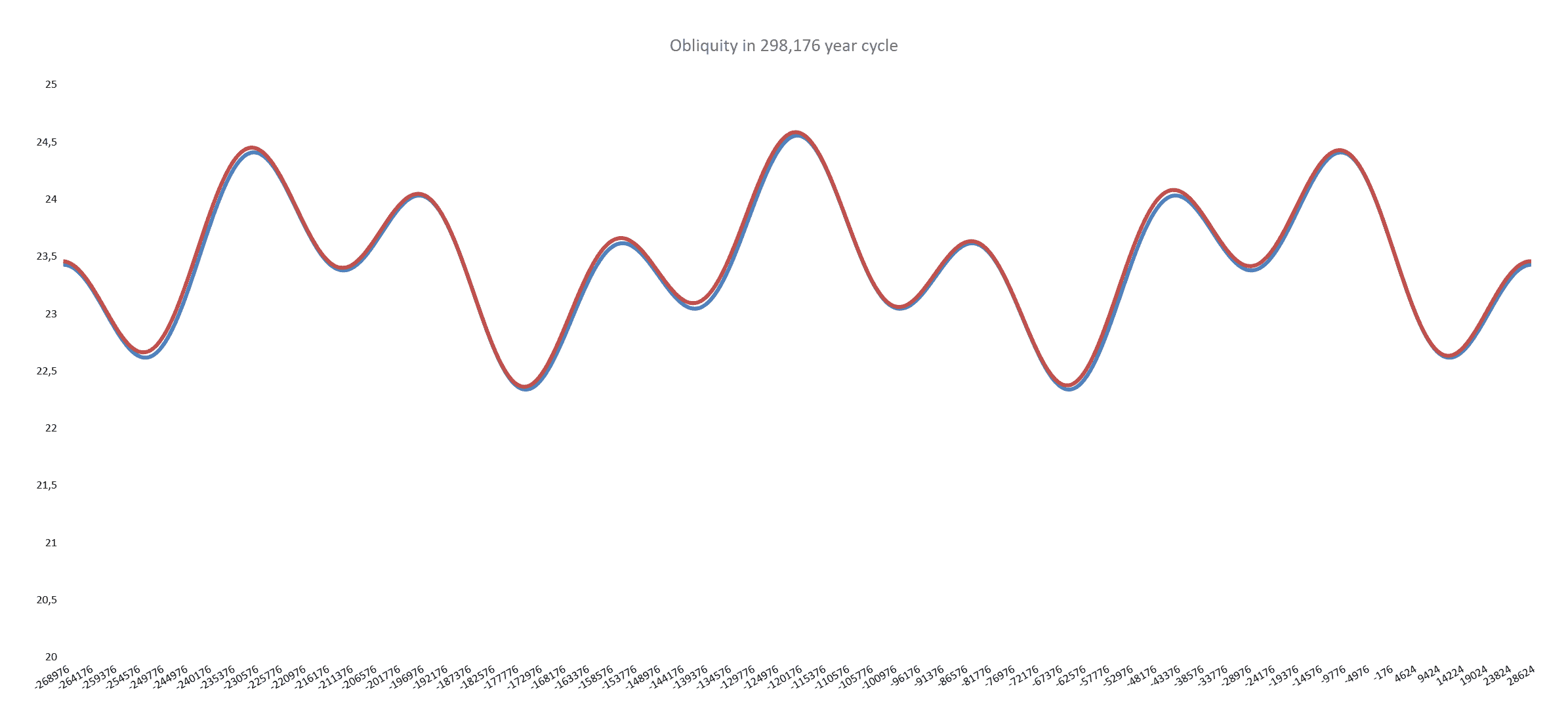
Maximum obliquity = Mean + Axial tilt effect + Inclination tilt effect
                = 23.41353° + 0.63607° + 0.63607°
                = ~24.72°

Minimum obliquity = Mean - Axial tilt effect - Inclination tilt effect
                = 23.41353° - 0.63607° - 0.63607°
= ~22.21°- Add together (maximum ~24.72°): both tilt effects at their extreme in the same direction.
- Cancel out (minimum ~22.21°): both tilt effects at their extreme in opposite directions.
- Neutral (~23.41353°): one or both at their mean position.
The two-component decomposition is the model’s theoretical construction of Earth’s obliquity oscillation. The H/3 inclination tilt component remains part of this structural decomposition, but does not directly drive Earth’s climate — see Climate Connection below.
The Axial Tilt Effect
Two easily-confused things act on Earth’s spin axis:
(1) The precession of the equinoxes (~25,794 yr, H/13) — Earth’s axis direction traces a cone in space. This is the classical precession observed by Hipparchus. It rotates where the axis points but does NOT change the tilt angle; the ±0.63607° amplitude is not visible on this cycle.
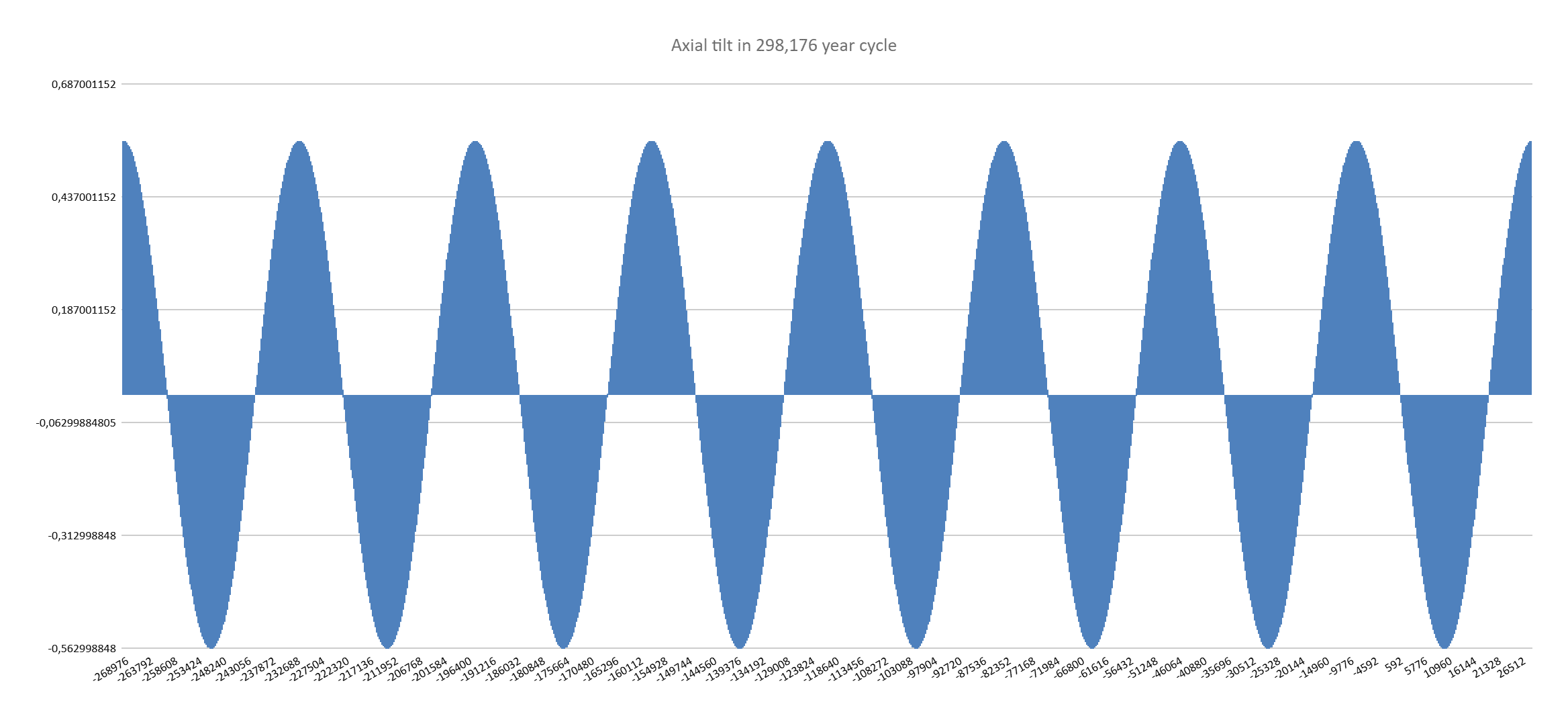
(2) The axial tilt effect (~41,915 yr, H/8) — the angle between Earth’s rotation axis and the ecliptic varies by ±0.63607° around its mean ~23.41353°. This is the effect that produces the observed ~41k-year Milankovitch obliquity cycle, where the ±0.63607° amplitude is actually observable.
Why H/8 and not H/13? The tilt is carried by the H/5 ecliptic precession layer and beats against the H/3 apsidal precession via Fibonacci addition: 1/(H/5) + 1/(H/3) = (3 + 5)/H = 8/H = 1/(H/8). The H/3 inclination movement delays the H/5 axial component, so the net tilt oscillation only emerges at the H/8 interference period, not at H/13.
| Property | Value |
|---|---|
| Mean | ~23.41353° |
| Amplitude | ±0.63607° |
| Range | 22.78° to 24.05° |
| Visible oscillation period | ~41,915 years (H/8 — obliquity cycle) |
| Physical cause | Fibonacci beat H/5 + H/3 → H/8 |
| Unrelated: axial precession | ~25,794 years (H/13 — equinox precession; does not change the tilt angle) |
The Inclination Tilt Effect
Earth’s orbital plane is tilted relative to the solar system’s invariable plane. The inclination oscillates over the ~111,772-year apsidal precession cycle:
| Property | Value |
|---|---|
| Mean inclination | ~1.48113° |
| Amplitude | ±0.63607° |
| Range | 0.845° to 2.117° |
| Cycle period | ~111,772 years |
| Cause | Earth’s perihelion point orbiting the Sun |
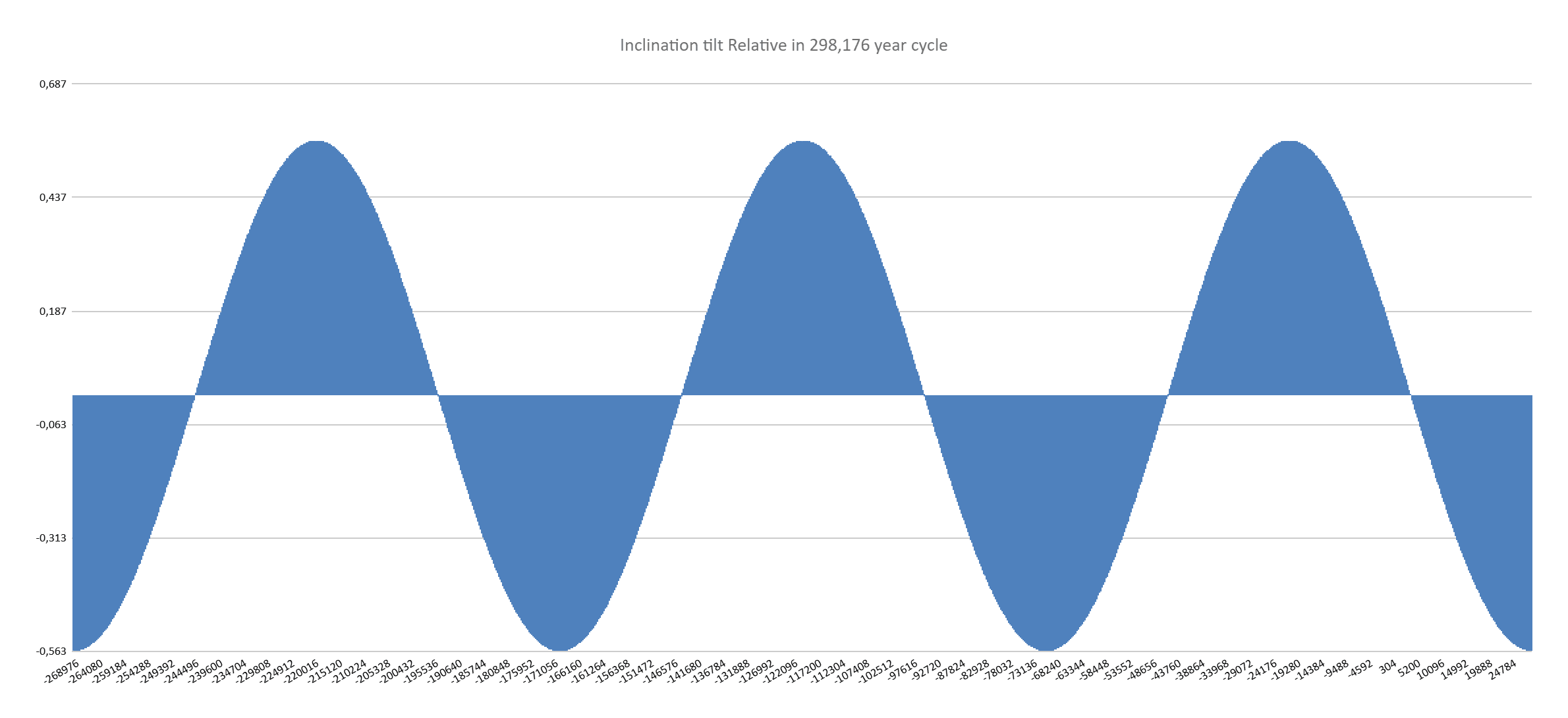
The ±0.63607° oscillation contributes to obliquity changes. For more about the invariable plane and how all planets relate to it, see The Invariable Plane.
Why the Same Amplitude?
Both the axial tilt effect and the inclination tilt effect oscillate by ~0.63607°. This equal amplitude is an empirical observation, not an assumption — the model’s geometric construction produces ±0.63607° for both, similar to how Kepler observed elliptical orbits before Newton explained why. The ±0.63607° inclination amplitude is independently predicted by Fibonacci Law 2.
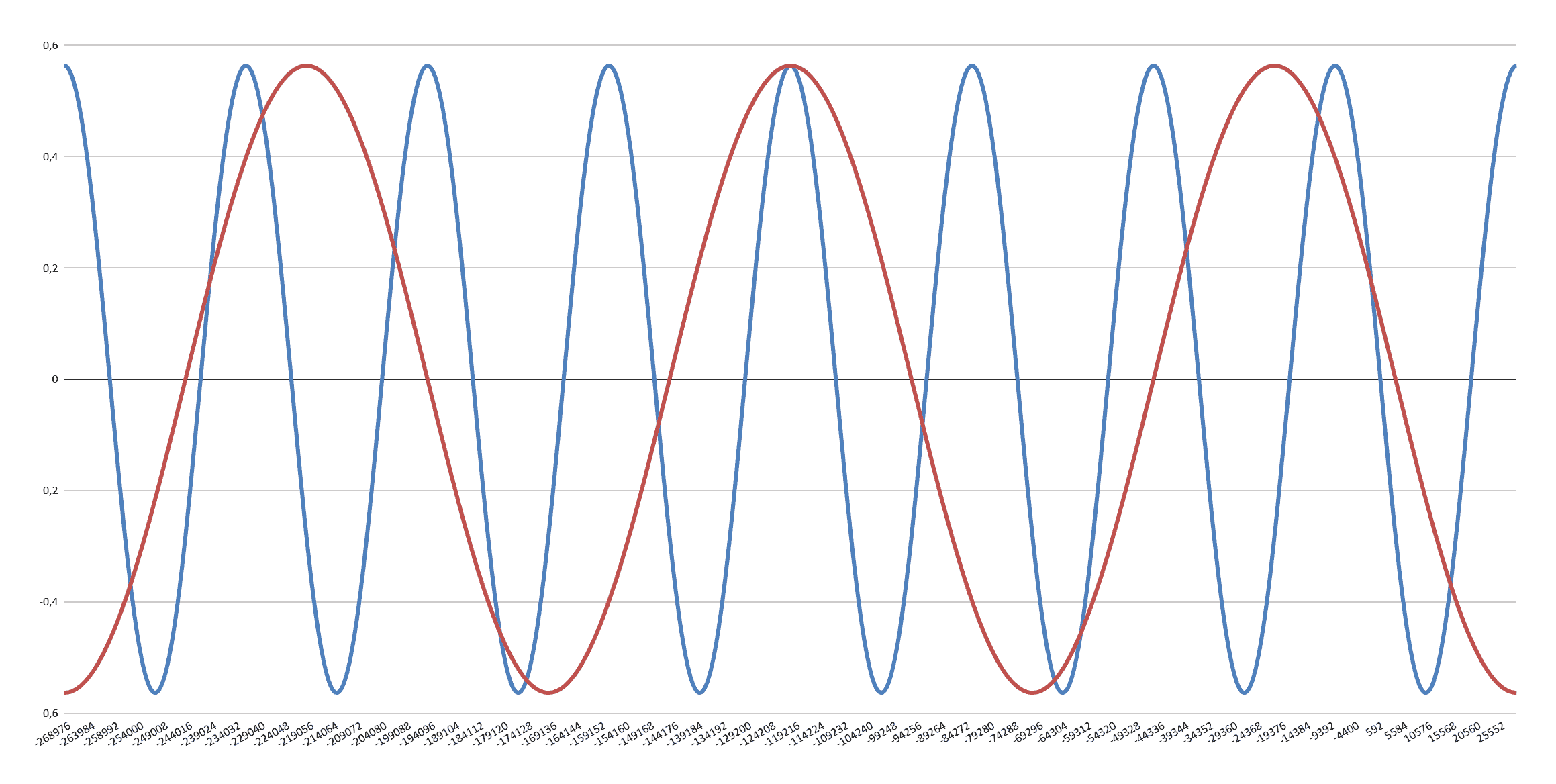
Physics supports it. Berger (1978) decomposed obliquity into 47 Fourier terms; the dominant term (frequency s₃ + k, period ~41k yr) has amplitude 0.684° — within 8% of the model’s 0.63607° — arising from exactly the same two motions (axial precession + orbital-plane precession). The next-largest term is only 35% as strong (0.238°), confirming that a single dominant amplitude controls the obliquity signal. Equal amplitudes are also the natural state in coupled-oscillator physics when two oscillators are effectively identical (a symmetry consistent with angular momentum conservation; unequal amplitudes would require a net angular momentum source). Detail: Supporting Evidence §9 and §10.
Fibonacci anchor vs 8H-lattice secular period. Berger’s s₃ + k beat is the secular obliquity period on the 8H lattice — 8H/65 = 41,270 yr — sitting one 8H-lattice step from the model’s Fibonacci anchor H/8 = 8H/64 = ~41,915 yr. The one-step offset is the gas-giant driving: Earth’s obliquity sits just above Saturn’s perihelion period and Earth’s ecliptic precession just below Jupiter’s. Jupiter’s ICRF perihelion and Saturn’s ecliptic perihelion lock at 8H/65, the climate-recorded obliquity beat (Fibonacci Laws — Law 6).
The ~41,915-Year Obliquity Cycle
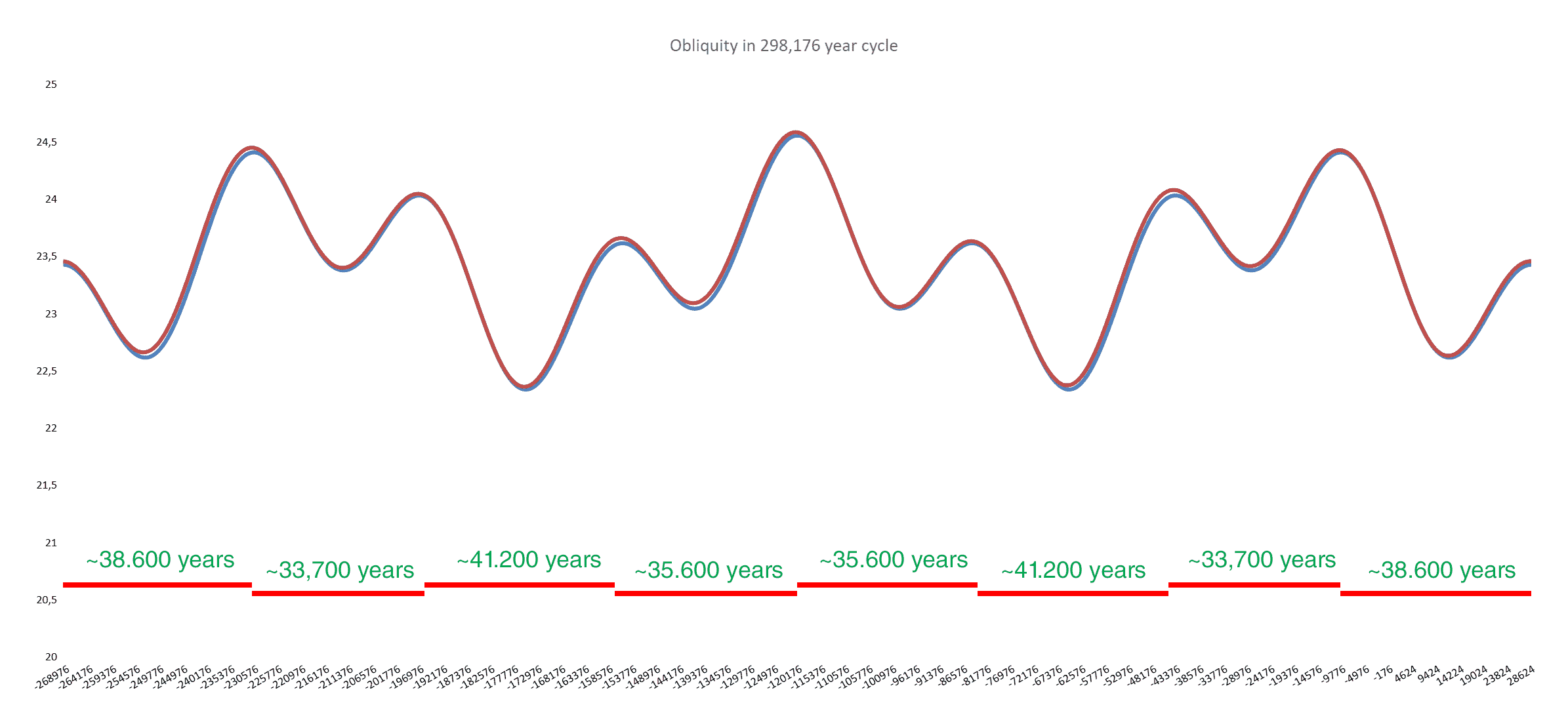
The dominant visible cycle is the ~41,915-year axial tilt effect (H/8) with the H/3 inclination tilt modulating its amplitude. The axial tilt effect cycles every ~41,915 yr (H/8); the inclination tilt effect cycles every ~111,772 yr (H/3). Both contribute ±0.63607°, and their combined effect produces peaks and troughs at an average interval of ~41,915 yr — the visible obliquity cycle.
The H/13 equinox precession (~25,794 yr) is a separate phenomenon: it rotates the axis pointing direction (the slow westward drift first described by Hipparchus) but does not change the tilt angle.
Comparison with Standard Formulas
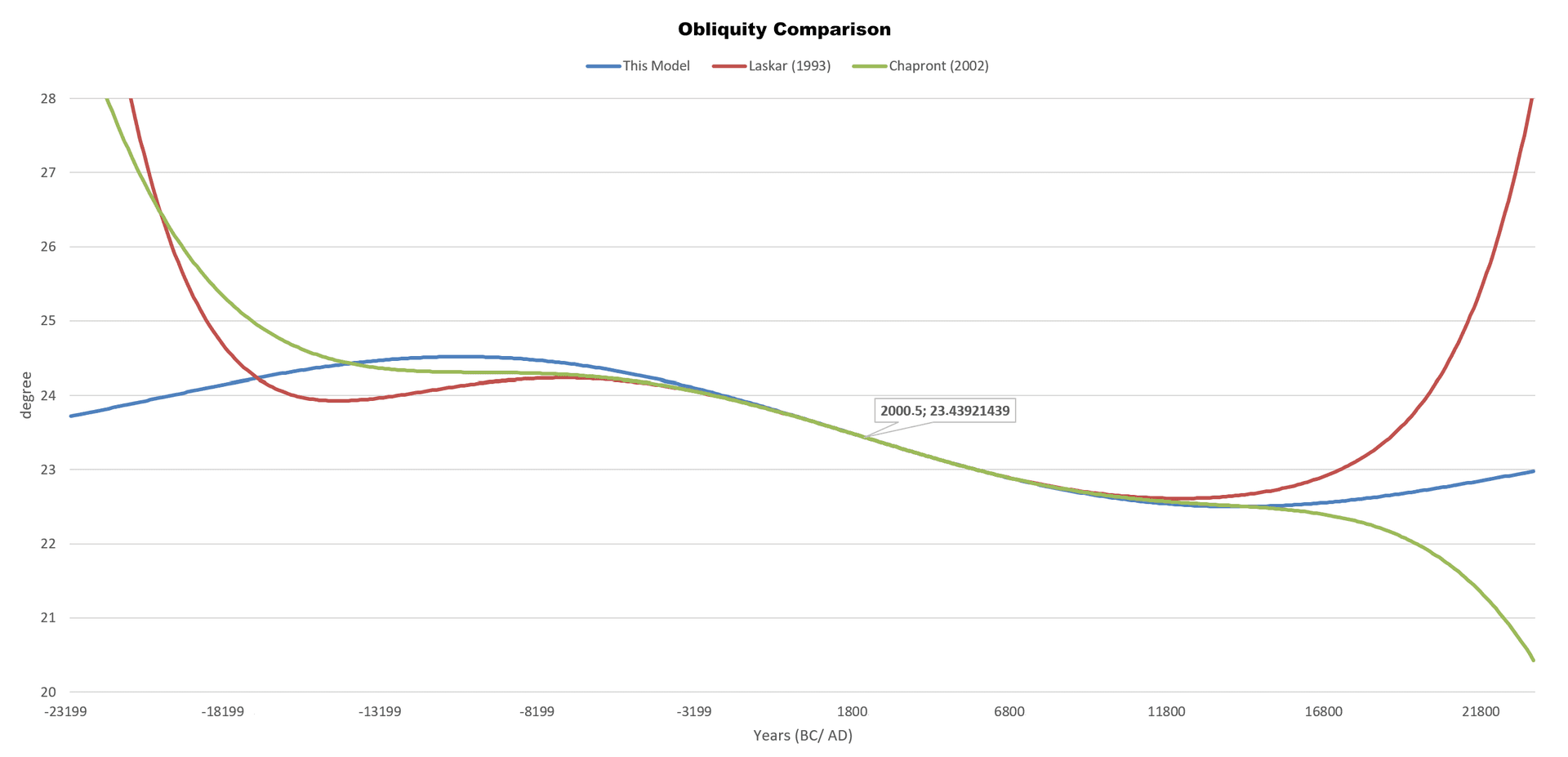
The model’s obliquity values closely match the La2004 numerical solution (Laskar et al. 2004) and the Chapront et al. (2002) polynomial for thousands of years around the present. Both converge at J2000 (model: 23.4393°, La2004: 23.4393°). Beyond ±10,000 years the model predicts bounded oscillation within ~22.21° – ~24.72°, while La2004 continues its slower secular oscillation and Chapront’s polynomial extrapolation diverges to unphysical values.
| Timeframe | Agreement |
|---|---|
| ±2,000 years | Exact match with Laskar / Chapront |
| ±10,000 years | Very close (<0.2° difference) |
| Beyond ±10,000 years | Significant differences (See Laskar and Chapront formulas) |
Actual measurements only exist for a short timeframe around the present epoch. All values before ~1000 AD and after today are theoretical predictions — including those from Laskar and Chapront.
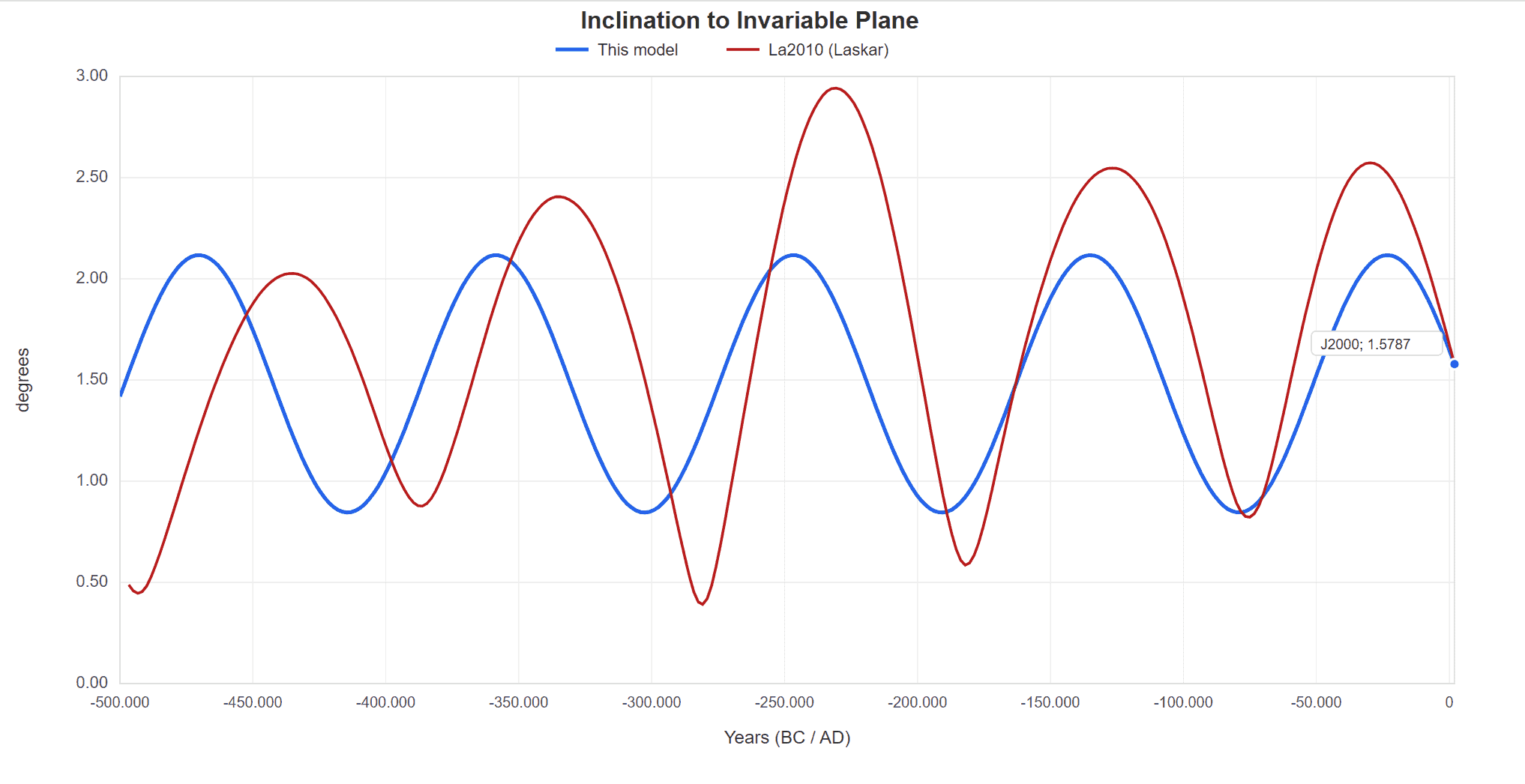
Inclination comparison. The model’s apsidal precession cycle (~111,772 years) is independently validated against the La2010a numerical orbital solution (Laskar et al. 2011) over 250 Myr in the invariable plane frame. Both show Earth’s inclination near 1.57869° at J2000 (Souami & Souchay 2012) and oscillating on the same H/3 timescale. The model captures the dominant ±0.63607° envelope; Laskar’s full N-body solution adds higher-order modulation that widens the range on multi-cycle timescales.
Derived from One Equation
The obliquity story on this page can now be derived rather than asserted. Integrating the single averaged precession equation — the spin axis precessing about the moving orbit normal, with the orbit normal taken from the model’s own N-body node modes (the same ±10-million-year run behind the deep-time metronome) and exactly one anchor, the model’s H/13 axial-precession rate — reproduces the obliquity history with zero fitted constants:
| Quantity | Derived | Reference |
|---|---|---|
| Obliquity rate at J2000 | -48.00″/cy | IAU: -46.84″/cy |
| Precession constant α | 54.811″/yr | literature ~54.9″/yr |
| Dominant obliquity beat | 41.2 kyr | the observed ~41-kyr cycle |
| ε vs La2004, last 13 kyr | 50″ rms | fitted harmonic law: 711″ |
| ε vs La2004, full million years | 687″ rms, correlation 0.948 | fitted local laws decorrelate |
Two readings. First, the obliquity rate — a number the simulator’s scene machinery previously had to solve for — falls out of the node modes plus the H/13 anchor to a quarter-percent. Second, the ~41-kyr cycle emerges as the beat between the axial precession and the strongest nodal mode (s₃) — which is precisely the model’s H/8 identity, produced natively by the dynamics. The full verdict is banked as a gate-guarded artifact in the simulation repo (Supporting Evidence §18); every number above reads live from it.
Climate Connection
Earth’s climate variations are driven by gravitational coupling among the planets acting on the 8H lattice — not by Earth’s intrinsic obliquity or inclination cycles in isolation. The 8H/n integer divisors of the Solar System Resonance Cycle set the natural frequencies; gas-giant perturbations modulate Earth’s spin axis and orbital plane at these frequencies; Earth’s climate responds.
Obliquity (~~41,915-year cycle) directly affects seasonal contrast. Higher tilt produces more extreme seasons, lower tilt milder. This is the standard Milankovitch obliquity mechanism, visible as the ~41-kyr cycle in climate records. In the model this cycle is the climate-recorded obliquity beat at 8H/65 (k+s₃), one lattice step off Earth’s Fibonacci anchor H/8 = 8H/64. The mechanism is Jupiter+Saturn gravitational coupling (Law 6).
Earth’s H/3 inclination does NOT directly drive climate. Earth’s ~111,772-year apsidal precession (H/3, n=24 on the 8H lattice) is a real geophysical cycle and, since its regime admission, one of the 33 L1 divisors — but on the full LR04 record it carries only 0.79× the median amplitude. The dominant ~100-kyr climate signal is a broad single peak (~80–125 kyr) carried by multi-planet eigenmode beats at adjacent lattice integers (n=22 = 121.9 kyr, n=25 = 107.3 kyr centroid, n=28 = 95.8 kyr Berger peak). Earth’s own H/3 sits within one Rayleigh element of these but the L1 amplitude fit cleanly separates them, and H/3 drops out. The one regime where the record does carry the H/3 line is pre-iNHG (2.7–5.3 Myr): ΔR² = +0.0196 when n=24 is added to the lattice, cross-validated, at the model’s own phase — an open attribution question, not a 100-kyr-world driver. Full empirical case in Climate Formula and the insolation null test.
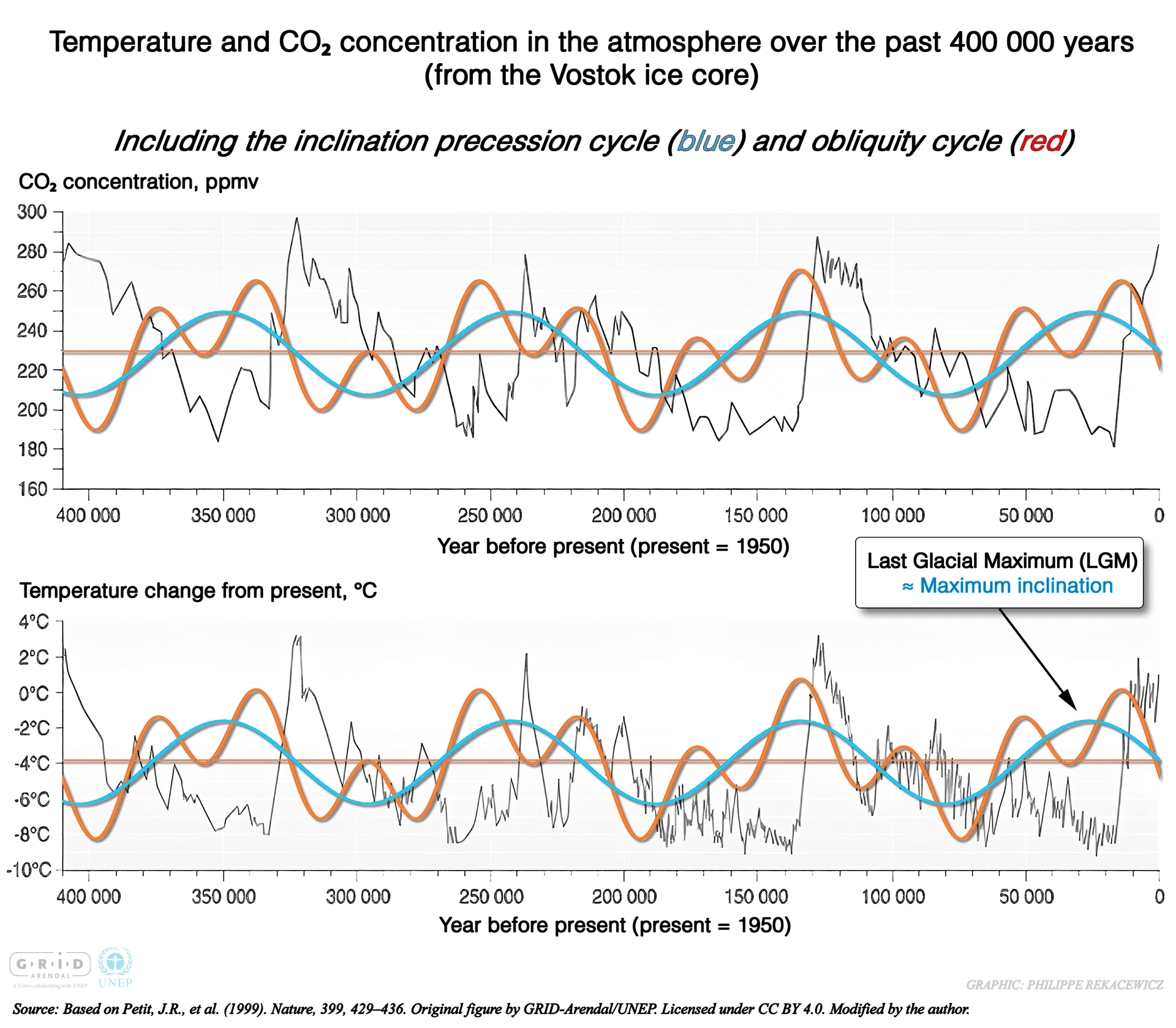
Vostok ice core (Petit et al. 1999) with Earth’s H/3 inclination cycle overlaid. The visual alignment at this 400-kyr window is striking but misleading: on the full LR04 record the L1 fit places near-zero amplitude at n = 24 = H/3. The 100-kyr signal is carried by adjacent multi-planet eigenmode beats. H/3 remains a real geophysical cycle, just not the climate driver.
The Two-Component Structure Beyond Earth — a Typed Description
Status (the restatement). Earth’s two-component obliquity structure is measured and validated (above). Its extension to the other planets, below, is a typed description of the J2000-era lattice, not a prediction: a planet’s obliquity cycle is physically set by its own spin precession beating against the invariant nodal s-modes (Saturn’s spin is locked to s₈, Jupiter sits near s₇ — Ward & Hamilton 2004; Saillenfest 2020–2022), and the published long-term spin-axis integrations find no regular cycle for Jupiter and Saturn and a frozen axis for Uranus — against this table’s former H/2 and H/3 predictions, which are therefore retired as predictions. The Mercury and Mars rows match published values at the 0.2–2.4 % level as era-typed numeric descriptors (both published values are themselves theory: Bills 2005 theoretical, Laskar 2004 integration — and Mars’s obliquity is chaotic at long term). The table is kept as the lattice’s description of the present configuration.
Every planet’s row below follows the same two-cosine pattern as Earth’s — one term at the ICRF perihelion period and one at the obliquity cycle period:
obliquity(t) = mean − A × cos(2πt / ICRF period) + A × cos(2πt / obliquity cycle)

Where A = ψ / (d × √m) — the Fibonacci-derived amplitude from Law 2
The inclination component (at ICRF perihelion period) has a negative sign; the obliquity component (at the obliquity cycle period) has a positive sign. The obliquity cycle is the dominant visible period; the inclination component modulates the amplitude envelope.
Obliquity Cycles for All Planets
Each planet’s obliquity cycle period comes from the Fibonacci decomposition of its perihelion ecliptic rate: the rate numerator N decomposes as N = A + B (Fibonacci sum), giving the obliquity rate.
| Planet | ICRF period | Obliquity cycle | Fibonacci decomp. (8H/N) | Amplitude | Status |
|---|---|---|---|---|---|
| Mercury | -28,844 yr | 894,179 yr (8H/3) | 11 = 3 + 8 | ±0.386501° | Typed descriptor (0.2% vs ~895 kyr, Bills 2005 theoretical) |
| Venus | -24,387 yr | 24,387 yr (= |ICRF|) | obliq = ICRF → cancels | ±0.062168° → 0 | Constant (cancellation) |
| Earth | 111,772 yr | ~41,915 yr (H/8 = 8H/64) | 128 = 64 + 64 | ±0.63607° | Confirmed (2% vs ~41k yr) |
| Mars | -39,449 yr | 127,740 yr (8H/21) | 35 = 21 + 14 | ±1.164287° | Typed descriptor (2.4% vs ~124,800 yr Laskar integration; chaotic long-term) |
| Jupiter | -41,270 yr | 167,659 yr (H/2 = 8H/16) | 40 = 16 + 24 | ±0.021405° | Retired as prediction (integrations: no regular cycle) |
| Saturn | -15,873 yr | 111,772 yr (H/3 = 8H/24) | 64 = 24 + 40 | ±0.065196° | Retired as prediction (spin locked to s₈) |
| Uranus | -33,532 yr | 167,659 yr (H/2 = 8H/16) | 24 = 16 + 8 | ±0.023832° | Retired as prediction (axis frozen) |
| Neptune | -26,825 yr | 26,825 yr (= |ICRF|) | obliq = ICRF → cancels | ±0.013552° → 0 | Constant (cancellation) |
Venus and Neptune have obliquity cycle = |ICRF perihelion period|. In the two-component formula the inclination term (−A · cos(ω_ICRF · t)) and obliquity term (+A · cos(ω_obliq · t)) are at the same frequency and cancel exactly, producing constant obliquity — the spin axis tracks the orbital plane in lockstep.
Formula Midpoint per Planet
The two-cosine obliquity formula uses a midpoint parameter (obliquityMean in the constants file) around which the two cosine terms oscillate. The midpoint differs from the J2000 snapshot by a fixed anchoring offset. These are formula parameters, not time-averages of the full obliquity signal — for planets where higher-order harmonic terms contribute significantly, the true time-average can differ from the midpoint by several hundredths of a degree.
| Planet | J2000 tilt | Formula midpoint | Shift |
|---|---|---|---|
| Mercury | 0.03° | 0.01° | −0.02° |
| Venus | 2.64° | 2.64° | — |
| Earth | 23.44° | 23.41353° | −0.03° |
| Mars | 25.19° | 25.32° | +0.21° |
| Jupiter | 3.13° | 3.12° | −0.01° |
| Saturn | 26.73° | 26.80° | +0.07° |
| Uranus | 82.23° | 82.24° | +0.01° |
| Neptune | 28.32° | 28.32° | — |
Geometric vs Pythagorean mean. The formula midpoint (23.41353° for Earth) is the geometric time-average of the two-cosine formula. The true mean obliquity measured at the solstice is ~23.453° — systematically higher by ~0.040° because the perpendicular tilt components add by Pythagorean composition, always positive. This is why J2000 obliquity (23.44°) sits slightly above the formula midpoint. See Formulas for the full derivation.
Cross-Planet Connections
Three cross-planet period matches link obliquity cycles to other planets’ precession:
| Connection | Period | Significance |
|---|---|---|
| Mars obliquity = Jupiter axial precession | 8H/21 = 127,740 yr | Exact match (mirror pair, d=5); 21 = F₈ |
| Mercury obliquity = 2 × Saturn axial | 8H/3 = 2 × 4H/3 | Exact within the model; ~0.1% vs observed Saturn axial (uncertain) |
| Jupiter ICRF peri. = Saturn ecliptic peri. (Law 6 lock) | 8H/65 = 41,270 yr | Drives Earth’s obliquity; Earth’s H/8 = 8H/64 cycle sits one 8H-step off |
The Mars-Jupiter connection is the strongest: both are mirror pairs (d=5) and the match is exact. If this reciprocity extends, Jupiter’s obliquity = Mars axial precession = H/2 — a testable prediction.
Calculate Obliquity at Any Year
To calculate obliquity values for any year, see the Formulas page.
Summary
| Question | Answer |
|---|---|
| What is obliquity? | The tilt of Earth’s equator relative to its orbit (~23.4393°) |
| What determines it? | Axial tilt effect + inclination tilt effect (two equal-amplitude oscillations) |
| Why same amplitude? | Balanced system — observed empirically, predicted by Law 2 |
| What’s the cycle? | ~41,915 years (H/8) |
| What’s the range? | ~22.21° – ~24.72° |
| Current value? | ~23.4393° (decreasing) |
| Climate connection? | ~41-kyr obliquity cycle drives seasonal contrast (gas-giant-driven at 8H/65, Law 6); Earth’s H/3 inclination does NOT directly drive climate — 100-kyr signal is multi-planet eigenmode beats (Climate Formula) |
| Universal pattern? | All planets follow the same two-component structure: 3 confirmed (Mercury, Earth, Mars), 3 predicted (Jupiter, Saturn, Uranus), 2 cancellations (Venus, Neptune) |
Continue to Eccentricity to see how Earth’s orbital shape changes over time.