The Invariable Plane
The invariable plane is the solar system’s true reference plane — the plane perpendicular to the total angular momentum vector, fixed in space while everything else moves around it. Imagine a spinning top: no matter how it wobbles, the spin axis stays constant.
| Property | Description |
|---|---|
| Definition | Plane perpendicular to total angular momentum of the solar system |
| Location | Passes through the Sun’s center |
| Stability | Fixed in space — does not change over time |
| Dominated by | Jupiter (~60% of angular momentum) and Saturn (~25%) |
The model’s ~111,772-year inclination precession is Earth’s orbital plane tilting relative to this plane (see How It Works). Without a fixed reference that motion cannot be defined. Beyond providing a reference, the invariable plane reveals structure: planetary inclinations measured against the (moving) ecliptic look irregular, but against the invariable plane the same data shows smooth, predictable oscillations and a clean Fibonacci structure.
Planetary inclinations
Every planet’s orbit is tilted relative to the invariable plane. The tilts oscillate in predictable patterns around mean values.
| Planet | J2000 inclination | Mean | Amplitude | Range | Ecliptic perihelion period† |
|---|---|---|---|---|---|
| Mercury | 6.347° | 6.703228° | ±0.386501° | 6.32° – 7.09° | ~243,867 yr |
| Venus | 2.155° | 2.151359° | ±0.062168° | 2.09° – 2.21° | ~447,089 yr* |
| Earth | 1.579° | 1.48113° | ±0.63607° | 0.845° – 2.117° | ~111,772 yr |
| Mars | 1.631° | 1.833263° | ±1.164287° | 0.67° – 3.00° | ~74,515 yr |
| Jupiter | 0.322° | 0.321086° | ±0.021405° | 0.30° – 0.34° | ~68,783 yr |
| Saturn | 0.925° | 0.984969° | ±0.065196° | 0.92° – 1.05° | ~41,270 yr* |
| Uranus | 0.995° | 1.015183° | ±0.023832° | 0.99° – 1.04° | ~111,772 yr |
| Neptune | 0.735° | 0.743803° | ±0.013552° | 0.73° – 0.76° | ~670,634 yr |
*Venus and Saturn have retrograde apsidal precession (opposite direction to the other planets).
†Periods shown are ecliptic-frame perihelion periods, which is what direct observation reports. Earth is the special case: its row uses the ICRF perihelion period (H/3 = ~111,772 yr) because Earth is the only planet whose ICRF perihelion is prograde — see Why Earth Is Unique. The inclination-oscillation formula below uses ICRF perihelion for all planets.
Neptune has the smallest amplitude (±0.013552°), followed by Jupiter (±0.021405°) and Uranus (±0.023832°). Jupiter’s small amplitude is because it contributes the most angular momentum — it essentially defines where the invariable plane is. Mars has the largest amplitude (±1.164287°).
Notable patterns
- Earth and Uranus both have an H/3 period (~111,772 yr) — Earth’s is the ICRF perihelion / inclination-oscillation period; Uranus’s is the ecliptic perihelion period. A numerical coincidence, not a shared physical period.
- Jupiter’s ecliptic perihelion period (68,783 yr = 8H/39) sits close to Earth’s ecliptic precession period — suggesting Jupiter’s gravitational torque drives the precession of Earth’s orbital plane.
- Saturn’s ecliptic perihelion period (41,270 yr = 8H/65) coincides exactly with Jupiter’s ICRF perihelion period at 8H/65 — the gas-giant lock that drives Earth’s obliquity (k+s₃ climate beat). Earth’s own obliquity Fibonacci anchor is H/8 = 8H/64, one lattice integer off. Canonical: Fibonacci Laws §Law 6; see also Predictions §17 — Invariable Plane Tilt.
- Saturn is the only planet whose longitude of perihelion moves obviously retrograde in the ecliptic frame at the current epoch (~-3,400 arcsec/cy from JPL WebGeoCalc). The model interprets this as a permanent feature (8H/65 = 41,270 yr, ecliptic-retrograde), not a transient oscillation — full analysis at Supporting Evidence §12.
- All periods are simple fractions or multiples of the 335,317-year Earth Fundamental Cycle (J2000 anchor; the H/N and 8H/N integer-divisor labels are invariant, but the literal year counts rescale at geological time — see Expanding Resonance).
Inclination oscillation
Each planet’s inclination to the invariable plane oscillates around its mean value over its precession period.
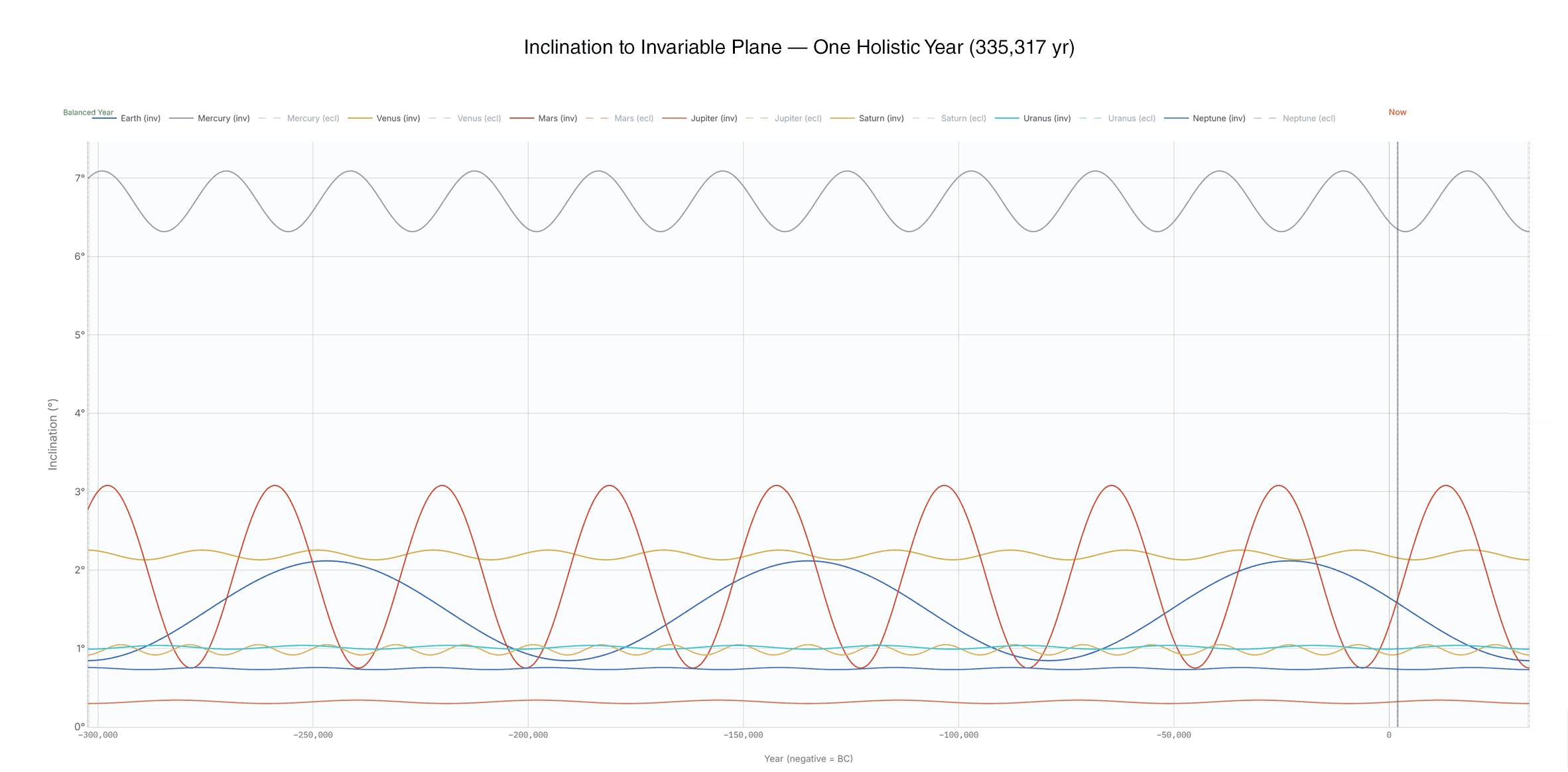
Gravitational pull from the other planets causes each orbit to precess around the invariable plane, producing two coupled effects: nodal precession (the ascending node rotates around the plane) and inclination oscillation (the tilt angle oscillates toward and away from the plane). The general formula:
inclination(t) = mean + amplitude × cos(ϖ_ICRF(t) − phase_angle)ϖ_ICRF(t) is the planet’s ICRF perihelion longitude (ecliptic rate minus general precession H/13). The phase_angle is the planet’s own ICRF perihelion longitude at the Balanced Year (302,635 BC), which determines whether the planet is in-phase (cosine sign positive) or anti-phase (sign flipped). The ascending node precesses on the invariable plane at a different rate; its role is to set the direction of the angular momentum perturbation vector that determines the vector balance below. The J2000-verified ascending node values — refined from Souami & Souchay (2012) using spherical trigonometry — match JPL ecliptic inclinations to <0.0001°.
Earth’s oscillation
| Property | Value |
|---|---|
| Mean inclination | ~1.48113° |
| Amplitude | ±0.63607° |
| Range | 0.845° to 2.117° |
| Current value | ~1.57869° (decreasing) |
| Period | ~111,772 years |
For how Earth’s inclination drives obliquity, see Obliquity & Inclination.
Data source: inclination values and ascending node positions are based on Souami, D. & Souchay, J. (2012): “The solar system’s invariable plane” (A&A 543, A133). The original S&S ascending nodes have been refined to achieve <0.0001° accuracy when reproducing JPL J2000 ecliptic inclinations — full methodology, comparison tables, and verification scripts at Plane Calibration. Key parameter: Earth’s ascending node = 284.51°.
Model-derived cycle anchors: each planet has its own inclination cycle anchor φ — the ICRF perihelion longitude that pins the planet’s inclination oscillation in the formula i(t) = mean + antiPhaseSign × amp × cos(ω̃(t) − φ). Anchors are derived from the System Reset epoch (302,635 BC, n=7) where all eight planets land at MIN inclination simultaneously. The anchor convention is: in-phase planets’ φ = ω̃(t_SR) + 180° (so at System Reset, ω̃ − φ = 180° → cos = −1 → i = mean − amp = MIN); Saturn’s φ = ω̃(t_SR) (so at System Reset, cos = +1, but its antiPhaseSign = −1 flips the sign → i = mean − amp = MIN too). Earth’s anchor is ~21.77°; Saturn’s is ~116.26°. The 7+1 split — Saturn’s sign-flipped contribution to the balance sum — is what enables the inclination balance (Law 3) at ≈99.998%.
Why not use the ecliptic?
The ecliptic (Earth’s orbital plane) is commonly used as a reference, but it moves:
| Aspect | Ecliptic | Invariable plane |
|---|---|---|
| Definition | Earth’s orbital plane | Total angular momentum perpendicular |
| Stability | Changes due to precession | Fixed in space |
| Precession period | ~67,063 years | None (fixed) |
| Best for | Short-term calculations | Long-term dynamics |
| Reference | Earth-centric | Solar-system-centric |
Measured against the ecliptic, planetary inclinations look chaotic because the reference plane itself oscillates. The clean structure visible against the invariable plane disappears:
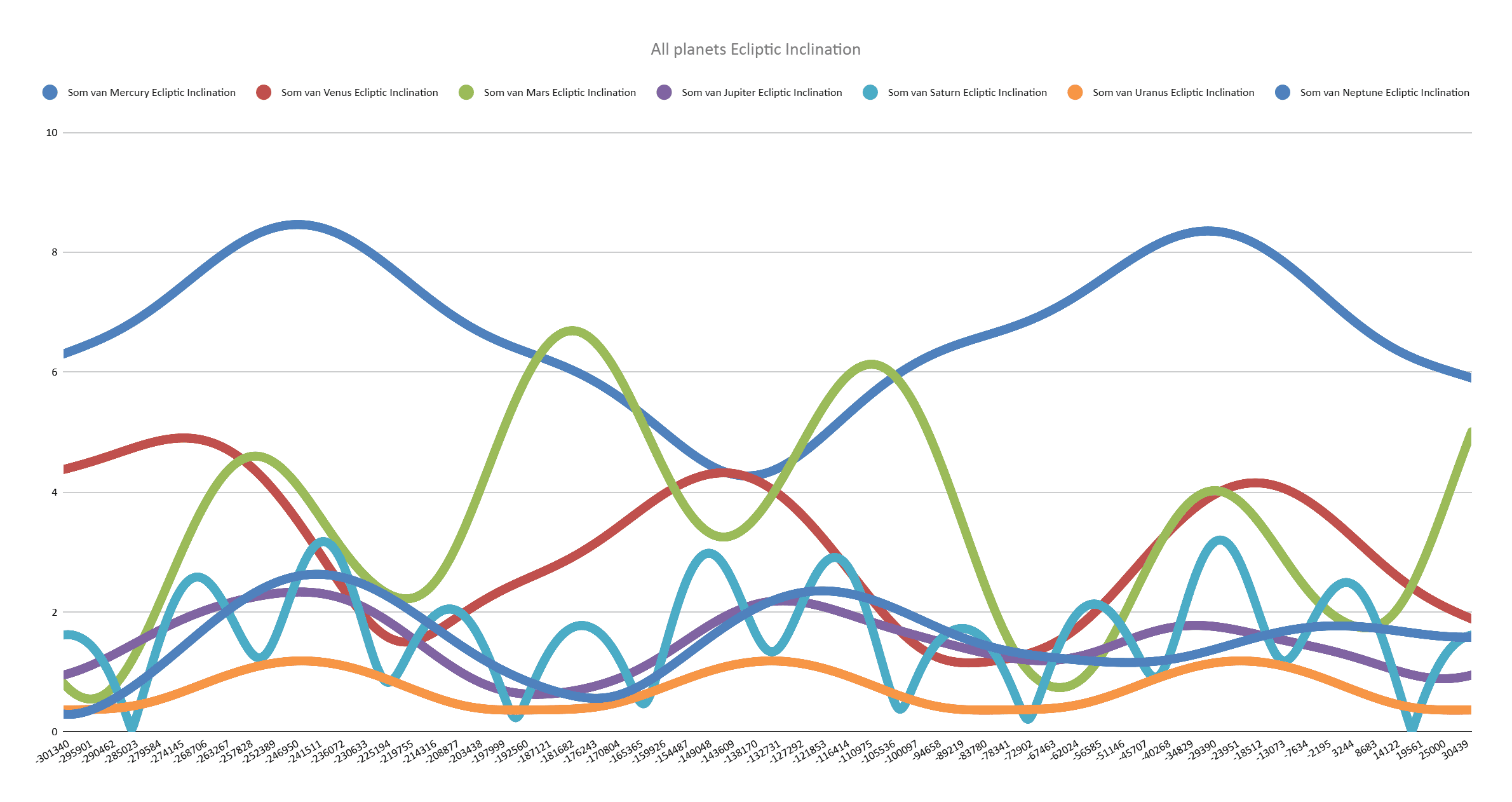
A planet’s ecliptic inclination depends on both the planet’s tilt to the invariable plane and Earth’s tilt to the invariable plane — both oscillating at different rates, hence the complex appearance. The J2000 values below are the JPL-observed targets used in the ascending node calibration:
| Planet | Ecliptic J2000 | Approx. range | Notes |
|---|---|---|---|
| Mercury | 7.005° | ~5.0° – 8.5° | Highest inclination values |
| Venus | 3.395° | ~0.7° – 4.2° | Can nearly align with ecliptic |
| Mars | 1.850° | ~0.6° – 4.7° | Largest range; can nearly align with ecliptic |
| Jupiter | 1.304° | ~0.6° – 2.4° | Can nearly align with ecliptic |
| Saturn | 2.486° | ~0° – 3.1° | Can fully align with ecliptic |
| Uranus | 0.773° | ~0.4° – 1.2° | Smallest range; can nearly align with ecliptic |
| Neptune | 1.770° | ~0.1° – 2.8° | Can nearly align with ecliptic |
Special cases: Mars, Saturn, and Uranus have invariable-plane inclination ranges that overlap Earth’s range. When their inclinations match Earth’s and their ascending nodes align, their orbital planes can become nearly parallel to the ecliptic. Saturn can even reach exactly 0°, meaning its orbital plane temporarily coincides with the ecliptic. Venus, Jupiter, and Neptune can also approach near-zero ecliptic inclinations when their ascending nodes align favourably with Earth’s.
Visualising the invariable plane
In the Interactive 3D Simulation:
- The invariable plane is shown as a reference grid (under celestial tools).
- Earth’s orbit is tilted ~1.57869° to this plane.
- Earth moves above and below the plane during its yearly orbit.
Earth crosses the plane twice per year. The crossing dates shift slowly over millennia as inclination and node precess. Around J2000:
| Period | Position | Crossing date (J2000 epoch) |
|---|---|---|
| July to January | Above the plane | ~July 4, 21:00 UTC (ascending) |
| January to July | Below the plane | ~January 4, 05:00 UTC (descending) |
Maximum distance above or below is small — about 4 million km at the extremes.
Solar system orientation: the invariable plane is tilted ~1.579° to the ecliptic, ~60° to the galactic plane, and ~7.25° to the Sun’s equator. The solar system is essentially “sideways” compared with the Milky Way’s disk.
Why the plane is stable: vector balance
The invariable plane is stable because all planetary angular momentum perturbations cancel as 2D vectors. Each planet’s orbital tilt creates a “force” on the plane with a direction (ascending node Ω) and magnitude (L × sin i). For the plane to be stable, all 8 forces must sum to zero. The force is highly concentrated in the outer planets:
| Planet | Force share | Role |
|---|---|---|
| Saturn | ~42% | Sole anti-phase planet (pushes opposite) |
| Jupiter | ~36% | Largest in-phase contributor |
| Neptune | ~11% | |
| Uranus | ~10% | |
| Inner planets | <1% combined | Mercury, Venus, Earth, Mars — negligible |
The 42/58 split of L × sin(i_J2000) magnitudes is not a balance by itself — the actual Law 3 scalar balance uses a different weight formula (w_j = √(m·a(1-e²))/d × amp) and produces the 99.9974% balance. The model achieves 99.9974% scalar balance — the structural weights of the in-phase group closely match those of the anti-phase group. This is a genuine physical constraint that selects the Fibonacci d-values. The vector balance (whether the 2D forces cancel at all times) depends on how the ascending nodes precess: in the model’s single-mode approximation, vector balance degrades to ~72% over time as nodes go out of sync; in a multi-mode representation (7 eigenfrequencies per planet, matching secular perturbation theory), vector balance is maintained at 100% — but this property holds for any frequencies, not just specific ones.
The scalar balance (Laws 3 + 5) is the genuine constraint — it determines the d-values and cannot be achieved by arbitrary configurations. The vector balance is guaranteed by the eigenmode structure regardless of the specific ascending node periods. The Balance Explorer in the 3D simulation lets you toggle single-mode vs multi-mode interactively.
Ascending node periods: a structural prediction
Each planet’s ascending node regression period takes the form 8H/N for integer N, with Jupiter and Saturn locked at a shared N=36. Across all 7 fitted planets, the 8H/N integers reproduce JPL’s J2000-fixed-frame ascending-node trends with cumulative residual ~5.8″/century (~0.8″/century per planet).
| Planet | Period | Note |
|---|---|---|
| Mercury | −8H/9 | |
| Venus | −8H/1 | full Solar System Resonance Cycle |
| Earth | −H/5 = −8H/40 | coincides with ecliptic precession |
| Mars | −8H/64 | |
| Jupiter | −8H/36 | locked with Saturn |
| Saturn | −8H/36 | locked with Jupiter |
| Uranus | −8H/11 | |
| Neptune | −8H/3 |
The model derives all eight from a single constant H. Laskar’s secular theory measures them as eight independent eigenfrequencies with no known structural relationship to each other.
Observability limitation: these periods describe motion over 50,000–2,000,000 year timescales. With only ~4,000 years of recorded astronomy, no period can be verified by direct observation of a complete cycle. The model’s advantage is that all eight derive from a single constant.
Compute inclination at any year
The full closed-form expressions for planetary inclinations to the invariable plane at arbitrary year are in Formulas. For the underlying ascending node values and how they were derived: Plane Calibration.
Continue to Moon & Planets for how the model handles lunar and planetary motion, or Plane Calibration for the technical methodology behind the refined ascending node values used throughout this page.