Days & Years
A day is one spin of the Earth and a year is one orbit, and neither is one number, because the frame each is measured against is itself moving: the stars, the equinox and the perihelion all give a different day and a different year. The differences are small, but they are not noise — they are the same motion, Earth’s axial precession, seen at two scales. One precession cycle adds exactly one sidereal day at the day level and removes exactly one sidereal year at the year level, and that identity is the thesis of this page.
This page establishes:
- The three days differ by a few minutes and a few milliseconds, and the smallest of those gaps is precession seen along the equator — Days, built up.
- The three years differ by minutes and seconds, each for one frame’s reason — Years, built up.
- Those two sets of differences are one rate: one extra sidereal day and one fewer sidereal year per precession cycle, verified quantitatively — The link.
- Every value quoted here is a J2000 anchor on a slowly evolving history; the geological evolution lives on Expanding Resonance.
All values on this page are J2000 anchors. Over geological time, Earth’s days-per-year, day length (LOD), and the precession clock all evolve via the proper-physics LOD formula. At 380 Ma (Devonian) Earth had ~399.96 days per year (Wells 1963; canonical validation table at Supporting Evidence §11), versus ~365.2422 today. The relationships described below apply to the current epoch; for the full geological-timescale evolution see Expanding Resonance.
Days, built up
Start with the only day a clock on the ground can see: the solar day, the Sun back on the meridian, ~86,400 s. It is about four minutes longer than one spin of the Earth, because Earth moves along its orbit while it rotates — after one full turn relative to the stars it must turn a little further for the Sun to be back where it was. One spin measured against the stars is the stellar day, 86,164.100105 s on the model’s day of J2000.
Between those two sits the sidereal day, 86,164.091730 s: Earth’s rotation measured not against the fixed stars but against the vernal equinox. The equinox is not fixed. Axial precession carries it once round the sky per precession cycle (~25,772 years), against the direction of rotation, so the equinox comes back to the meridian a little before the stars do — and the sidereal day is shorter than the stellar day by ~8.38 ms.
| Type | Definition | On the SI day (exactly 86,400 s) | On LOD_real of J2000 (the model’s physical day) | Connected to |
|---|---|---|---|---|
| Solar day | Time for the Sun to return to the same position in the sky | 86,400.000000 s | 86,400.001200 s | Solar year |
| Sidereal day | Earth’s rotation period relative to the vernal equinox | 86,164.090531 s (IAU) | 86,164.091730 s | Solar day |
| Stellar day | Earth’s actual rotation period (relative to fixed stars) | 86,164.098904 s (IAU 2000A) | 86,164.100105 s | Sidereal year |
The two columns are the same two days on two solar days. The IAU constants are defined on the conventional day of exactly 86,400 s; the model’s day of J2000, LOD_real, is 1.20 ms longer (the physical day Earth turns through, introduced below), and the sidereal and stellar days scale with it by Y/(Y+1), so they sit above the IAU constants by almost exactly that excess. The right-hand column is what the simulator’s Days & Years rows and its Framework Verification panel read; the left-hand column is what the IAU publishes. Neither is “more correct” — they answer on different days, and the difference between them is the whole content of the LOD_mean/LOD_real distinction.
Which precession rate the gap is. The equinox precesses at p = 50.29″/yr measured in ecliptic longitude. A meridian clock does not see the ecliptic; it sees the equator, and the equinox’s motion along the equator is the projection m = p·cos ε = 46.13″/yr. Applying that projection gives a stellar–sidereal gap of ~8.38 ms, matching the gap between the two IAU constants to within 0.01 ms — the gap is the same on any solar day, which is why it, and not the day length, is the observable this section is about. The ecliptic rate itself is a named day in the model too — the ecliptic sidereal day, 86,164.099662 s, the ecliptic-frame counterpart of the stellar day — and its gap to the sidereal day, ~9.13 ms, is the figure the model used to publish for this difference. The two numbers are one rate in two frames: 9.13 ms × cos(23.44°) = 8.38 ms, and the equator-observable offset recovers the ecliptic rate by dividing by cos ε. The ecliptic day is not meridian-observable, but it is fully determined by observed quantities, the obliquity and the equatorial precession rate.
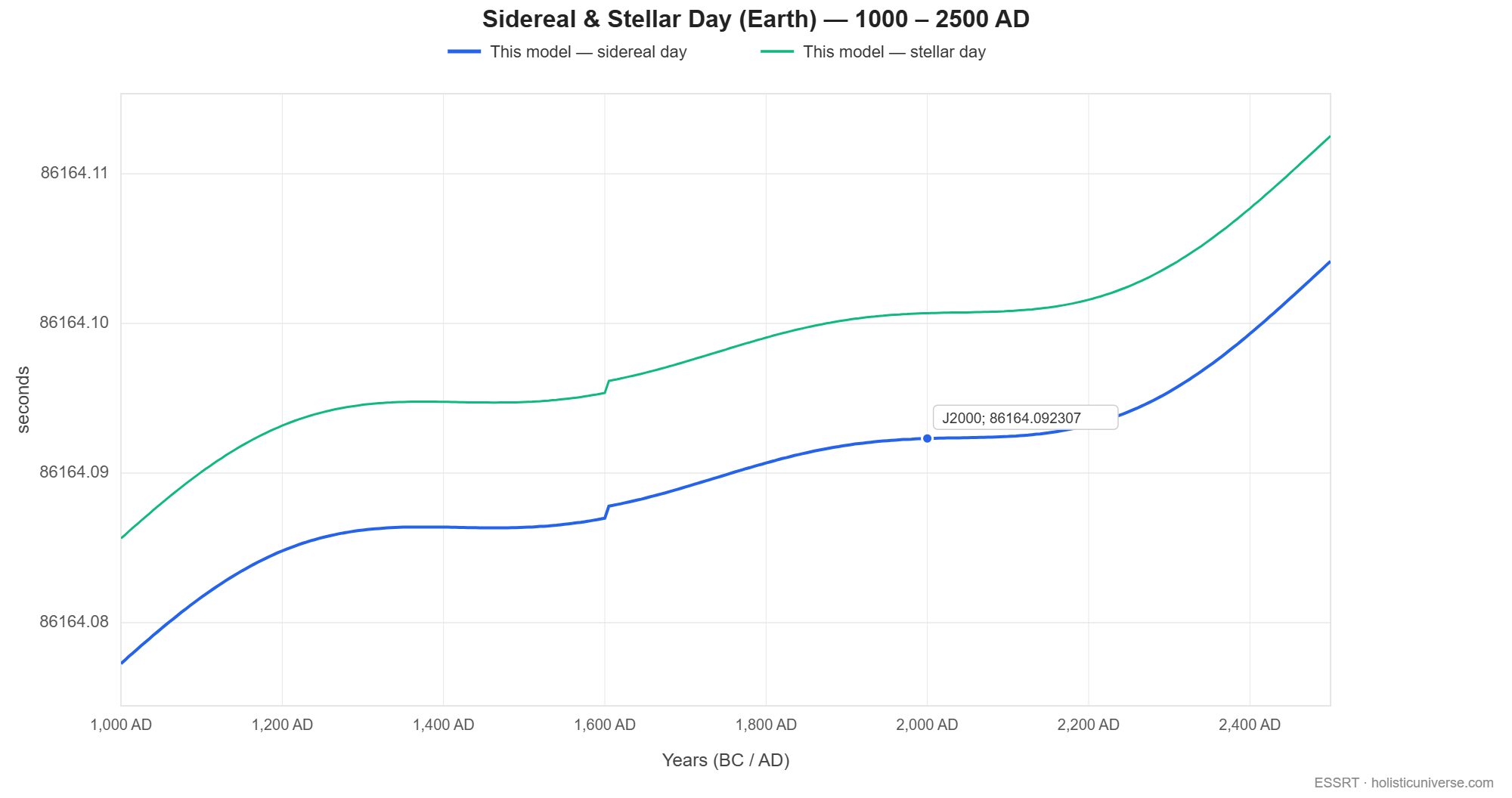
Both days lengthen, and the chart shows the model’s two curves together: the stellar day sits ~8.38 ms above the sidereal day throughout, the gap breathing only with the obliquity and the precession rate of date. The slow rise is Earth’s rotation slowing under the Moon’s tide; the step near 1610 AD is where the model’s day joins the telescopically measured ΔT record (Timekeeping).
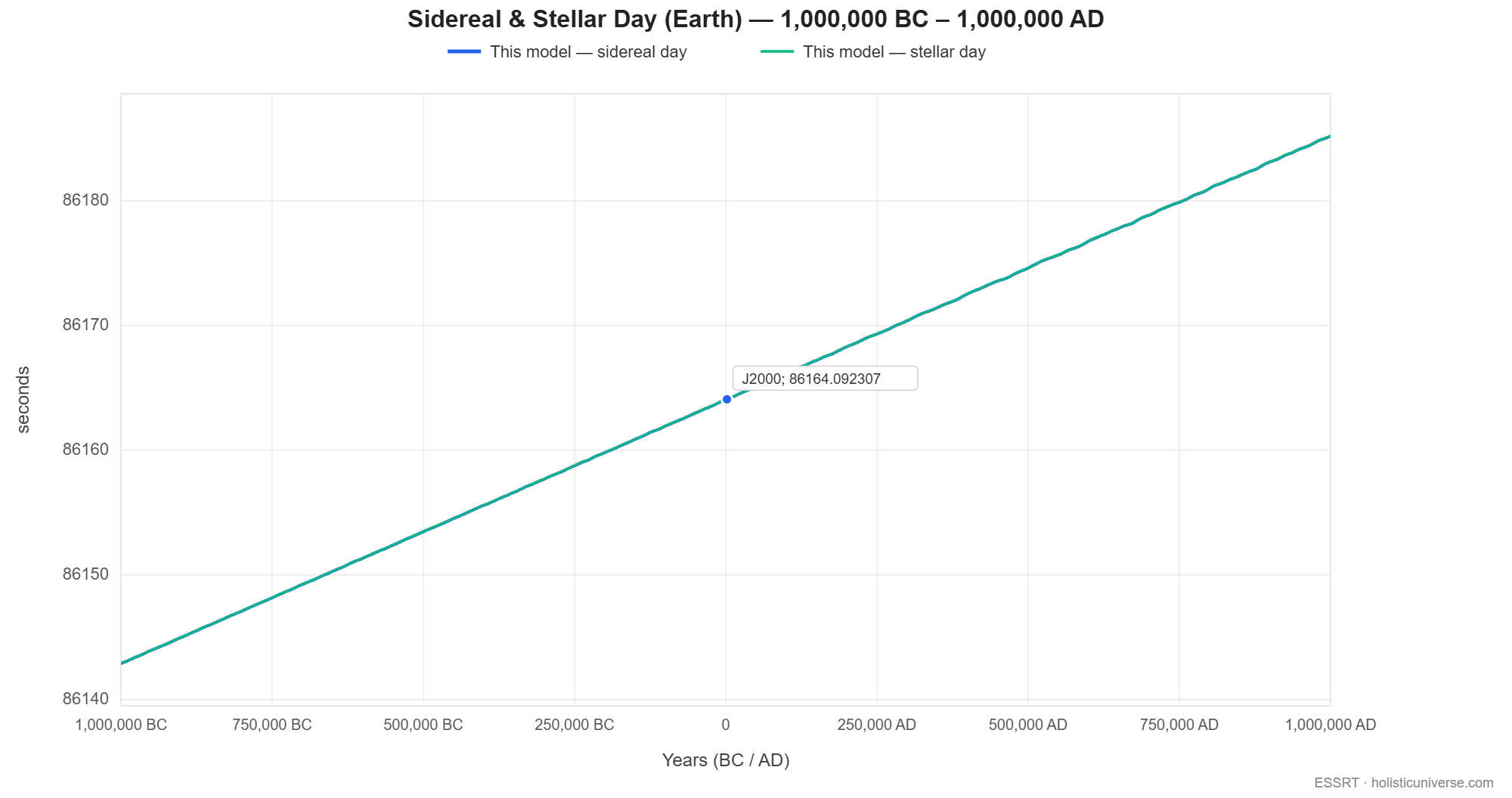
Over a million years either side of the present the two curves are indistinguishable at the scale of the chart — the whole stellar–sidereal gap is eight milliseconds against a 40-second tidal lengthening.
Two mean solar days. The mean length of the solar day is not one number either. LOD_mean (kinematic), 86,400.000000 s, follows from the identity siderealYearSeconds / meanSiderealYearDays — the sidereal year counted in SI days, the day the IAU year inputs are stated in — and is what every sidereal↔tropical conversion uses. LOD_real (physical), 86,400.001200 s, is the day Earth actually turns through: LOD_mean plus the ecliptic missing-motion term and the calibrated ΔT stack, closing on the USNO J2000 anchor by construction. The derivation is in Physical vs kinematic LOD below.
Years, built up
The same construction at the year level. Measured against the stars, Earth’s orbit is the sidereal year, 31,558,149.76 s at J2000 — the model’s anchor, from which every other year length derives. Measured against the equinox it is the solar (tropical) year, 365.2421905 days (31,556,925.26 s), shorter by 1,224.5 seconds because the equinox has precessed backwards along the orbit and the Sun reaches it early. Measured against the perihelion it is the anomalistic year, ~365.2596350 days, longer than the solar year by about 25 minutes because the perihelion moves forward along the orbit at the perihelion-precession period of ~20,938 years.
| Type | Definition | Duration | What causes variation |
|---|---|---|---|
| Solar year | Solstice to solstice (or equinox to equinox) | ~365.2421905 days | Obliquity, axial precession |
| Sidereal year | Sun returns to the same position relative to fixed stars | 31,558,149.76 s (J2000) | Fluctuates only in days |
| Anomalistic year | Perihelion to perihelion | ~365.2596350 days | Perihelion precession |
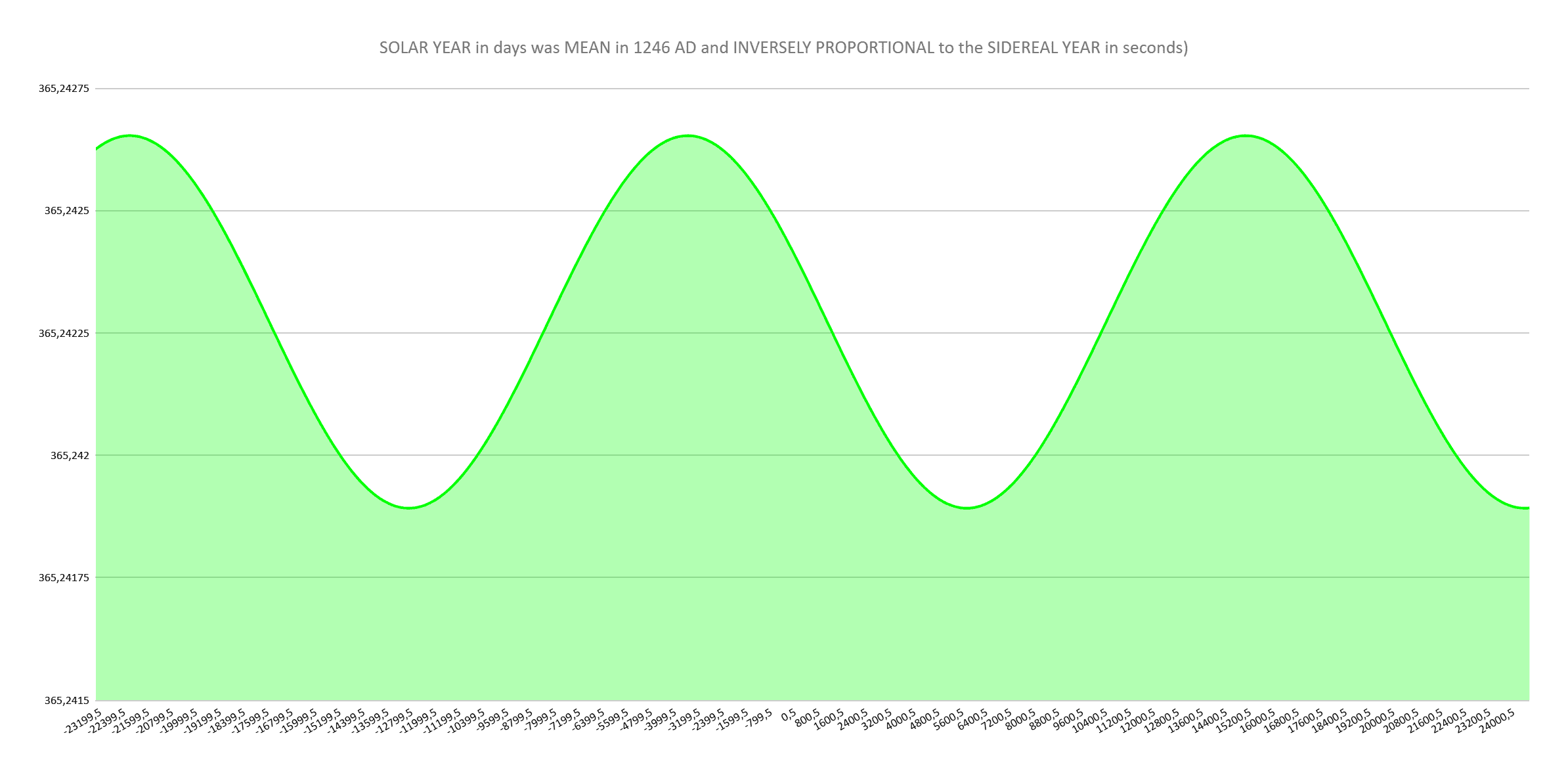
None of the three is a fixed number. Across the window above the tropical year moves through roughly a hundred seconds peak to peak — a swing invisible in the four decimals usually quoted for it; the chart puts the model’s own curve against one derived from Vondrák’s expression, which it tracks until the window runs past what Vondrák covers.
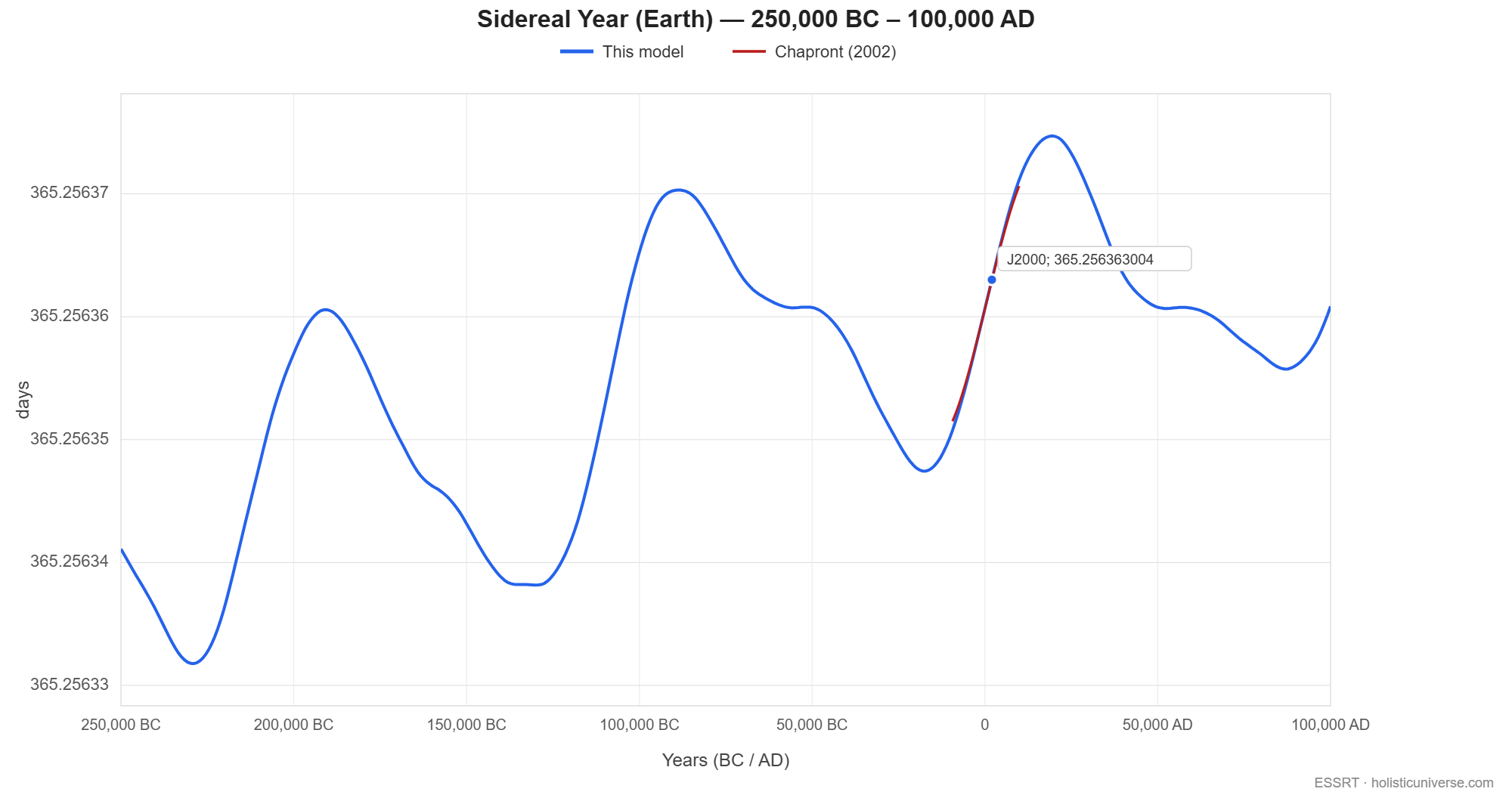
The sidereal year moves far less — a few parts in ten million, against Chapront’s published expression where that is defined. It is the steadiest of the three because it is measured against the stars, so neither the precessing equinox nor the moving perihelion enters it; in days it varies only because the day does.
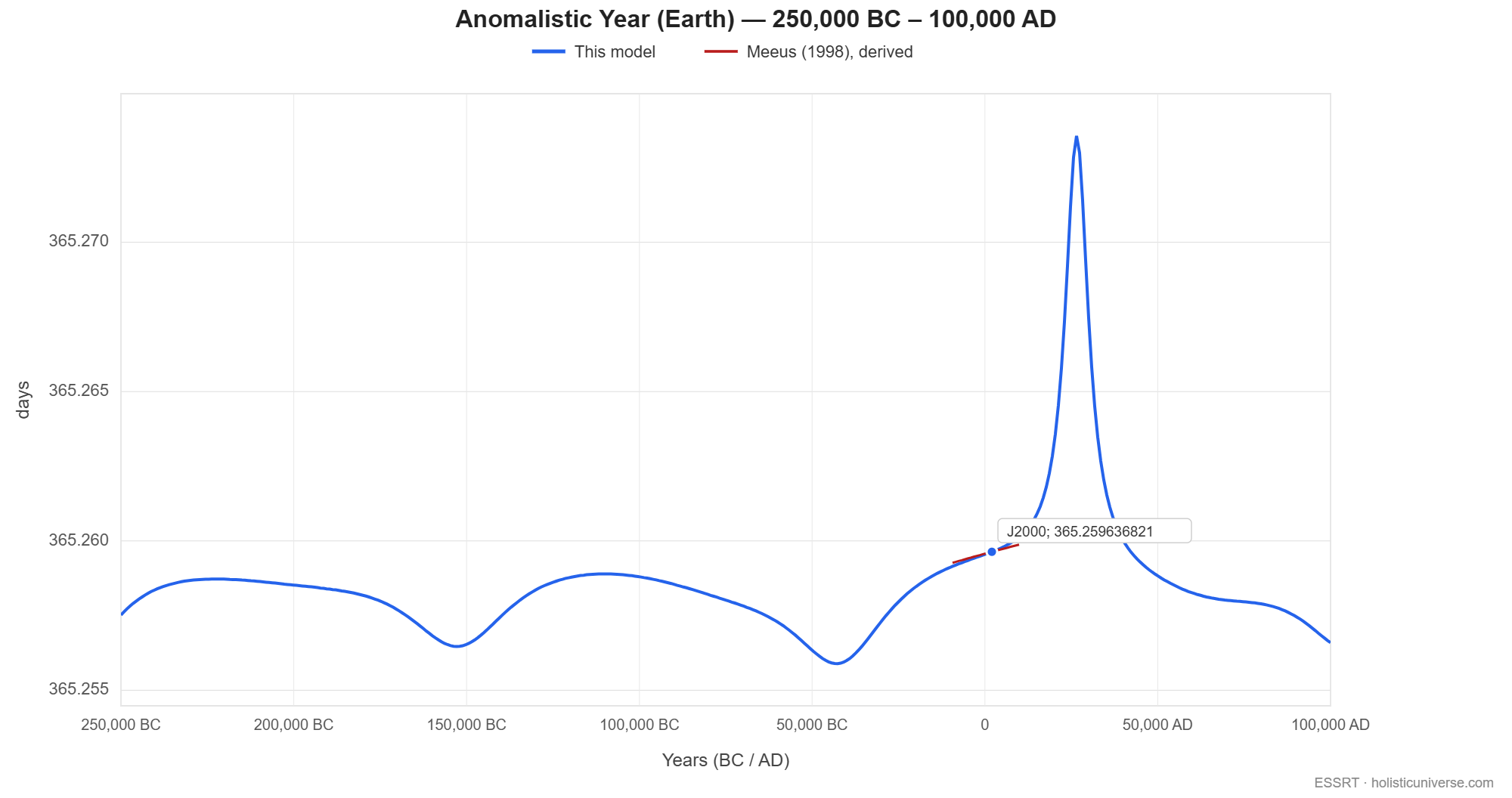
The anomalistic year is the volatile one, and the spike near 27,000 AD is the same event the precession chart shows as the apsidal period running away (Precession): perihelion-to-perihelion lengthens without limit as the apsidal motion passes through zero. Reading the two charts together is the clearest check that the spike is structure and not an extrapolation artifact — it appears in both quantities, at the same epoch, for one reason.
Technical note: the sidereal year in seconds is held at its J2000 snapshot value within the modern-era scope, but the underlying orbital period drifts very slowly across geological time — solar mass loss (~6 × 10⁹ kg/s) sums to ~10⁻¹⁴/yr (~0.3 ms/century) via Kepler’s third law; lunar tidal drag and long-period planetary perturbations are smaller contributors. Over a few hundred thousand years the cumulative change is ~1 second — negligible for the model’s predictions in the modern epoch. For the geological-timescale evolution of LOD, the precession clock, the sidereal year in seconds itself, and days-per-year, see Expanding Resonance.
The link: one rate at two scales
The 1,224.5 seconds by which the solar year falls short of the sidereal year every year are the same slip as the ~9.13 ms by which the sidereal day falls short of the ecliptic sidereal day every day. Both are the equinox moving once round the sky per precession cycle, and the coin rotation paradox says what that must add up to:
When a coin rolls around another coin of equal size it rotates twice — once for the orbit, plus once for its own rotation.
At the day level, in one year Earth rotates ~365.25 times relative to the Sun and ~366.25 times relative to the stars: Earth’s orbital motion adds exactly one rotation per year.
At the year level the paradox runs in reverse, because the two motions turn in opposite directions: Earth’s wobble centre circles Earth clockwise over ~25,772 years (axial precession), while Earth’s perihelion point orbits the Sun counter-clockwise over ~111,635 years.
| Measurement | Count per axial precession cycle |
|---|---|
| Solar years | ~25,772 |
| Sidereal years | ~25,771 |
| Difference | Exactly 1 fewer |
Just as there is exactly one more sidereal day than solar days per year, there is exactly one fewer sidereal year than solar years per axial precession cycle.
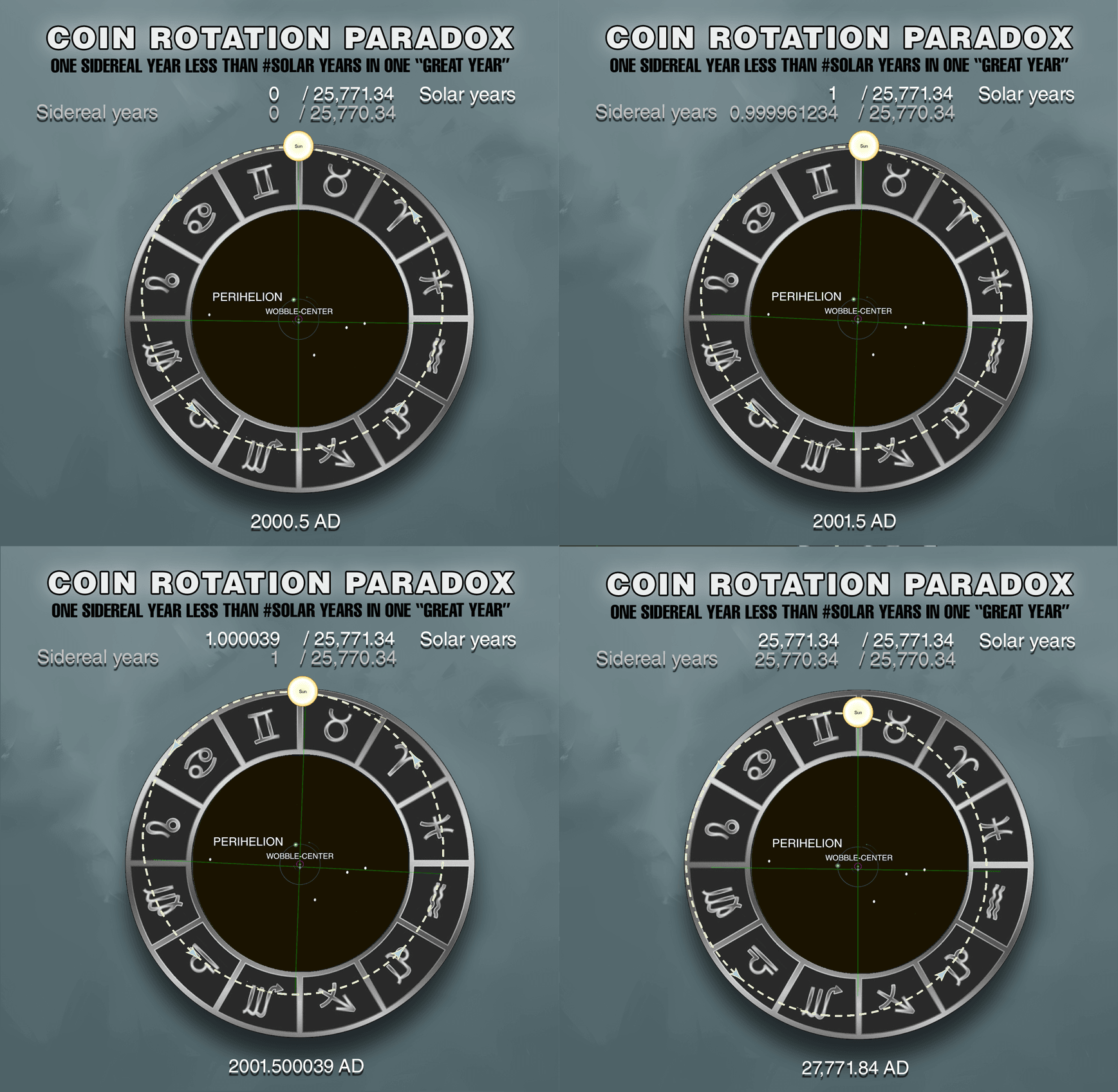
The accumulation, verified. Because the precessing equinox completes one full loop per mean axial precession cycle, the accumulated slip between the precessing and the fixed reference must equal exactly one rotation at the day level and exactly one orbit at the year level:
Day level:   9.13 ms/sidereal day × 366.25 sidereal days/year × ~~25,772 years
           = ~86,164.09 seconds = 1 sidereal day → 1 sidereal day less per axial precession cycle

Year level:  1,224.5 s/year (sidereal − solar year at J2000) × ~~25,772 years
           = 31,558,149.76 seconds = 1 sidereal year → 1 sidereal year less per axial precession cycle
The day-level identity is written in ecliptic longitude, which is why it takes the 9.13 ms ecliptic rate and not the 8.38 ms the meridian clock sees: substituting the equator-projected value would give 0.917 sidereal days per cycle instead of exactly one. The year-level identity closes because the precession period is, by definition, the beat of the two years — sidereal ÷ (sidereal − solar) — so the product is the sidereal year exactly:
1,224.5 seconds/year × ~25,771 years = 31,558,149.76 seconds ≈ 1 sidereal yearThis is why the equinoxes precess through the zodiac constellations, and why the equinox-measured year reads 1,224.5 s short of the star-measured one.
The years, geometrically
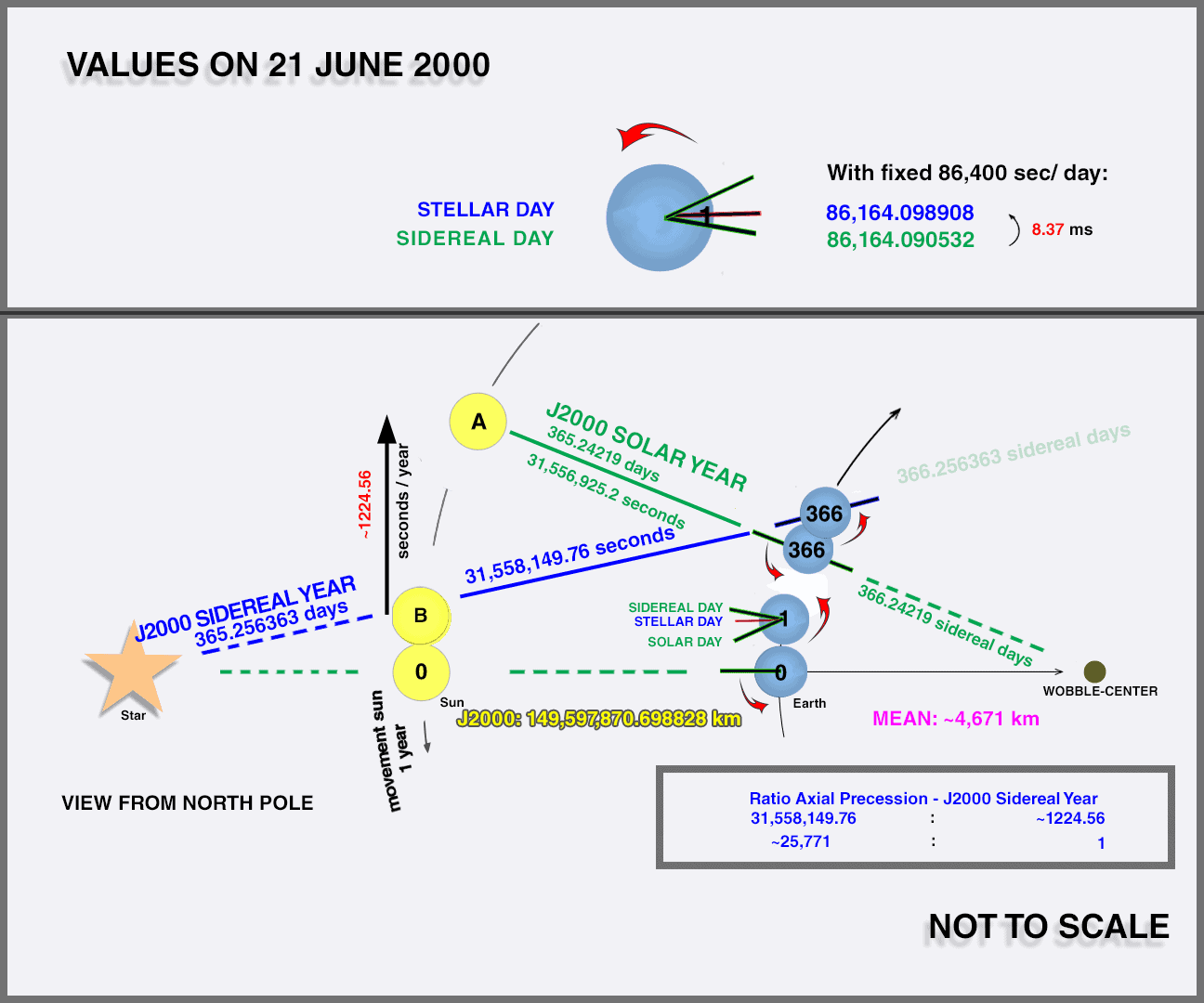
Starting from Earth’s perspective at Position 0 (Sun and Earth aligned at the start):
- After 1 solar year (~365.2421905 days) the Sun returns to the same seasonal position (Position A).
- After 1 sidereal year (~365.25636300 days) the Sun aligns with the same fixed star again (Position B).
The angular difference between A and B is the annual precession shift (~50.29 arcsec/yr at J2000). The anomalistic year adds a third marker further on: perihelion shifts forward by about a day every 57 years, and perihelion-to-perihelion closes a full turn against the equinox only after ~20,938 years.
| Year | In seconds | In days | Depends on |
|---|---|---|---|
| Sidereal | J2000 (31,558,149.76 s) | Varies | Gravitational perturbations (tiny) |
| Solar | Varies | Varies | Obliquity (axial tilt) |
| Anomalistic | Varies | Varies | Obliquity–inclination beat |
The sidereal year in days varies only because the day does — Sidereal Year (days) = Sidereal Year (seconds) / Day Length (seconds) — and the day length is read back from the same anchor:
Day Length = Sidereal Year (seconds) / Sidereal Year (days)
         = 31,558,149.76 s / 365.25636300 days
         = 86,400.000000 seconds
Fourier analysis across 491 data points (±25,000 years, 100-year steps) confirms which frame each year follows:
| Year type | Dominant period | Amplitude | Physical driver |
|---|---|---|---|
| Tropical | the obliquity cycle (~~41,099 yr) | ±1.8 s | Steeper ecliptic angle → faster equinox crossing |
| Sidereal | obliquity + apsidal cycles (tiny) | ±0.1 s | Planetary gravitational interactions |
| Anomalistic | a ~14-kyr beat term | ±0.04 s | Obliquity × inclination interplay |
The tropical-year variation is 15× larger than the sidereal, confirming the orbital period is nearly constant while the equinox reference frame shifts with obliquity. Where each year length comes from: Formulas.
Current and mean values. Each measurement has a mean over the full precession cycles; the current values fluctuate around it.
| Parameter | Current (J2000) | Mean |
|---|---|---|
| Solar day — LOD_mean (kinematic) | 86,400.000000 s | 86,400.000000 s |
| Solar day — LOD_real (physical, Layer 4 composite) | (mean-only, no J2000 ripple) | 86,400.001200 s |
| Sidereal day (on LOD_real) | 86,164.091730 s | 86,164.0905329 s |
| Stellar day (on LOD_real) | 86,164.100105 s | 86,164.0989084 s |
| Solar year | ~365.2421905 days | 365.2421905 days |
| Sidereal year (seconds) | 31,558,149.76 s | (J2000 anchor) |
| Sidereal year (days) | ~365.25636300 days | 365.2563630 days |
| Anomalistic year | ~365.2596350 days | 365.2596350 days |
LOD_mean is the SI day at J2000 and as a mean. LOD_real is the physical J2000 day, the one the sidereal and stellar days of the first table’s right-hand column are read on, and it has no separate mean row: it closes on the USNO anchor by construction. The mean sidereal and stellar days in the right-hand column here are read on the kinematic mean day (the SI day), which is why they sit below the J2000 values, read on the slightly longer LOD_real. Both evolve slowly across geological time; the sidereal and stellar day and the year lengths also fluctuate through the year (equation of time) and through the precession cycles.
Physical vs kinematic LOD (the ecliptic term)
The model maintains two distinct mean-LOD values because they answer two different physical questions:
| Concept | J2000 value | What it represents |
|---|---|---|
| LOD_mean (kinematic) | 86,400.000000 s | The framework’s kinematic baseline — derived from the kinematic identity siderealYearSeconds / meanSiderealYearDays (the SI day). Used inside all sidereal↔tropical conversions and the calibrated ΔT computation. |
| LOD_real (physical, Layer 4 composite) | 86,400.001200 s | The physical LOD Earth actually experiences — LOD_mean + the ecliptic missing-motion term + calibrated cyclic ΔT stack + Core-mantle swing. Matches the USNO Earth Orientation Center J2000 anchor exactly by construction of the joint fit. |
| ↳ intermediate: raw kinematic + ecliptic term | 86,400.003441 s | LOD_mean + the ecliptic term, no ΔT calibration. Overshoots USNO by ~2.24 ms; the calibrated ΔT stack contributes that net -2.24 ms at J2000 to close the composite onto the anchor. |
The ~3.441 ms ecliptic term represents Earth’s need to rotate slightly more per solar day to catch the Sun on the meridian, because the Sun’s apparent motion follows the ecliptic — which precesses relative to the invariable plane on Earth’s orbital nodal period (the orbit’s dominant nodal mode, ~~68,751 years). Over one solar day the ecliptic advances by 1/(T_nodal·mSY) revolutions — requiring that many extra revolutions of Earth rotation:
δ_rev = 1 / (T_nodal × mSY) revolutions per day
raw kinematic + ecliptic term = LOD_mean + LOD_mean × δ_rev    ≈ 86,400.000000 s + 3.441 ms
                            = 86,400.003441 s          (overshoots USNO by ~2.24 ms)
LOD_real (Layer 4)            = raw kinematic + ecliptic term + Σ calibrated ΔT cycles + Core-mantle swing
                            = 86,400.001200 s at J2000     (matches USNO anchor exactly)
The calibrated stack is the Bond/Hallstatt/Jose5/Jose4 cyclic ΔT stack plus the core-mantle swing, the model’s damped core-eigenmode episode — see Timekeeping, “The fifth component”.
Why other precession cycles don’t need their own correction:
- Axial precession is already implicit in LOD_mean via the sidereal-to-tropical year ratio (one fewer sidereal year per precession period — the missing year IS the axial precession). Adding an explicit precession correction would double-count.
- The obliquity cycle is an oscillation, not a precession — its time-averaged contribution to LOD is zero.
- Apsidal precession applies to the invariable-plane frame, not to the Sun’s apparent motion — using it as the LOD correction would give the wrong reference frame.
- Perihelion motion against the equinox contributes to the anomalistic year, not to the tropical-day counting relative to the Sun.
Only the ecliptic’s own precession (the nodal period) gives the correct reference for the Sun’s apparent motion and therefore the correct solar-day correction.
| LOD | Purpose |
|---|---|
| LOD_mean | Sidereal↔tropical conversions, calibrated ΔT stack (matches Stephenson-2016 history), Meeus geometry, eclipse timing |
| LOD_real (Layer 4 composite) | Physical LOD display — used for the tweakpane readout, the physical-LOD row in J2000 tables, and USNO comparisons. |
| raw kinematic + ecliptic term | Pure-physics ΔT prediction (the “V curve” near J2000) — shown as the calibrated stack’s raw-physics baseline. |
See Timekeeping & Delta-T for how each LOD enters the ΔT calculation and the two zoom-outs visualising LOD_real(t) across ±12 kyr (short-term ripples on the tidal trend) and −248 to +102 kyr (Milankovitch coupling to glacial cycles), and the Formulas reference for closed-form expressions.
Cardinal point variation
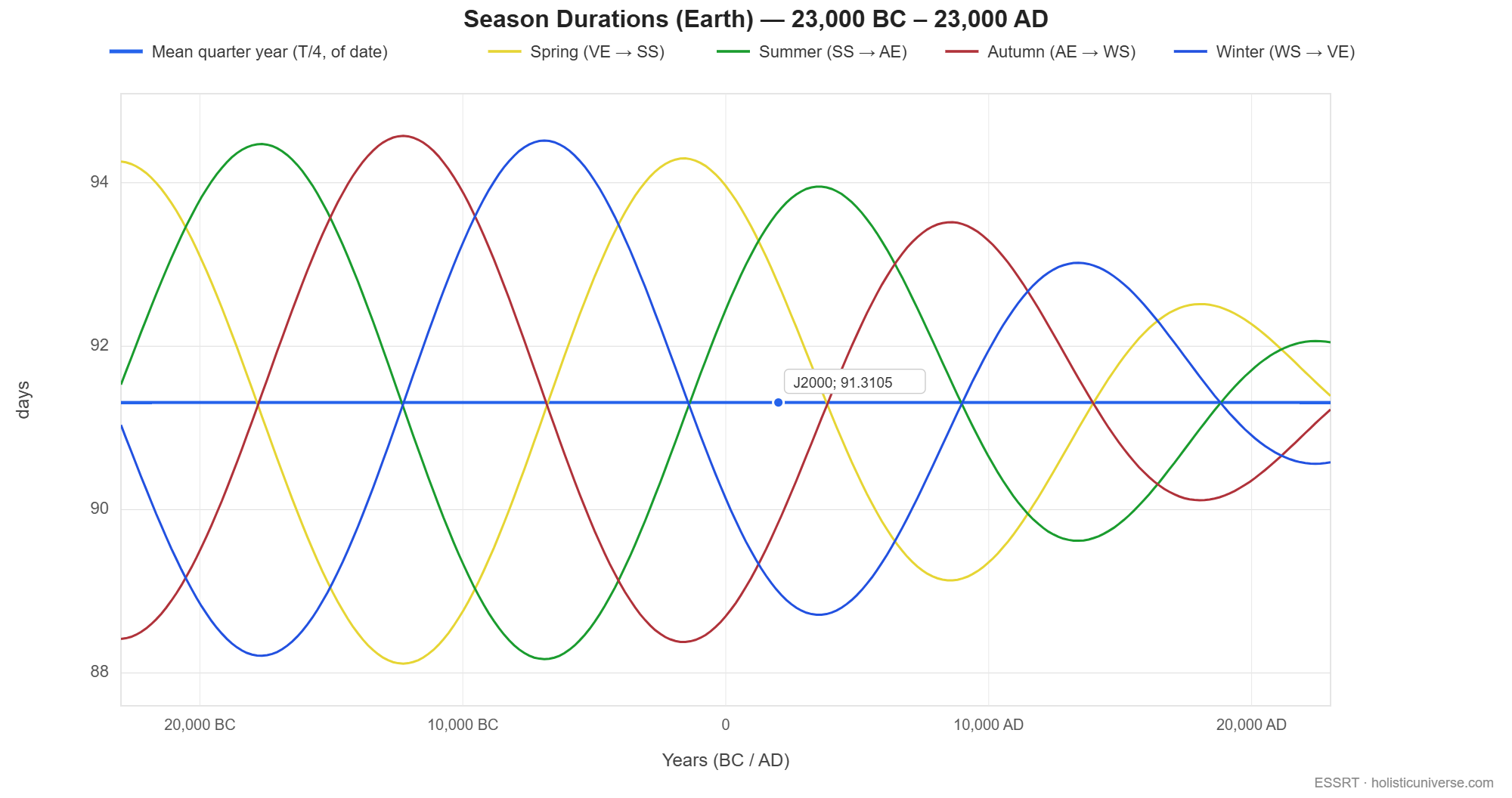
The four seasons take turns being the long one. Each is a quarter-cycle out of phase with the next, because what moves is a single thing — the perihelion walking round the year — and all four must average to the mean quarter year, the flat line they cross. The envelope narrows toward the future because the amplitude scales with eccentricity, which is falling.
The tropical year length depends on which cardinal point is used to measure it. At the current epoch (perihelion in early January), Earth moves faster near perihelion (Kepler’s 2nd law) and slower near aphelion. The consequence runs the opposite way to intuition: a tropical year is the sidereal year minus the time the Sun needs to make up the ~50″ the equinox has precessed. Where the Sun moves fast it makes that up quickly, so little is subtracted and the year is longer; where it moves slowly, more is subtracted and the year is shorter:
| Cardinal point | Year length (days) | vs mean (seconds) | Reason |
|---|---|---|---|
| Summer solstice | 365.241628 | −49 s (shortest) | Near aphelion → the Sun’s apparent motion is slowest, so the ~50″ precession deficit takes longest to cross |
| Autumnal equinox | 365.242014 | −15 s | Past aphelion, motion still below average |
| Vernal equinox | 365.242379 | +16 s | Approaching perihelion, motion already above average |
| Winter solstice | 365.242741 | +48 s (longest) | Near perihelion → the Sun’s apparent motion is fastest, so the deficit is crossed quickest and the year stays closest to the sidereal year |
Total spread ~96 seconds. These are the model’s own values and they reproduce the classical per-point tropical years of Meeus to better than a millisecond. The pattern reverses when perihelion precesses to July (half a perihelion-of-date cycle after the 1246 alignment): winter solstice becomes shortest and summer solstice longest. The mean of all four cardinal points cancels this effect and gives the true mean tropical year.
One rotating vector — the braid law
These four differences are not four separate phenomena. The model requires them to be one complex function read through four fixed rotations:
δ_X(t) = Im[ e^(i·n·λ_X) · W_n(t) ] λ = 0°, 90°, 180°, 270° (SS → AE → WS → VE)where W₁(t) is Earth’s perihelion vector as seen in event time: its argument is the longitude of perihelion ϖ(t), its modulus is the eccentricity e(t). Both halves do work. The argument’s rotation carries the seasonal pattern around the calendar — which is why the roles swap after half a perihelion-precession cycle. The modulus sets the pattern’s amplitude, so Earth’s changing eccentricity scales every seasonal asymmetry with it: e(t) comes from the N-body series, not from a fixed constant (Eccentricity). The model evaluates the four offsets directly from this vector — the N-body series’ e(t) and ϖ(t) read through the four fixed rotations — with no per-point term: the per-point tropical years in the table are its readings, not fitted values, and the four points are statistically identical by construction.
What makes this science rather than curve fitting is a sign experiment: the model requires the seasonal-asymmetry spectrum to be quadrature-locked counter-rotating — the sidebands must rotate against the time phase. Both rotation senses were fitted with identical freedom: the required sense captures the residual; the opposite sense captures nothing. A wrong geometry would fail both; an overfitting description would pass both. Exactly one sense passing means the structure is real: every seasonal asymmetry, from the ~91-second spread in this table down to the sub-minute fine structure, is a single rotating geometric object — the perihelion vector.
The law’s forward-looking content — checkable against century-scale precision timing of the equinoxes and solstices (IMCCE/Meeus-class ephemeride series): it fixes the differential drift rates of the four per-point tropical years with zero per-point freedom. At J2000, relative to the common mean: SS +0.4, WS −0.4, VE +1.5, AE −1.6 s/century — two near-opposite pairs summing to zero, the quadrature structure expressed in rates (the per-point year lengths themselves already match the IAU values at J2000 to 0.2–3.2 s). The seasonal pattern rotates with perihelion — half a perihelion-of-date cycle after 1246 the winter/summer solstice roles swap — and any future decomposition of cardinal-point timing residuals must find the fine structure in the counter-rotating sideband only; a coherent co-rotating component at measurable amplitude would falsify the one-vector geometry outright.
How everything connects
┌─────────────────────────────────────────────────────────────────┐
│                    COIN ROTATION PARADOX                        │
├─────────────────────────────────────────────────────────────────┤
│  366.25 sidereal days = 365.25 solar days (1 more rotation)     │
│  25,771 sidereal years = ~25,772 solar years (1 fewer orbit)     │
└─────────────────────────────────────────────────────────────────┘
                            │
                            ▼
┌─────────────────────────────────────────────────────────────────┐
│                    DAY-YEAR CONNECTIONS                         │
├─────────────────────────────────────────────────────────────────┤
│  Stellar Day ────────► Sidereal Year (J2000 anchor)             │
│       │                      │                                  │
│       ▼                      ▼                                  │
│  ~8.38ms difference    ~1,224.51s difference                   │
│       │                      │                                  │
│       ▼                      ▼                                  │
│  Sidereal Day ───────► Solar Year                               │
│       │                      │                                  │
│       ▼                      ▼                                  │
│  Axial Precession     Perihelion Precession                     │
│  (~~25,772 years)      (~~20,938 years)                           │
│                              │                                  │
│                              ▼                                  │
│                       Anomalistic Year                          │
└─────────────────────────────────────────────────────────────────┘
Compute it
Complete closed-form expressions for the solar year, the sidereal year, the day length and the precession durations at any year are in the Formulas reference. Every value in this chapter can be checked directly against the model with the Analysis Tools: Create Year Analysis Report exports year-by-year measurements to Excel, and Console Tests (F12) validate specific calculations against IAU reference values.
Continue to Timekeeping & Delta-T for how Earth’s rotation cycles affect time measurement.