Appendix
This appendix consolidates all reference data, astronomical constants, and bibliography sources used in the framework. Every value is read from the model’s registry, so the tables here agree with the pages that derive them.
This page establishes:
- Earth’s clock and long periods, the precession rates, and the Earth, Moon and Sun constants with their cycles — I. Solar System Data.
- The parallax chain — Parallax Calculations.
- Earth’s, the Sun’s and the Galaxy’s movement budgets — II. Heliocentric Movements.
- Every cited source — III. Bibliography.
I. Solar System Data
Earth’s Clock and Long Periods
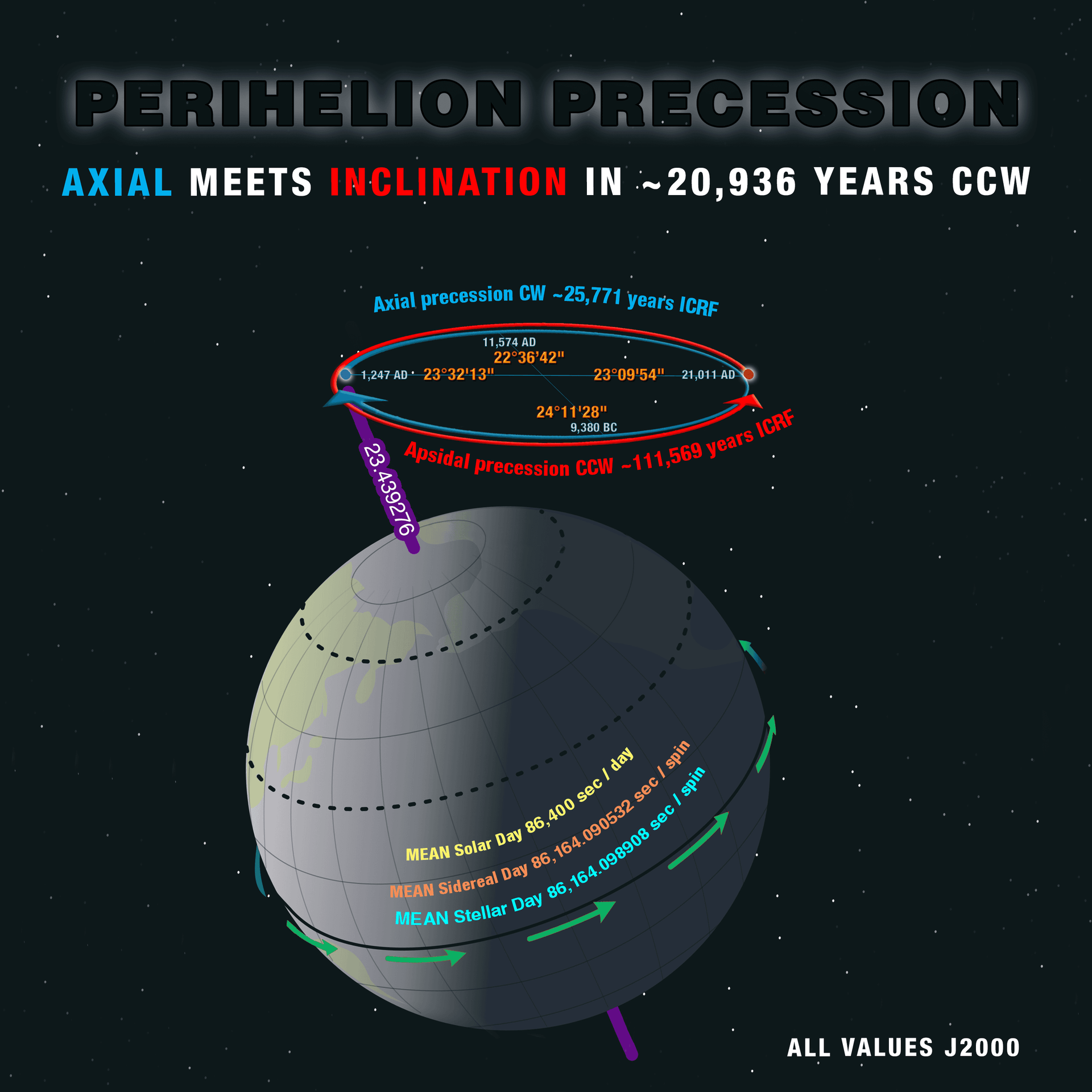
All cycle durations below are J2000 values — the model’s own dynamical periods, read against its precession clock (the former integer-divisor labels are retired — Earth’s Clock). The spin quantities lengthen at geological time with the clock; the orbital ones do not — see Expanding Resonance for the deep-time evolution layer.
| Cycle | Duration | Formula |
|---|---|---|
| Lunisolar precession period (the clock) | 25,771.6 years | the composed torque rate’s period at J2000 |
| Apsidal Precession | ~111,635 years | the beat of the one-family anomalistic and sidereal years at J2000, T_anom·T_sid/(T_anom − T_sid) — the movement’s own apsidal rate of date |
| Ecliptic Precession | ~68,751 years | the N-body chain’s dominant nodal mode s₃, 1,296,000/|s₃| |
| Obliquity cycle | ~41,099 years | the beat of the spin axis's inertial precession against the nodal mode s₃, 1,296,000/(ψ̇ᵢₙ − |s₃|) |
| Axial Precession | 25,771.58 years | the of-date year laws’ beat at J2000, T_sid·T_trop/((T_sid − T_trop)·365.25 d) |
| Perihelion Precession | ~20,938 years | the perihelion-of-date beat of the one-family route at J2000: 1/T_peri = 1/T_p + 1/T_aps |
Precession Rates
| Precession Type | Cycle (years) | Rate (arcsec/year) |
|---|---|---|
| Apsidal (vs ICRF) | ~111,635 | — |
| Ecliptic (nodal mode s₃) | ~68,751 | — |
| Obliquity cycle | ~41,099 | — |
| Axial (general precession, J2000) | ~25,772 | 50.288 |
| Perihelion (vs equinox of date, J2000) | ~20,938 | 61.897 |
Earth Data
| Property | Value |
|---|---|
| Equatorial circumference | 40,075.02 km |
| Equatorial diameter | 12,756.27 km |
| Equatorial radius | 6,378.14 km |
Earth Cycles
| Cycle Type | Value |
|---|---|
| Mean Solar year | 365.2421905 days |
| Sidereal year (J2000 anchor) | 31,558,149.76 SI seconds |
| Mean Anomalistic year | 31,558,432.46 SI seconds |
Moon Data
| Property | Value |
|---|---|
| Mean diameter | 3,474.8 km |
| Orbital circumference | 2,415,250.59 km |
| Orbital radius | 384,399.07 km |
Moon Cycles
| Cycle | Duration |
|---|---|
| Sidereal month | 27.3216615600 days |
| Synodic month | 29.5305888682 days |
| Anomalistic month | 27.5545500869 days |
| Draconic month | 27.2122207740 days |
| Tropical month | 27.3215822584 days |
| Full Moon cycle (observed) | 411.7844739478 days |
| Full Moon cycle (the lunar chain’s fixed-frame value) | 411.7664607945 days |
| Draconic year (observed — eclipse year) | 346.6200668908 days |
| Draconic year (the lunar chain’s fixed-frame value) | 346.6073036718 days |
| Apsidal precession (of date) | ~8.85 years |
| Nodal precession (of date) | ~18.6 years |
Sun Data
| Property | Value |
|---|---|
| Mean diameter | 1,392,684 km |
| Orbital circumference | 939,951,143.16 km |
| Orbital radius (1 AU) | 149,597,870.698828 km |
| Eccentricity (J2000) | 0.01671022 |
| Orbital speed | 107,225.047752503 km/h |
Parallax Calculations
| Property | Value |
|---|---|
| Arcseconds in a circle | 1,296,000 |
| Arcseconds per radian (ρ) | 206,264.806247096 |
| 1 arcsecond displacement | 725.270943796471 km |
| One parsec | 30,856,775,814,671.9 km |
| Solar parallax | 8.794143836 arcseconds |
The arcseconds per radian value (ρ = 648,000/π) is the conversion factor between angular measurement in arcseconds and radians.
The 1 arcsecond displacement (725.270943796471 km) represents the distance at 1 AU that subtends 1 arcsecond, calculated as Earth’s radius divided by the solar parallax:
6,378.1369994839 km / 8.794143836 arcsec = 725.270943796471 kmThe distance to the Sun (1 AU) is then simply:
725.270943796471 km × 206,264.806247096 arcsec/radian = 149,597,870.698828 kmII. Heliocentric Movements
The heliocentric model involves numerous complex movements. These can be categorized based on the body in motion—Earth, Sun, or Galaxy—and divided into three primary types: rotation, linear motion, and precession.
Earth Movements
-
Rotation: Earth rotates 360° on its axis
- Mean solar day: ~86,400 SI seconds
- Sidereal day: ~86,164.09 SI seconds
- Stellar day: ~86,164.10 SI seconds
-
Orbital Motion: Earth revolves around the Sun
- Orbital path: ~940,000,000 km
- Period: ~365.24219 days
-
Earth-Moon System: Both orbit a common center of gravity
- Mass ratio: ~81.3
- Period: ~29.53 days (lunar month)
-
Axial Precession: Polar axis wobble
- Mainstream (J2000): ~25,771 years
- ESSRT: ~25,772 years (the clock, J2000 reading)
- Direction: Clockwise (backwards in time)
-
Perihelion Precession: Movement of closest approach
- Mainstream (J2000): ~20,951 years
- ESSRT: ~20,938 years (the perihelion-of-date beat)
- Direction: Forward in time
-
Obliquity Cycle: Axial tilt variation
- Mainstream (J2000): ~41,040 years, range ~22.1° to ~24.5°
- ESSRT: ~41,099 years (the obliquity beat), range 22.08° to 24.45°
- Current value (2000 AD): ~23.4393°
-
Inclination Cycle: Orbital plane variation
- Mainstream (J2000, vs ecliptic): ~68,700 years
- ESSRT (nodal precession, vs ecliptic): ~68,751 years
- ESSRT (apsidal precession, vs ICRF): ~111,635 years
- Current inclination: ~1.57869°
-
Chandler Wobble: Polar location variation
- Cycle: ~14 months
- Amplitude: 3–15 meters
Sun Movements
-
Solar System Barycenter: Sun wobbles around center
- Primary influence: Jupiter
- Period: ~11.859 years
-
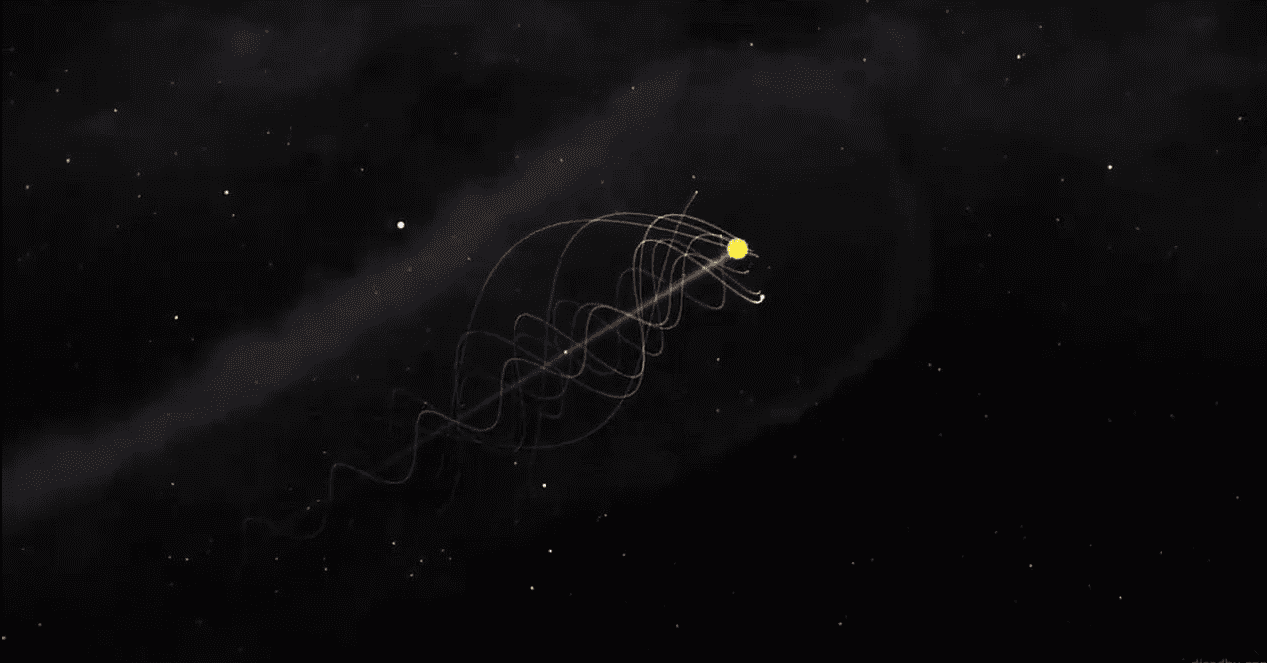
Galactic Orbit: Sun orbits the Milky Way
- Distance from center: ~25,000-28,000 light years
- Speed: ~230 km/s (828,000 km/h)
- Period: ~250 million years
Galaxy Movements
Our Milky Way Galaxy moves through the Universe at hundreds of km/s, with the Local Group of galaxies being pulled toward the Great Attractor in the Hydra-Centaurus / Norma direction.
III. Bibliography
“Your time is limited, so don’t waste it living someone else’s life. Don’t be trapped by dogma — which is living with the results of other people’s thinking.”
— Steve Jobs (Stanford Commencement Speech, 2005)
Astronomical Data & Tools
JPL Horizons — ssd.jpl.nasa.gov/horizons The JPL Horizons solar system data and ephemeris computation service provides access to key solar system data.
Webgeocalc (WGC) — wgc.jpl.nasa.gov Web-based graphical user interface to SPICE system observation geometry computations.
NASA Space Place — spaceplace.nasa.gov
IERS Earth Orientation Parameters — hpiers.obspm.fr Astronomical constants and Earth orientation parameters from the International Earth Rotation and Reference Systems Service.
Wikipedia Constants — Astronomical Constant
Astronomy Textbooks
- Introduction to Astronomy and Cosmology (PDF)
- Astronomy on OpenStax (Source 1)
- Astronomy on OpenStax (Source 2)
- Astronomical Algorithms by Jean Meeus (PDF)
- The Copernican Revolution by Thomas Kuhn (PDF)
Precession & Earth’s Motion
Key Research Papers
- Inclination, Axial & Obliquity Precession Connection (PDF)
- Physics Forums Discussion
- Khan Academy: Apsidal Precession & Milankovitch Cycles
Background Information
- Wikipedia: Axial Precession
- Earth’s Motions
- Coordinate Changes (UVA)
- Why does Earth’s axis move opposite to its rotation?
Historical 9.12 ms debate. Under the framework this is resolved: ~9.13 ms is the axial precession rate counted in ecliptic longitude — the frame the “one extra sidereal day per axial precession cycle” identity is written in; the observed stellar–sidereal day offset is ~8.38 ms — the same axial precession projected onto the equator by the obliquity, m = p·cos ε. Both numbers are real; they name different measurements. See Days & Years — coin rotation paradox.
Related Work
Milankovitch Cycles & Climate
- Wikipedia: Milankovitch Cycles
- Skeptical Science: Climate Relation
- The 100,000 Year Problem (PDF)
- Milankovitch: Father of Paleoclimate Modelling (PDF)
- Modified Milankovitch Theory (PDF)
- A Brief History of Climate Change (UK)
Planetary Events & Catalogues
Transits
- Mercury Transit Catalogue (NASA)
- Venus Transit Catalogue (NASA)
- Planetary Transits and Occultations (Wikipedia)
Mars Data
Jupiter & Saturn Conjunctions
- Jupiter-Saturn Conjunction Data
- Great Conjunction (Wikipedia)
- Jupiter-Neptune Conjunction Data
- Triple Conjunction Dates (Wikipedia)
- List of Future Astronomical Events (Wikipedia)
Orbital Elements
The Invariable Plane
Academic Search Engines
| Search Engine | Description |
|---|---|
| RefSeek | Academic resource search with over a billion sources |
| WorldCat | Search contents of 20,000+ worldwide libraries |
| Springer | Access to 10+ million scientific documents |
| Bioline | Scientific bioscience journals from developing countries |
| RePEc | 4 million publications on economics and related sciences |
| Science.gov | US government search on 2,200+ scientific sites |
| BASE | 100+ million scientific documents, 70% free |
Return to The Model or explore the 3D Simulation.