Fibonacci Laws of Planetary Motion
The orbits of the eight planets are not random. Their shapes (eccentricities) and tilts (inclinations) follow patterns built on Fibonacci numbers — the sequence 1, 1, 2, 3, 5, 8, 13, 21, 34, … where each number is the sum of the two before it. Fibonacci ratios converge toward the golden ratio (1.618…), which plays a central role in the stability of dynamical systems. In the solar system, Fibonacci patterns mark the orbits that survived 4.5 billion years of gravitational evolution.
Six independent laws connect planetary precession periods, inclinations, and eccentricities through Fibonacci numbers and mass-weighted quantities, predicting orbital properties for all eight planets from a single timescale: the Holistic-Year H = 335,317 years. This value is empirically fitted — it is the unique timescale that simultaneously satisfies eight independent constraints from observed precession cycles, climate patterns, and integer day counts. See Mathematical Foundation for the full derivation.
This page explains the Fibonacci Laws in accessible language. For the full mathematical treatment, derivations, and statistical analysis, see Fibonacci Laws Derivation.
The Scientific Foundation
The Fibonacci Laws rest on three pillars — each independently supported by established science and peer-reviewed research.
1. Two real counter-rotating motions
The model’s foundation is not speculative. Earth undergoes two well-documented precession motions that move in opposite directions:
| Precession | Direction | Current period | Mean period | Physical Cause |
|---|---|---|---|---|
| Axial precession | Clockwise (westward) | ~25,771 years | 25,794 years (= H/13) | Gravitational torque from Moon & Sun on Earth’s equatorial bulge |
| Apsidal precession | Counter-clockwise (prograde) | ~112,000 years | 111,772 years (= H/3) | Gravitational perturbations from other planets (mainly Jupiter) |
Both are standard astronomy with known physical causes — documented in IAU reference models (Capitaine et al. 2003 ) and planetary ephemerides. The current periods vary slightly over time; the mean periods over the full 335,317-year Holistic cycle are the structurally significant values. The opposite directions are a consequence of the underlying physics: axial precession follows from gyroscopic torque on Earth’s equatorial bulge, while apsidal precession follows from planets pulling Earth’s perihelion forward in its orbital direction. The key observation: the ratio of their mean periods is 111,772 : 25,794 = 13 : 3 — consecutive Fibonacci numbers.
2. Fibonacci patterns in orbital mechanics are documented
Fibonacci-related frequency ratios in the solar system are not unique to this model. They appear throughout the peer-reviewed literature:
- Molchanov (1968) in Icarus found that many planetary orbital resonances approximate Fibonacci fractions, including Venus/Earth at 8/13 = 0.615
- Aschwanden (2018) analyzed 75 orbital period ratios in the solar system (planets and moons) and found approximately 60% match Fibonacci fractions within measurement uncertainty
- Pletser (2019) in Astrophysics and Space Science confirmed that ~60% of planetary and satellite period ratios preferentially cluster near Fibonacci fractions, with these orbits associated with more regular, less inclined, and more circular configurations
- Aschwanden & Scholkmann (2017) found Fibonacci harmonic ratios in 73% of 932 exoplanet pairs — extending the pattern well beyond our solar system
- Fibonacci patterns also appear in DNA structure (34 × 21 angstroms per turn; Yamagishi & Shimabukuro 2008 ), phyllotaxis (sunflower spirals, pineapple scales), and numerous other natural systems
The Kirkwood Gaps in the asteroid belt provide dramatic visual confirmation: asteroids at simple integer resonances with Jupiter (3:1, 5:2, 2:1) have been swept away, while those at Fibonacci-related frequencies survive.
3. KAM theory explains why
The Kolmogorov–Arnold–Moser (KAM) theorem (1954–1963) provides the rigorous mathematical explanation. In perturbed dynamical systems, orbits whose frequencies have the “most irrational” ratios are maximally stable against perturbation. The golden ratio φ ≈ 1.618 — toward which Fibonacci ratios converge — is the most irrational number in a precise mathematical sense: it is the hardest to approximate by simple fractions. This means orbits with golden-ratio-related frequencies are the last to become unstable when perturbed by gravitational interactions.
Over 4.5 billion years, the solar system has naturally selected for these maximally stable configurations. Greene and Mackay (1979) confirmed computationally that the “golden” invariant torus is indeed the last to break. Morbidelli and Giorgilli (1995) showed super-exponential stability near golden-ratio frequency ratios in the asteroid belt.
In summary: The two counter-rotating precession motions are established astronomy. Their period ratio is a Fibonacci fraction. Fibonacci patterns in orbital mechanics are well-documented in peer-reviewed literature, and KAM theory rigorously explains why stable orbits favor these ratios. The Fibonacci Laws extend these observations into a quantitative framework that predicts specific orbital properties for all eight planets. See section 5 for more details on KAM theory, and Scientific Background for the full scientific discussion with references.
1. The Six Fibonacci Laws
The six laws form a symmetric architecture. Law 1 establishes the timescale — all major precession periods derive from the Holistic-Year divided by Fibonacci numbers. Laws 2–5 quantify individual and collective orbital properties: inclination amplitudes and their balance (Laws 2–3), then eccentricity amplitudes and their balance (Laws 4–5). Each combines a planet’s orbital property with the square root of its mass — a weighting dictated by the Angular Momentum Deficit (see section 3 below). Law 6 closes the circle — it reveals the gravitational resonance mechanism that connects the timescale to the orbital structure.
Law 1: The Fibonacci Cycle Hierarchy
Dividing the Holistic-Year by successive Fibonacci numbers produces the major precession periods of the solar system.
The Holistic-Year H = 335,317 years is the master timescale. When divided by the Fibonacci numbers 3, 5, 8, 13, …, the resulting periods correspond to observed astronomical cycles:
| Fibonacci | H / F | Period (years) | Astronomical meaning |
|---|---|---|---|
| 3 | H/3 | 111,772 | Inclination Precession / Earth perihelion (ICRF) |
| 5 | H/5 | 67,063.4 | Ecliptic Precession / Jupiter perihelion (ecliptic) |
| 8 | H/8 | 41,915 | Earth obliquity cycle / Jupiter perihelion (ICRF) / Saturn perihelion (ecliptic-retrograde) |
| 13 | H/13 | 25,794 | Axial precession |
| 21 | H/21 | 15,967 | Saturn + Axial beat frequency |
| 34 | H/34 | 9,862 | Earth + Saturn beat frequency |
These periods are not independent — they follow the same addition rule as the Fibonacci sequence itself. Just as 3 + 5 = 8, the corresponding frequencies add:
1/111,772 + 1/67,063.4 = 1/41,915
This works at every level: 1/67,063.4 + 1/41,915 = 1/25,794, and 1/41,915 + 1/25,794 = 1/15,967. The beat frequency rule is a direct consequence of the Fibonacci addition, applied to the timescale hierarchy. The ratios between consecutive periods approach the golden ratio: 111,772/67,063.4 = 1.667, 67,063.4/41,915 = 1.600, converging toward 1.618…
Why this matters: Law 1 establishes that the solar system’s major timescales are not arbitrary — they form a Fibonacci-structured hierarchy rooted in a single number H. The same Fibonacci numbers that organize these timescales (3, 5, 8, 13, 21, 34) reappear as the divisors in Laws 2–5. See Precession for the physical meaning of each cycle.
Law 2: The Inclination Constant
Each planet’s mass-weighted inclination amplitude, multiplied by a Fibonacci divisor, equals the same universal constant.
Inclination measures how tilted an orbit is relative to the average plane of the solar system. Each planet’s tilt oscillates slowly over hundreds of thousands of years. The mass-weighted inclination amplitude is η = amplitude × √m. When multiplied by a Fibonacci divisor d specific to each planet, the result is a single constant ψ shared by all eight planets:
d × η = ψ
where d is a pure Fibonacci number — the same sequence (3, 5, 21, 34) that appears throughout the model. The constant ψ is derived purely from Fibonacci numbers and H = 335,317:
ψ = 2205 / (2 × 335,317) = 0.003288
The numerator 2205 = 5 × 21² uses Fibonacci numbers F₅ and F₈ — the period denominators of Jupiter (H/5) and Saturn (H/8) from Law 1. The denominator 2 × H uses F₃ = 2, Earth’s period denominator (H/3). The same three planets whose precession periods form the resonance loop (Law 6) determine the universal constant.
Why the symbol ψ? In quantum mechanics, ψ denotes the wave function, and ψ² gives probabilities across quantum states. Here, ψ² appears in the energy formula AMD = √a × ψ² / (2d²), where the Fibonacci divisor d acts as a quantum number (see the AMD interpretation below). The analogy is structural, not physical.
Worked example — Earth’s inclination amplitude:
Rearranging the law: amplitude = ψ / (d × √m), where mass is in solar masses (M☉ = 1.989 × 10³⁰ kg):
| Step | Value |
|---|---|
| Earth’s Fibonacci divisor d | 3 |
| Earth’s mass | 5.972 × 10²⁴ kg = 3.003 × 10⁻⁶ M☉ |
| √m | 1.733 × 10⁻³ |
| d × √m | 3 × 1.733 × 10⁻³ = 5.199 × 10⁻³ |
| amplitude | 0.003288 / 0.005199 = 0.63603° |
Earth’s orbit tilts ±0.63603° around its mean inclination of 1.48128° — oscillating between 0.845° and 2.117° over hundreds of thousands of years. The same formula, with only the divisor d and mass changed, predicts every other planet’s tilt range.
The eight divisors form a mirror-symmetric pattern across the asteroid belt (see section 4).
What ψ physically means — mass-independent energy partition: Law 2 divides each planet’s tilt by √m — heavier planets tilt less. But this mass dependence is not arbitrary: √m is the unique exponent that makes the underlying energy partition completely mass-free. The standard AMD for a planet’s inclination oscillation is m × √a × amp² / 2. Substituting amp = ψ / (d × √m) from Law 2, the m in front cancels the m in the denominator:
m × √a × [ψ / (d√m)]² / 2 = √a × ψ² / (2d²)
Each planet’s share of the eight-planet inclination oscillation energy is proportional to √a/d²:
| Planet | d | √a/d² | Share |
|---|---|---|---|
| Mercury | 21 | 0.0014 | 0.2% |
| Venus | 34 | 0.0007 | 0.1% |
| Earth | 3 | 0.1111 | 18.2% |
| Mars | 5 | 0.0494 | 8.1% |
| Jupiter | 5 | 0.0912 | 14.9% |
| Saturn | 3 | 0.3430 | 56.1% |
| Uranus | 21 | 0.0099 | 1.6% |
| Neptune | 34 | 0.0047 | 0.8% |
Saturn alone carries over half the tilt oscillation energy — not because it is the most massive (Jupiter is 3× heavier), but because it has the lowest d combined with a large orbit. Earth, despite being 1000× lighter than Jupiter, carries more oscillation energy (18% vs 15%) because its d = 3 beats Jupiter’s d = 5 in the 1/d² scaling. The Earth–Saturn pair (d = 3) carries 74% of the eight-planet total, and the E–J–S resonance triad (Law 6) carries 89%. (Shares are relative to the eight major planets, which carry 99.994% of the system’s orbital angular momentum; TNOs contribute the remainder.)
Connection to Law 3: The same structural properties that make Saturn the dominant energy carrier — d = 3 and a large orbit — also make it the sole counterweight in the inclination balance (Law 3 below). In the mass-independent energy partition above, Saturn carries 56%. In the mass-dependent balance of Law 3, Saturn carries exactly 50% (by definition — it equals the other seven combined). The gap is absorbed by mass: Jupiter is 3.3× heavier than Saturn, which boosts Jupiter’s balance weight relative to its energy share, redistributing the load from 56/44 to an exact 50/50 split.
This also reveals what determines ψ’s magnitude: it is fixed by the total inclination oscillation energy of the solar system (set at formation) and the geometric sum Σ(√a/d²) (set by Fibonacci structure and orbital spacing). Law 3 below tells us the oscillations cancel; the budget equation tells us their scale. See Fibonacci Laws Derivation — Physical meaning of ψ for the full derivation.
Law 3: The Inclination Balance
The angular-momentum-weighted inclination oscillations of seven planets balance against Saturn’s alone.
The invariable plane — the fundamental reference plane of the solar system, perpendicular to the total angular momentum vector — must remain stable. Each planet’s orbital tilt oscillates with a per-planet phase angle (the ICRF perihelion longitude at the balanced year, clustering near Laplace-Lagrange eigenmodes). For the invariable plane to stay fixed, the angular-momentum-weighted oscillations of the two groups must cancel:
Prograde group: Mercury, Venus, Earth, Mars, Jupiter, Uranus, Neptune — Anti-phase group: Saturn (alone)
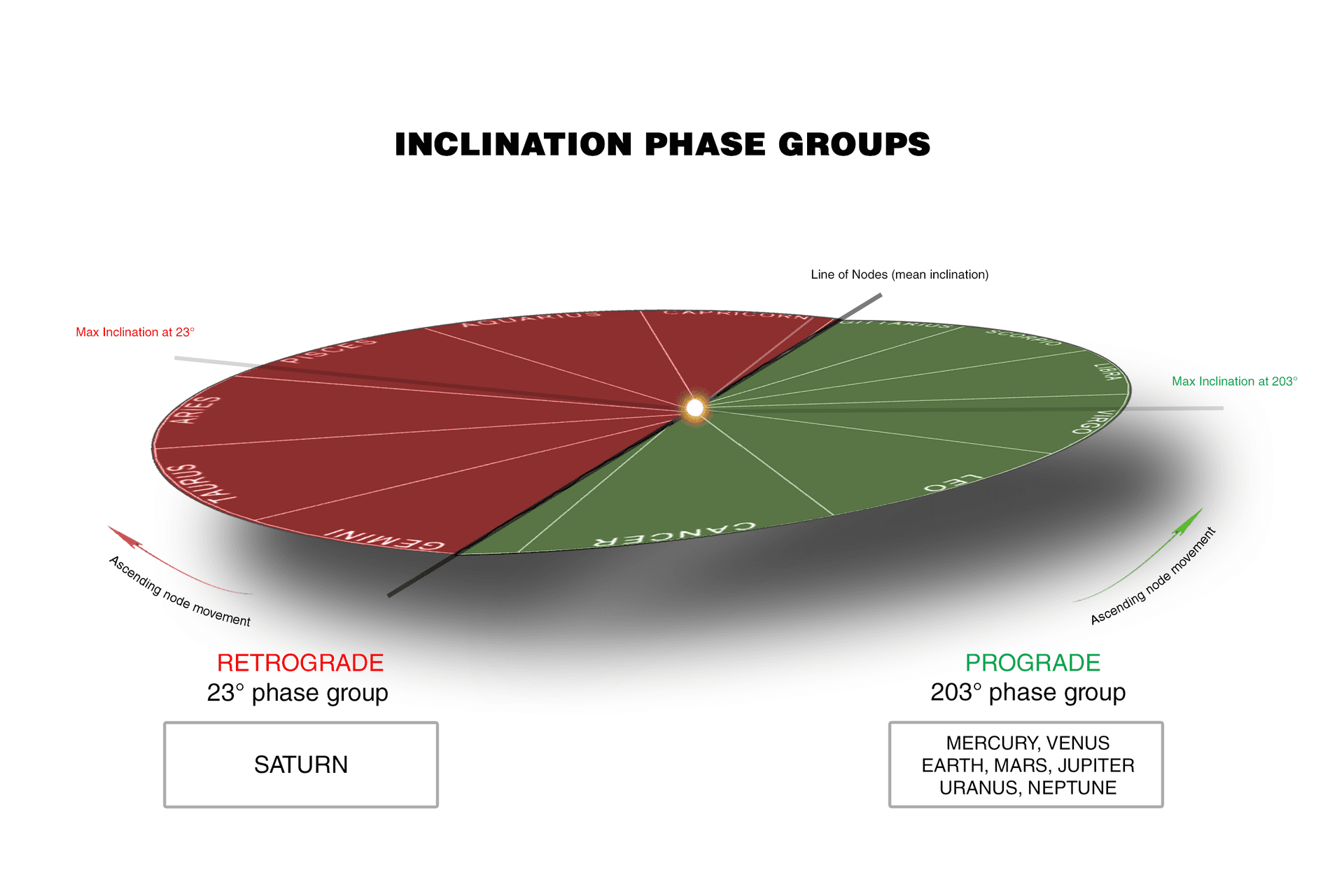
How the balance works: Each planet’s structural weight is w = √(m × a) / d, where a is the semi-major axis. Because every planet shares the same ψ (Law 2), the universal constant cancels — the balance depends only on these structural weights. The sum of the seven prograde weights must equal Saturn’s weight alone:
| Contributor | Weight w | Share |
|---|---|---|
| Saturn (anti-phase — alone) | 0.01737 | 100% of anti-phase side |
| Jupiter (prograde — dominant) | 0.01408 | 81% of prograde side |
| Uranus + Neptune | 0.00253 | 15% |
| Earth + Mars | 0.00072 | 4% |
| Mercury + Venus | 0.00005 | ~0% |
| Prograde total | 0.01737 |
The balance is 100% (with dual-balanced eccentricities, which enter via the angular momentum factor √(1 − e²)). Jupiter alone gets 81% of the way to matching Saturn; Uranus and Neptune contribute most of the remaining 19%. The four inner planets barely matter — their small masses and distances make their weights negligible.
Law 4: The Eccentricity Constant
Within each mirror pair, the ratio of eccentricity to mean inclination satisfies two Fibonacci constraints that together determine all eight eccentricities from the inclinations alone.
Laws 2–3 determine inclination amplitudes and collective balance, but leave individual eccentricities undetermined — Law 5 gives only one equation for eight unknowns (seven degrees of freedom). Law 4 fills this gap.
For each planet, define the AMD partition ratio R = e / i_mean, where i_mean is the mean inclination in radians (from Law 2). This ratio measures how a planet divides its orbital deviation between eccentricity and inclination — a high R means most deviation is in orbit shape, a low R means most is in orbit tilt.
Within each mirror pair, these R values satisfy two Fibonacci constraints:
| Mirror pair | R² sum | Second constraint |
|---|---|---|
| Mars / Jupiter | R²_Ma + R²_Ju = 377/5 (= F₁₄/F₅) | R_Ma × R_Ju = 34/2 (= F₉/F₃) |
| Earth / Saturn | R²_E + R²_Sa = 34/3 (= F₉/F₄) | R_E × R_Sa = 2 (= F₃/F₁) |
| Venus / Neptune | R²_V + R²_Ne = 1/2 (= F₁/F₃) | R_V / R_Ne = 2/8 (= F₃/F₆) |
| Mercury / Uranus | R²_Me + R²_Ur = 21/2 (= F₈/F₃) | R_Me / R_Ur = 2/3 (= F₃/F₄) |
The two equations per pair determine both R values, and therefore both eccentricities e = R × i_mean. Belt-adjacent pairs (Mars/Jupiter, Earth/Saturn) use a product constraint; outer pairs (Venus/Neptune, Mercury/Uranus) use a ratio constraint — reflecting the different coupling regimes across the asteroid belt.
Worked example — Earth and Saturn eccentricities:
Earth and Saturn form a mirror pair (both have divisor d = 3). Their mean inclinations from Law 2 are: Earth 1.48128° (0.02585 rad), Saturn 0.982568° (0.01627 rad). The two Fibonacci constraints for this pair are:
R²_E + R²_Sa = 34/3 and R_E × R_Sa = 2
From the product constraint: R_Sa = 2 / R_E. Substituting into the sum gives a quadratic with two solutions: R = 0.604 and R = 3.312. Earth (smaller eccentricity) takes 0.604; Saturn takes 3.312. Converting back to eccentricities:
| Planet | R | × i_mean (rad) | = predicted e | Observed e | Error |
|---|---|---|---|---|---|
| Earth | 0.604 | × 0.02585 | 0.01561 | 0.015386 * | +1.9% |
| Saturn | 3.312 | × 0.01627 | 0.05389 | 0.05386 | +0.05% |
* Base eccentricity (cycle midpoint), not J2000 (0.01671022). See Eccentricity: How Base Eccentricity Was Derived.
The same procedure applied to all four mirror pairs predicts all eight eccentricities — with zero free parameters. The full prediction table is in section 2.
Dynamical coupling — communicating vessels: The product constraint R_E × R_Sa = 2 implies that Earth’s and Saturn’s eccentricities cannot evolve independently. As Earth’s eccentricity decreases (currently heading toward its ~0.0140 minimum around 11,725 AD), R_E decreases, forcing R_Sa to increase — and with it Saturn’s eccentricity. The coupling is bidirectional: Saturn has its own perihelion precession cycle (H/8 = 41,915 years, ecliptic-retrograde), which drives its own eccentricity changes. Through the product constraint, those changes feed back into Earth’s eccentricity. The two planets behave like communicating vessels: what one loses in eccentricity, the other gains, mediated by the Fibonacci product constraint.
An observational clue supports this coupling: Earth’s eccentricity is currently decreasing while Saturn’s is increasing — exactly as the product constraint predicts. This bidirectional coupling may explain why the model’s eccentricity curve for Earth does not perfectly match the formula-based predictions: the eccentricity shown in the model reflects only Earth’s own 20,957-year perihelion cycle, but does not yet account for the additional perturbation from Saturn’s eccentricity evolution feeding back through the pair constraint. The physical coupling is already visible in the precession formulas: Saturn is the only planet whose precession formula requires Earth’s time-varying obliquity and eccentricity as inputs (see Formulas). A further consequence: because eccentricity determines the sidereal year length in days, Saturn’s influence on Earth’s eccentricity indirectly affects both the length of Earth’s year in days and the Length of Day — giving Saturn a measurable impact on the days and years experienced on Earth. Whether the same communicating-vessel behaviour holds for the other three mirror pairs (Mars/Jupiter, Venus/Neptune, Mercury/Uranus) is a further test of this framework.
What Law 4 adds: Law 2 determines how much each orbit tilts. Laws 3 and 5 ensure these tilts and shapes collectively balance. Law 4 determines how much of each planet’s orbital deviation goes into eccentricity versus inclination — completing the prediction of all orbital parameters from the Holistic-Year.
Law 5: The Eccentricity Balance
The same Fibonacci divisors and phase groups produce an independent balance condition on eccentricities.
Using the same divisors and the same Saturn-vs-seven grouping, each planet receives an eccentricity weight v = √m × a³ᐟ² × e / √d, where a is the semi-major axis and e is the eccentricity. Compared to the inclination weight (w = √(m × a) / d), the eccentricity weight scales differently: a³ᐟ² instead of √a, linear e instead of no eccentricity term, and 1/√d instead of 1/d. The sum of the seven prograde weights must equal Saturn’s weight alone:
| Contributor | Weight v | Share |
|---|---|---|
| Saturn (anti-phase — alone) | 0.01547 | 100% of anti-phase side |
| Jupiter (prograde — dominant) | 0.00793 | 51% of prograde side |
| Uranus | 0.00571 | 37% |
| Neptune | 0.00173 | 11% |
| Inner 4 planets | 0.00007 | ~0% |
| Prograde total | 0.01543 |
Balance: 100% (with dual-balanced eccentricities)
The load distribution differs from Law 3: Jupiter carries only 51% (vs 81% for inclination), while Uranus contributes 37% — making the eccentricity balance more evenly spread among the three outer prograde planets.
This balance is not a structural artifact — three tests confirm it depends on the actual eccentricity values:
- Without eccentricities, the weight formula gives only 74% balance — the observed eccentricities contribute 26 percentage points of improvement
- Random eccentricities substituted into the same formula give only 50–85% balance
- The balance peaks sharply at linear eccentricity (100% with dual-balanced eccentricities), dropping to 91% for eccentricity squared — linear dependence is special
This is genuinely independent of Law 3: the eccentricity weights differ from the inclination weights by over 100-fold for some planets, yet both conditions are satisfied by the same set of Fibonacci divisors and the same phase assignment. The eccentricity balance operates on linear e rather than e², distinguishing it from the quadratic Angular Momentum Deficit (AMD) — the standard conserved quantity in secular theory. What conservation law produces this linear balance remains an open question.
Because Saturn is the only planet on one side, the balance equation directly predicts Saturn’s eccentricity from the other seven: e_Saturn = (prograde total) / (√m_Sa × a_Sa³ᐟ² / √d_Sa) = 0.01543 / 0.2875 = 0.05374 (observed J2000: 0.05386, error −0.22%). This dual-balanced value is the model’s prediction.
An analogy: The planets can be compared to strings on an instrument, each vibrating at a characteristic frequency. The Fibonacci Laws state that these frequencies are not arbitrary — they form harmonics based on the golden ratio, with Saturn playing a unique role as the string whose tension balances all others.
Law 6: The Saturn-Jupiter-Earth Resonance
Saturn’s ecliptic-retrograde precession creates a closed resonance loop with Jupiter and Earth — the physical mechanism that links the Fibonacci timescale to orbital structure.
Saturn is unique among the planets: as seen from Earth’s ecliptic frame, its perihelion precesses retrograde (opposite to orbital motion) with a period of ~41,915 years = H/8. All other planets precess prograde in this frame. JPL’s WebGeoCalc confirms the ecliptic-retrograde motion at ~-3400 arcsec/century — see Supporting Evidence §14 for how this observation distinguishes the model from the standard Great Inequality explanation. When Saturn’s retrograde motion interacts with Jupiter’s prograde motion, it creates beat frequencies that form a closed loop:
| Relationship | Calculation | Result |
|---|---|---|
| Earth + Jupiter → Saturn | 1/111,772 + 1/67,063.4 | = 1/41,915 = Obliquity / Saturn (H/8) |
| Saturn − Jupiter → Earth | 1/41,915 − 1/67,063.4 | = 1/111,772 = Earth inclination (H/3) |
| Saturn − Earth → Jupiter | 1/41,915 − 1/111,772 | = 1/67,063.4 = Jupiter (H/5) |
All three rows are cyclic permutations of a single Fibonacci identity: 3 + 5 = 8. Each planet’s period is the beat frequency of the other two:
               Saturn (H/8)
              ╱            ╲
          8−5=3          8−3=5
            ╱                ╲
    Earth (H/3) ──3+5=8── Jupiter (H/5)
This also connects to Law 1’s higher-level identity: combining Jupiter (H/5) and Saturn (H/8) produces Earth’s axial precession: 1/67,063.4 + 1/41,915 = 1/25,794 (i.e., 5 + 8 = 13), extending the triangle into the full cycle hierarchy. The same three planets whose period denominators drive the ψ formula (Law 2) are the ones locked into this resonance triangle.
Law 6 reveals the mechanism behind Law 1: The beat frequency rule 1/H(n) + 1/H(n+1) = 1/H(n+2) is not an abstract mathematical property — it is the physical consequence of gravitational coupling between Saturn, Jupiter, and Earth. Saturn’s ecliptic-retrograde precession is the fulcrum that converts Fibonacci arithmetic into physical reality. The same three planets dominate the inclination balance (Law 3) and the eccentricity balance (Law 5).
The ICRF Perspective: A Fibonacci Chain
The ecliptic frame — Earth’s orbital plane — is the natural frame for solar system dynamics. Secular perturbation theory, the Laplace-Lagrange eigensystem, and angular momentum conservation all operate in this plane; the planetary precession rates emerge from mutual gravitational interactions within it. The ICRF (International Celestial Reference Frame), fixed to distant quasars, provides an inertial reference — but no physical mechanism couples the solar system’s internal precession to that external frame. The ICRF rates are therefore a kinematic consequence of the ecliptic dynamics, not an independent constraint.
So what happens when we view the same motions from the ICRF? The conversion subtracts H/13 (the general precession) — the rate at which the ecliptic reference direction itself rotates in the fixed frame. This correction is the same for all planets: it is a property of the reference frame, not the individual orbit.
In ICRF, only Earth precesses prograde. Earth’s ecliptic rate (H/16 = 62″/yr) is the only one that exceeds the general precession threshold. All other planets — including Jupiter — precess retrograde in the ICRF. For the three Law 6 planets:
| Planet | Ecliptic rate | − H/13 | = ICRF rate |
|---|---|---|---|
| Earth | +H/16 (prograde) | −H/13 | +H/3 (prograde) |
| Jupiter | +H/5 (prograde) | −H/13 | −H/8 (retrograde) |
| Saturn | −H/8 (ecliptic-retrograde) | −H/13 | −H/21 (retrograde) |
The frame transformation produces Fibonacci subtraction identities:
- Earth: ecliptic 16 − general precession 13 = ICRF +3 → 16 − 13 = 3
- Jupiter: ecliptic 5 − general precession 13 = ICRF −8 → 5 − 13 = −8
- Saturn: ecliptic −8 − general precession 13 = ICRF −21 → −8 − 13 = −21
These follow directly from the Fibonacci recurrence: since 5 + 8 = 13, subtracting 13 from 5 gives −8; since 8 + 13 = 21, subtracting 13 from −8 gives −21. The complete Fibonacci chain 3 → 5 → 8 → 13 → 21 is generated by a single operation: subtracting the general precession (13) from the ecliptic denominators. Since 13 is itself a Fibonacci number, the results are Fibonacci.
The Earth/Saturn mirror pair deepens here: Earth is the sole prograde planet in the ICRF, while Saturn is the sole retrograde planet in the ecliptic. Every other planet has the same direction in both frames (prograde in ecliptic, retrograde in ICRF). The same Fibonacci number — 13, the general precession — creates both exceptions. Only the three Law 6 planets have pure Fibonacci ICRF denominators (3, 8, 21); other planets have non-Fibonacci ICRF denominators, consistent with Jupiter and Saturn carrying ~85% of the solar system’s angular momentum. For the full picture of Earth’s unique structural role — including the reference frame duality and the Fibonacci addition chain — see Why Earth Is Special.
2. What the Laws Predict
Precession hierarchy — from a single timescale
Law 1 predicts all major precession periods from the Holistic-Year H = 335,317. Six Fibonacci divisions (H/3 through H/34) match observed astronomical cycles, and their beat frequency relationships are exact algebraic identities. Law 6 shows these are physically coupled through the Saturn-Jupiter-Earth resonance loop.
Inclination amplitudes — zero free parameters
The most striking result is the zero-parameter prediction of inclination amplitudes. Given only the Holistic-Year (H = 335,317), planetary masses, and Fibonacci divisors, the model predicts how far each planet tilts during its oscillation cycle:
| Planet | Fibonacci divisor | Predicted amplitude |
|---|---|---|
| Mercury | 21 | 0.384267° |
| Venus | 34 | 0.061809° |
| Earth | 3 | 0.63603° |
| Mars | 5 | 1.157559° |
| Jupiter | 5 | 0.021281° |
| Saturn | 3 | 0.064819° |
| Uranus | 21 | 0.023695° |
| Neptune | 34 | 0.013474° |
All eight predictions fall within the bounds of Laplace-Lagrange secular theory — the standard framework of celestial mechanics for computing long-term orbital evolution. This is the non-trivial test: the Fibonacci formula predicts every planet’s tilt range, and secular theory independently confirms each is physically allowed.
The divisor assignments (3, 5, 21, 34) are not tunable — they are specific Fibonacci numbers found by exhaustive search as the unique configuration satisfying all four physical constraints (see section 4).
All eight eccentricities — zero free parameters
Law 4 predicts all eight eccentricities from the inclinations (Law 2) and the Fibonacci R² pair constraints — with no free parameters:
| Planet | Predicted eccentricity | Observed | Error |
|---|---|---|---|
| Mercury | 0.2111 | 0.2056 | +2.6% |
| Venus | 0.00661 | 0.00678 | −2.5% |
| Earth | 0.01561 | 0.015386 * | +1.9% |
| Mars | 0.09320 | 0.09339 | −0.2% |
| Jupiter | 0.04853 | 0.04839 | +0.3% |
| Saturn | 0.05389 | 0.05386 | +0.05% |
| Uranus | 0.04709 | 0.04726 | −0.4% |
| Neptune | 0.00865 | 0.00859 | +0.7% |
* Earth’s observed value is the base eccentricity (arithmetic midpoint of the 20,957-year eccentricity cycle), not the J2000 value (0.01671022). All other planets use J2000 values (JPL DE440).
Earth’s eccentricity, previously considered a free parameter (e_E = 0.015386 from the 3D simulation midpoint), is now a predicted value at 1.9% accuracy. The maximum error is 2.6% (Mercury). The inner planets also satisfy a Fibonacci ratio ladder: ξ_Venus : ξ_Earth : ξ_Mars : ξ_Mercury = 1 : 5/2 : 5 : 8, where ξ = e × √m. The outer planets form additional Fibonacci groupings: ξ_Saturn/ξ_Jupiter ≈ 8/13, and ξ_Uranus = 5 × ξ_Neptune.
Law 5 serves as an independent cross-check: feeding the dual-balanced eccentricities into the balance equation yields 100% balance. Monte Carlo tests confirm the constraints are genuinely independent of Law 5: among 150,000 random eccentricity sets satisfying the eccentricity balance, zero simultaneously reproduce the Fibonacci R² pair sums (probability < 10⁻⁵).
Saturn eccentricity — law convergence
Two structurally independent laws predict Saturn’s eccentricity — and bracket the observed value:
| Source | e_Saturn | vs J2000 |
|---|---|---|
| Law 4 (R² pair constraint) | 0.05389 | +0.05% |
| Law 5 (eccentricity balance) | 0.05374 | −0.22% |
| J2000 observed (JPL DE440) | 0.05386 | — |
Law 4 derives it from the Earth-Saturn pair constraint alone (R²_sum = 34/3). Law 5 derives it from the global balance equation involving all eight planets simultaneously. The two laws approach Saturn from different directions — pair-wise partition versus collective balance — yet agree to within 0.30%, both predicting a value within 0.25% of J2000.
This is significant because Saturn’s eccentricity oscillates secularly between ~0.01 and ~0.09 — a factor-of-9 dynamic range. That two independent Fibonacci constraints, drawing on different subsets of planetary data, converge on the same value across this range confirms that the eccentricity structure is internally consistent rather than coincidental. With dual-balanced eccentricities the balance reaches exactly 100%, confirming that Saturn’s Law 5 equilibrium value is the eccentricity at which the balance becomes exact.
Not curve fits: The Fibonacci divisors are integers — they cannot be “tuned” to improve the fit. The universal constant comes from a formula using only Fibonacci numbers and H. The predictions are either right or wrong, with no adjustable parameters to absorb errors.
3. Background to Laws 2–5
Laws 2–5 quantify individual and collective orbital properties — inclination amplitudes and their balance (Laws 2–3), eccentricity amplitudes and their balance (Laws 4–5). All four laws multiply orbital properties by √m (the square root of mass). This section explains why that weighting is not a free choice, and introduces the master ratio that connects the inclination scale to the eccentricity scale.
Why the square root of mass? (Laws 2–5)
The mass-weighting in Laws 2–5 is dictated by physics. In celestial mechanics, the Angular Momentum Deficit (AMD) is the key conserved quantity governing long-term orbital stability. It measures how much an orbit deviates from a perfect circle in the reference plane.
AMD naturally splits into two independent parts:
- Eccentricity contribution: proportional to eccentricity times the square root of mass
- Inclination contribution: proportional to inclination times the square root of mass
The square root of mass is the unique exponent that makes these contributions meaningful for stability analysis. Testing all possible mass exponents from 0 to 1 confirms this: at exactly 0.50 (square root), the Fibonacci structure achieves a spread of just 0.11% across all planets. The next-best exponent gives a spread above 28% — over 250 times worse.
This connects the Fibonacci Laws to 200 years of celestial mechanics, from Lagrange and Laplace’s original secular perturbation theory (1780s) through to Laskar’s modern AMD stability criteria (1997). The Fibonacci patterns are not imposed on the orbits — they emerge naturally when orbits are described in the variables that physics itself selects.
The master ratio R ≈ 311 (Laws 2 and 4)
The inclination constant ψ (Law 2) and the eccentricity scale (Law 4) are not independent — they are connected by a single ratio:
R = ψ / ξ_Venus ≈ 311
where ξ_Venus = e × √m for Venus, the planet with the smallest mass-weighted eccentricity. Since ψ is fixed by H and Fibonacci numbers alone, R determines the eccentricity scale: ξ_Venus = ψ / R. One measurement — Venus’s mass-weighted eccentricity, or equivalently Earth’s base eccentricity — anchors all eight eccentricity predictions.
The number 311 is prime and not a Fibonacci number — it cannot be built from the Fibonacci divisors used in Laws 2–5. However, it is a Fibonacci primitive root prime, meaning the Fibonacci sequence modulo 311 cycles through every possible value before repeating — ensuring maximum compatibility with the Fibonacci architecture.
The eccentricity scale — and therefore R — was set during the solar system’s formation and cannot be derived from H alone. This makes it the model’s single irreducible parameter. Remarkably, the same number 311 appears independently in the TRAPPIST-1 planetary system (see section 8), with a chance probability of approximately two in a million. See Physical Origin §3 for the full technical analysis of why 311.
4. Mirror Symmetry and Configuration Uniqueness
The eight Fibonacci divisors are not random — they form an exact mirror-symmetric pattern across the asteroid belt:
| Inner planet | Divisor | Outer planet |
|---|---|---|
| Mars | 5 | Jupiter |
| Earth | 3 | Saturn |
| Venus | 34 | Neptune |
| Mercury | 21 | Uranus |
Each inner planet shares its Fibonacci divisor with an outer counterpart. The divisors form two consecutive Fibonacci pairs: (3, 5) for the belt-adjacent planets and (21, 34) for the outermost pairs. Earth and Saturn share divisor 3, but are the only pair with opposite balance groups (prograde vs anti-phase) — Saturn’s unique anti-phase behavior (MAX inclination at balanced year, while all others are at MIN) is what makes it the balancing “pivot” for both Law 3 and Law 5.
This symmetry was not assumed — it was discovered
An exhaustive search tested 7,558,272 possible planet configurations — assignments of periods, Fibonacci divisors, and phase angles. Four independent physical constraints were applied:
| Filter | Configurations passing | Percentage |
|---|---|---|
| Inclination balance ≥ 99.994% | 743 | 0.010% |
| Mirror-symmetric assignments | 2,592 | 0.034% |
| Saturn as sole anti-phase planet | 236,196 | 3.1% |
| Laplace-Lagrange bounds compliance | 739,200 | 9.8% |
Each filter independently eliminates most of the search space. When combined, they narrow dramatically: the most restrictive three-filter intersection (Saturn-solo + balance + Laplace-Lagrange) yields only 5 configurations. Adding mirror symmetry leaves exactly one: Config #1 — representing 0.0000132% of the search space.
The mirror symmetry is not an input to the model — it is its most surprising output. The asteroid belt serves as a natural mirror axis, separating the solar system into two halves whose Fibonacci structures reflect each other.
An analogy: Imagine arranging 8 weights on a balance beam so that both sides cancel perfectly, using only Fibonacci-numbered weights. There are 7.5 million arrangements to try, four physical constraints to satisfy — and only one arrangement passes all four while also being symmetric. That is the arrangement the solar system chose.
5. Why Fibonacci? The KAM Connection
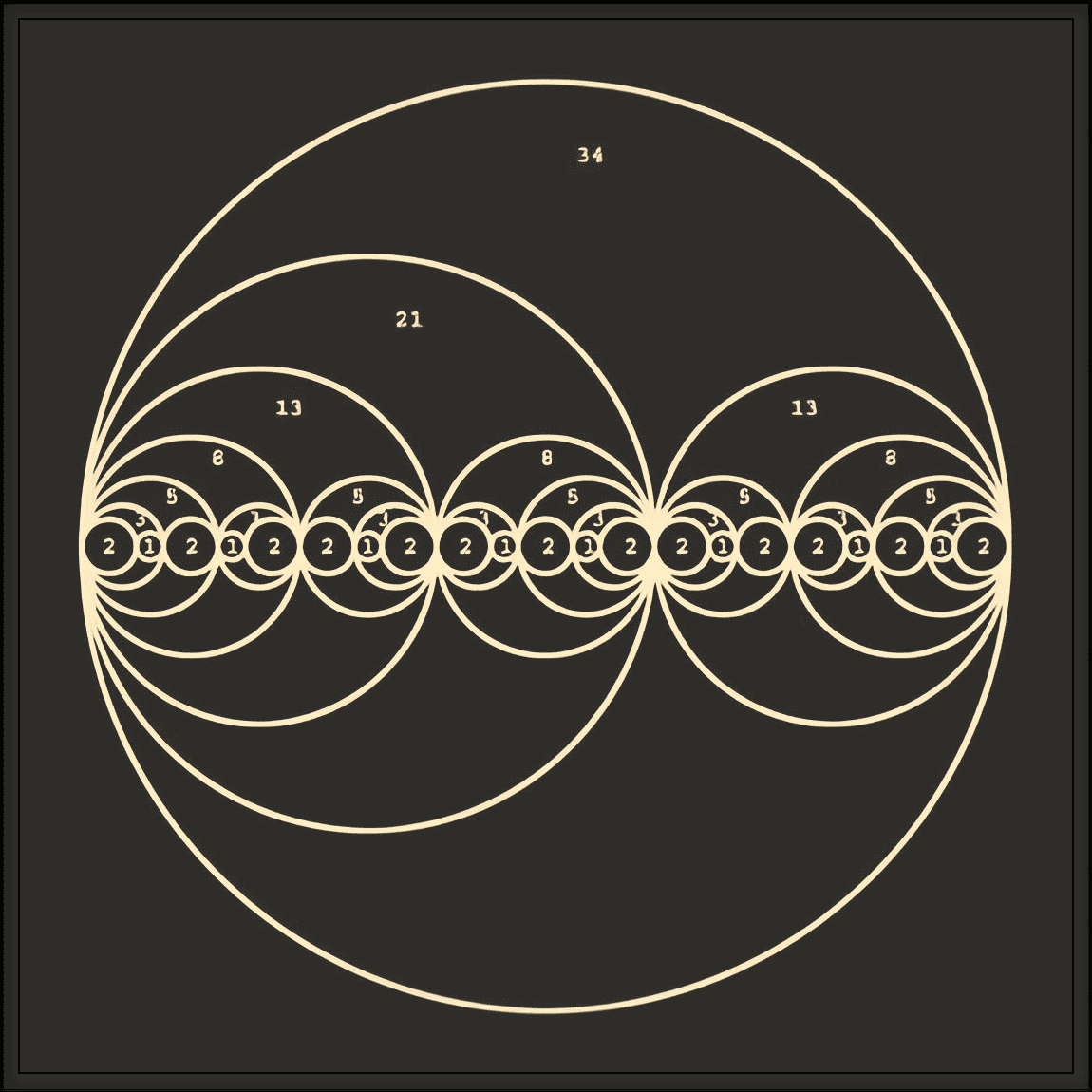
The appearance of Fibonacci numbers in orbital mechanics is not numerology — it is a mathematical necessity of long-term stability, explained by one of the deepest results in dynamical systems theory.
The KAM theorem
In the 1950s and 1960s, three mathematicians — Kolmogorov (1954), Arnold (1963), and Moser (1962) — proved a remarkable theorem about perturbed dynamical systems. In simplified terms:
Orbits whose frequencies have “most irrational” ratios are the most resistant to perturbation.
What makes a number “most irrational”? The golden ratio (1.618…) holds this distinction in a precise mathematical sense — it is the number hardest to approximate by simple fractions. Since Fibonacci ratios (3/2, 5/3, 8/5, 13/8, …) converge to the golden ratio, orbits with Fibonacci-related frequencies are the last to become unstable when perturbed by other planets.
Natural selection of orbits
The solar system is 4.5 billion years old. Over this vast timescale:
- The early solar system contained many more objects on various orbits
- Orbits with simple-fraction frequency ratios (like 2:1 or 3:1) experienced resonances — repeated gravitational kicks that destabilized them
- Orbits with golden-ratio-related frequencies avoided these resonances
- What survives today are the maximally stable configurations — those organized by Fibonacci numbers
Greene and Mackay (1979) showed computationally that the “golden” invariant torus — the orbit with the most irrational frequency ratio — is indeed the last to break under perturbation. This has been confirmed in numerous studies of Hamiltonian systems.
From theory to observation
The KAM theorem predicts that stable orbits should have frequencies near (not exactly at) golden-ratio relationships. This is precisely what the Fibonacci Laws show: the secular eigenfrequencies of the planets are close to Fibonacci ratios, but not exactly on them — as expected for a real, slightly perturbed system. The Kirkwood gaps in the asteroid belt provide dramatic visual confirmation: asteroids at simple resonances with Jupiter (3:1, 5:2, 2:1) have been swept away, while those between the gaps survive.
Key references: Kolmogorov (1954), Arnold (1963), Moser (1962) for the KAM theorem. Greene (1979) for computational confirmation of golden-torus stability. Morbidelli and Giorgilli (1995) for super-exponential stability near golden-ratio frequency ratios in the asteroid belt.
6. Relation to Existing Physics
The Fibonacci Laws combine established physics with genuinely new predictions. Understanding the boundary is important.
What builds on established theory
Law 1 (Fibonacci Cycle Hierarchy) builds on the known precession periods of the planets. The individual periods are established results of celestial mechanics — what is new is recognizing them as a single Fibonacci-divided hierarchy.
Law 3 (Inclination Balance) is rooted in angular momentum conservation. The invariable plane is defined as the plane perpendicular to the total angular momentum vector — inclination oscillations must balance around it. The novel contribution is that dividing each planet’s angular momentum by a Fibonacci divisor preserves this balance to 100% (with dual-balanced eccentricities entering via the angular momentum factor √(1 − e²)).
Phase angles are per-planet values (ICRF perihelion longitude at the balanced year) that cluster near Laplace-Lagrange eigenmodes (γ₁–γ₈) within 1–10°. Saturn’s anti-phase behavior (MAX inclination at balanced year, opposite to all other planets) is consistent with its known retrograde precession in secular theory.
Law 5 (Eccentricity Balance) connects to Angular Momentum Deficit (AMD) conservation, a known conserved quantity. However, the linear dependence on eccentricity (rather than quadratic, as in AMD) and the 1/√d scaling distinguish it from standard formulations.
Law 6 (Saturn-Jupiter-Earth Resonance) describes beat frequency relationships between known precession periods. The individual periods are well-established — the closed-loop structure connecting them through Fibonacci addition is the novel observation.
What appears genuinely new
-
Fibonacci division of a single timescale — No known physical theory predicts that all major precession periods should equal H/F(n) for a single H and successive Fibonacci numbers F(n). The existence of a master timescale H is without precedent.
-
Fibonacci structure in eccentricities and inclinations — Previous work (Molchanov, Pletser) found Fibonacci patterns only in orbital periods. The Fibonacci Laws extend this to two additional orbital elements — eccentricity and inclination — through the mass-weighted variables ξ = e × √m and η = i × √m.
-
Fibonacci quantization of inclination amplitudes — No known physical theory predicts that d × amplitude × √m should be constant when d is a Fibonacci number. This cannot be derived from Newtonian gravity, general relativity, or secular perturbation theory.
-
The universal constant ψ = 2205/(2 × 335,317) — The numerator 2205 = 5 × 21² is a pure Fibonacci product, but no theoretical framework explains why this value governs all eight planets’ tilt ranges.
-
Mirror symmetry across the asteroid belt — No known law predicts that inner and outer planets should pair with identical Fibonacci divisors in distance order.
-
Simultaneous satisfaction of six independent constraints — Pure Fibonacci divisors satisfy Laplace-Lagrange bounds, inclination balance, eccentricity balance, eccentricity-inclination partition, timescale hierarchy, and resonance closure at the same time. Out of 7,558,272 configurations tested, only one satisfies all four physical constraints simultaneously.
-
Fibonacci partition of eccentricity and inclination — No known theory predicts that the ratio e / i_mean within mirror pairs should satisfy specific Fibonacci fraction constraints. That 8 Fibonacci numbers determine all 8 eccentricities from inclinations alone is without precedent.
-
Saturn eccentricity prediction from two independent laws — Laws 4 and 5 independently predict Saturn’s eccentricity from different subsets of planetary data (pair constraint vs global balance), yet agree to within 0.30% and bracket the observed value. No other framework produces two structurally independent routes to the same prediction.
-
Closed resonance loop as Fibonacci identity — The Saturn-Jupiter-Earth beat frequency triangle is an algebraic consequence of 3 + 5 = 8, but no theory predicts that three planets’ precession denominators should satisfy a Fibonacci addition rule.
The balance conditions combine known conservation principles with a novel Fibonacci structure. The conservation laws guarantee that oscillations balance around the invariable plane — but they do not predict that integer Fibonacci divisors should preserve that balance to such high precision. A theoretical derivation from first principles, or a successful prediction for an independent system, would settle whether the Fibonacci structure encodes real physics or is an unexplained regularity.
7. Statistical Significance
Are these patterns real, or just numerology? In 1969, Backus criticized Molchanov’s earlier work on planetary resonances for failing to prove statistical significance. The Fibonacci Laws address this head-on with a comprehensive analysis: fourteen independent test statistics, each evaluated against three different null models — random planetary systems generated by permutation (reshuffling the real values among planets) and two types of Monte Carlo simulation (100,000 fully random systems each).
Nine of the fourteen tests are individually significant (p < 0.05) across all applicable null distributions:
- Inclination balance (Law 3) — p = 0.00027 (permutation), p < 10⁻⁵ (Monte Carlo)
- Eccentricity balance (Law 5) — p = 0.000025 (permutation), p < 10⁻⁵ (Monte Carlo)
- Saturn eccentricity prediction (Finding 4) — p = 0.000025 (permutation), p < 10⁻⁵ (Monte Carlo)
- K amplitude constant (Finding 6) — p = 0.000025 (permutation), p < 10⁻⁵ (Monte Carlo)
- Eccentricity Balance Scale (Finding 7) — p = 0.000025 (permutation), p < 10⁻⁵ (Monte Carlo)
- Mirror symmetry (Finding 1) — p = 0.0001 (Monte Carlo)
- Full 8-planet ψ-constant (Law 2) — p = 0.017–0.047
- E–J–S resonance (Law 6) — p = 0.031 (Monte Carlo)
- R² eccentricity-inclination partition (Law 4) — p = 0.018 (log-uniform MC)
Combining all fourteen tests using Fisher’s method gives an overall significance of p ≤ 1.8 × 10⁻²¹ — the probability that random planetary systems would simultaneously match all observed Fibonacci patterns. Even the most conservative null (permutation, which preserves the real eccentricity and inclination values) gives p = 7.2 × 10⁻¹².
The strongest individual results — the balance conditions and Saturn prediction — have zero look-elsewhere effect: the Fibonacci divisors, phase groups, and target planet are fixed by the model, not optimized after the fact.
Putting this in perspective: A combined p ≤ 1.8 × 10⁻²¹ means roughly 1 in 500 quintillion — the odds of the observed Fibonacci structure arising by chance in a random planetary system. In particle physics, the threshold for claiming a discovery (such as the Higgs boson) is “5 sigma,” corresponding to p ≈ 3 × 10⁻⁷. The Fibonacci Laws exceed this by a factor of roughly 10¹⁴, reaching approximately 9.4 sigma. Even the most conservative test (permutation) gives p = 7.2 × 10⁻¹² — 1 in 139 billion — comfortably above the 5-sigma threshold.
For the full methodology, all fourteen test definitions, and the complete results table, see Statistical Significance in the technical derivation.
8. Beyond the Solar System
If the Fibonacci Laws reflect a fundamental stability principle, they should appear in other planetary systems. Early evidence suggests they do.
TRAPPIST-1
The TRAPPIST-1 system — seven Earth-sized planets orbiting a nearby red dwarf star — shows striking Fibonacci parallels:
- Period ratios: 5 of 6 consecutive period ratios match Fibonacci fractions (83%), the same percentage as the solar system
- Fibonacci additive triad: The mass-weighted eccentricities (ξ = e × √m) of three TRAPPIST-1 planets satisfy the Fibonacci addition rule: 3 × ξ_b + 5 × ξ_g = 8 × ξ_e — using the same Fibonacci triple (3, 5, 8) that appears in the solar system’s period denominators for Earth, Jupiter, and Saturn, and holding to 0.34%
- The number 311: A super-period that organizes the entire TRAPPIST-1 system equals 311 times the innermost planet’s orbital period. The same number 311 appears independently in the solar system as the ratio of the Fibonacci constant ψ to Venus’s mass-weighted eccentricity (see section 3)
Monte Carlo simulations show the probability of 311 appearing in both systems by chance is approximately two in a million. See Physical Origin §3 for why 311 has special Fibonacci properties.
Kepler-90
The eight-planet Kepler-90 system also shows Fibonacci structure: 5 of 7 consecutive period ratios (71%) match Fibonacci fractions. However, only two Kepler-90 planets have measured masses, so the deeper laws (inclination balance, eccentricity balance) cannot yet be tested.
Current limitations: Testing the full Fibonacci Laws in exoplanetary systems requires precise measurements of both masses and eccentricities — data that is currently available for very few systems. The TRAPPIST-1 mass uncertainties are around 5-8%, sufficient for period ratios and the Fibonacci additive triad, but not for detecting sub-1% structures like the inclination constant. Future missions (JWST, PLATO) will provide the precision needed for definitive tests.
9. What Remains Unknown
The Fibonacci Laws predict orbital properties with remarkable precision, but several questions remain open:
-
Why 311? This prime number appears as a fundamental scale factor in two independent planetary systems (Solar System and TRAPPIST-1). It is a Fibonacci primitive root prime — R = ψ/ξ_V = 311 exactly, connecting the inclination and eccentricity scales. See Physical Origin §3 for the full analysis.
-
Can the R² Fibonacci targets be derived from simpler quantum numbers? Law 4 uses eight specific Fibonacci fractions (four R² sums and four products/ratios) to predict eccentricities. Exhaustive search over all simple formulas involving pair properties (k, d, period fractions) finds no rule that generates these targets — the Fibonacci indices (14, 9, 1, 8 for the numerators; 5, 4, 3, 3 for the denominators) appear to be irreducible data, an independent layer of the solar system’s Fibonacci architecture. Whether a deeper structural principle determines these numbers remains open.
-
What produces the eccentricity balance? The inclination balance follows from angular momentum conservation — a well-understood physical principle. What conservation law or perturbation mechanism produces the eccentricity balance? The linear (rather than quadratic) dependence on eccentricity distinguishes it from known conserved quantities like AMD.
-
Are the laws universal? TRAPPIST-1 and Kepler-90 show Fibonacci period ratios at rates consistent with the solar system. But do all stable planetary systems follow Fibonacci Laws, or only certain architectures? More exoplanet data is needed.
Summary
| Finding | What it means | Precision |
|---|---|---|
| Precession hierarchy predicted | All major cycles from H / Fibonacci (Law 1) | 6 cycles from one timescale |
| 8 planet tilts predicted | Zero free parameters, from H + balance condition (Laws 2–3) | All within secular theory bounds |
| 8 planet orbit shapes predicted | Zero free parameters, from R² partition + inclinations (Law 4) | All within 3% |
| Saturn eccentricity predicted | From balance equation using other 7 planets (Law 5) | 0.22% error |
| E–J–S resonance loop | Closed beat-frequency triangle (Law 6) | Exact (Fibonacci identity) |
| Mirror symmetry is unique | Only 1 of 7.5 million configurations passes all 4 filters | Exhaustive search |
| TRAPPIST-1 shows same patterns | Independent system, same Fibonacci rules | 0.34% (additive triad) |
| 311 appears in two systems | Chance probability: 2 in a million | 0.12% (TRAPPIST-1) |
| KAM theorem explains why | Golden ratio = maximally stable frequency | Proven theorem |
For the complete mathematical framework, derivations, divisor assignments, and computational verification scripts, see Fibonacci Laws Derivation.