Configuration 1: 1246 AD Alignment
Configuration 1 is based on the perihelion alignment year of 1246 AD - the last time the December solstice aligned with Earth’s perihelion.
Key Parameters
| Parameter | Value |
|---|---|
| Perihelion Alignment Year | 1246 AD |
| Holistic-Year | 333,888 years |
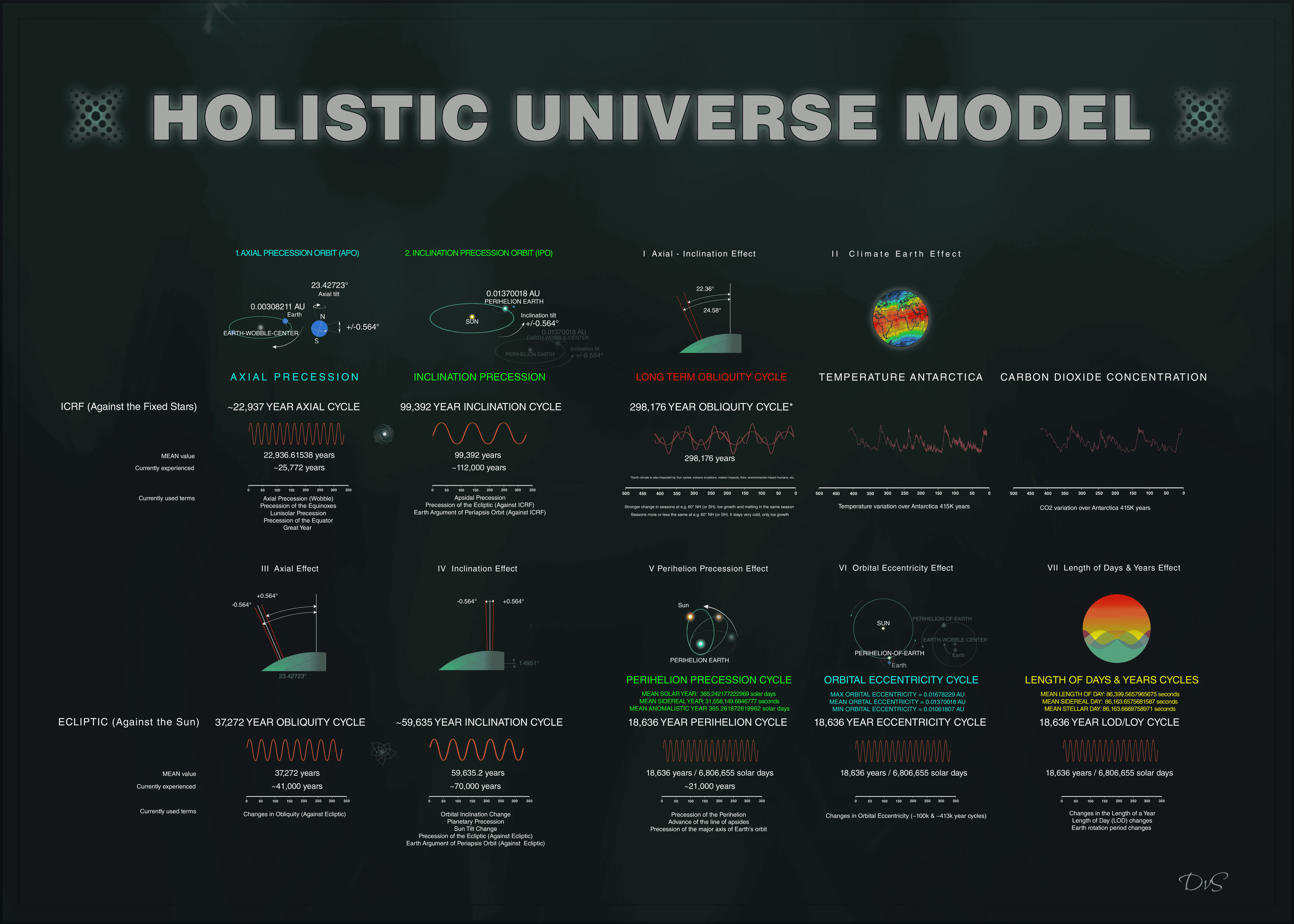
| Axial Precession | ~25,684 years (mean) |
| Inclination Precession | 111,296 years |
| Perihelion Precession | 20,868 years |
| Obliquity Cycle | 41,736 years |
Why 1246 AD?
According to J. Meeus’s formula, on December 14, 1245 AD, the December solstice was aligned with Earth’s perihelion. This means the longitude of perihelion was exactly 270° (or equivalently, 90° when measured from the vernal equinox).
By June 2000 AD, the longitude of perihelion had grown to ~102.95° - a shift of ~12.95° in 754 years.
This alignment date determines where we are in the perihelion precession cycle, which in turn determines all other cycle positions.
Why 333,888 Years?
The Holistic-Year length of 333,888 years is determined by six factors:
- Solstice-perihelion alignment in 1246 AD - must be exactly at a cycle boundary
- Fibonacci ratios - precession cycles must relate as 3:13 (inclination:axial)
- Climate cycles - three ~111k year cycles visible in ice core data
- Planet orbital periods - all major planets must complete whole orbits
- Moon cycles - lunar periods must align with the master cycle
- Observed precession rates - current measurements must fit within the cycle
333,888 is the smallest number satisfying all constraints.
Fibonacci Breakdown
| Fibonacci | Cycle | Duration |
|---|---|---|
| 1 | Holistic-Year | 333,888 years |
| 3 | Inclination Precession | 111,296 years |
| 5 | Ecliptic Inclination | 66,778 years |
| 8 | Obliquity | 41,736 years |
| 13 | Axial Precession | ~25,684 years |
| 16 | Perihelion Precession | 20,868 years |
Match Quality
What Config 1 Explains Well
| Aspect | Quality | Details |
|---|---|---|
| Precession cycles | Excellent | All three precession types match observations |
| Moon cycles | Good | Synodic, sidereal, nodal periods all fit |
| Obliquity | Good | Oscillation between 22.15° - 24.68° matches data |
| Climate patterns | Good | Approx. 100k year cycles visible in ice cores |
Known Limitations
| Aspect | Quality | Details |
|---|---|---|
| Eccentricity | Partial | Matches short-term (under 500 years), diverges long-term |
| Delta-T | Partial | General trend correct, specific values vary |
| Historic year lengths | Partial | Some discrepancy with ancient observations |
The limitations are being investigated. Config 2 and Config 3 will explore whether alternative alignment years can improve these matches.
Current Parameter Values (J2000)
Based on Config 1 calculations for January 1, 2000:
| Parameter | Value |
|---|---|
| Sidereal Year | 31,558,149.724 seconds (fixed) |
| Mean Solar Day | ~86,399.99 seconds |
| Mean Solar Year | ~365.2422 days |
| Sidereal Year | ~365.2564 days |
| Obliquity | ~23.44° |
| Eccentricity | ~0.0167 |
| Longitude of Perihelion | ~102.95° |
Predictions
Config 1 makes the following testable predictions which contradict the current theory:
- Sun at max obliquity the RA value will shift from 6h to less than 6h
- Eccentricity will decrease until 11,680 AD, then increase
- Mercury missing advance will be lesser the coming century
- Axial precession will appear to increase again in the next 200 years
These can be verified against future observations.
Resources
- 3D Simulation: Interactive 3D Solar System Simulation (pre-configured with Config 1)
- Excel Documentation: Available on GitHub
- Source Code: github.com/dvansonsbeek/3d
How It All Connects